Monday, July 30, 2007

I just *knew* diplomatic status would come in handy at some point!

So this weekend was supposed to be my adventure weekend. I was going to get out of Dreary Dushanbe and into the mountains that Tajikistan is (comparatively) famous for. I had hooked up a travel partner that spoke Russian. We had plane tickets to Khojand for Friday night after work. What could go wrong?

For the first day and a half, nothing. We flew up on Friday night on what could generously be describes as a rickety Russian built Antonov. Most of these things are a generation old and feel it. One actually crashed this weekend in Russia proper, and Russia and the former Soviet countries actually had a worse airline safety record than Nigeria in 2006. Anyway, this plane shook. And the cabin wasn’t really pressurized, so it was a little tough to breath at 20,000 feet. And it was beastly hot. And the approach to the runway was a little rocky, as in it seemed like the pilot figured out at the last minute that the runway was actually 500 feet to the left of where he was aiming. But no worries, landed safe and sound, took a taxi to town, and checked into the Hotel Leninabad. The hotel was fine except for the mosquitoes and the fact that the room didn’t have a shower. But eh, this is an adventure right?

So the next morning we were up early to see the largest statue of Lenin left this side of the Urals, 22 meters high, and then set off on our adventure proper. We took a minibus to the town of Istaravshan, with its historic mosques and hoppin’ Saturday bazaar. The people on the minibus were fascinated by us. They asked a million questions, my two favorites were “Does your father get paid on time?” (a bit of a rarity here) and “How much does the Tajik government give you to be a tourist here?” They were shocked and appalled that we weren’t getting anything. Why the hell were we here then? One guy was so outraged he paid our bus fare.

The bazaar was neat, huge enclosed space that smelled vaguely like tea and soap. They sold everything under the sun, from dried fruit to car parts to a real-life butter churn. (No joke, we actually saw women on the side of the road churning butter.) I took a couple pictures, one of a table selling hammers and sickles, one of the watermelons (this country is saturated with them this time of year), and one of the old guys selling snuff. This guy was very emphatic that it was really stupid to take pictures of watermelons, and that he made a much better subject. We then walked around the old town, saw the old mosque, hitched a ride with an agricultural NGO consultant from St. Paul, Minnesota, and set about hiring a driver to the two day trip through the mountains back to the capital.

Now getting the right car and driver is important. The car has to be sturdy enough to make it up the hills, and the driver has to be a decent enough human being not to leave you at the top of the pass unless you give him $100 and one of your kidneys. The market was nuts and thank goodness the person I was traveling with spoke Russian. We finally settled on a German built Opel driven by a gold-toothed guy named Xoet (pronounced Hi-Oat and meaning “life.”) Little did we know that we had just signed on to the Tajik tour of our lives, chauffeured in the Magical Amphibious Opel by the Indomitable Xoet himself.

A little background on the trip. We were leaving from Istaravshan and going across the Anyi mountain pass (3300+ meters) and to the lakeside town of Iskander-Kul, where we would spend the night, before crossing a second higher pass the next day on the way back to Dushanbe. The road has been having a little bit of a rockslide problem of late and is in the process of being rebuilt by huge teams of Chinese laborers. As a result, two sections of road on either side of the Anyi pass are closed to traffic during daylight hours while the crews work. Someone had told me this before I left, letting me know that it would add 8 hours to the trip if I got through at all, but eh, this is an adventure right?

So we set out. We hit the first part of closed road, but Xoet was ready. He drove down the hill and into a river bed that ran parallel to the road. This wouldn’t have been as big a deal as it turned out to be had it been a DRY riverbed, but someone had forgotten to mention this to the river. It was here that we got the first taste of the Magical Amphibious Opel. Xoet just drove through the river. There were sheep and goats grazing on the banks that didn’t even blink as we cruised through. I guess this is a standard practice. Xoet just smiled and told us to think of all the German engineers that had put some much time and effort into designing this beautiful machine. How they would be crying if they could see it now!

Anyway, we made it through the river and back up onto dry land. Then we hit our first real checkpoint. It was manned by a Chinese guard that didn’t speak any language other than Chinese and was not under any circumstances going to let us cross. We would have to wait four hours until 7 pm, then we could continue the last 6 hours through the treacherous pass to Iskander-Kul. Now Xoet hates the Chinese. He resents the fact that there are no jobs in Tajikistan and more than half of the male population has to go to Russia for part of the year to try to squeeze out a living doing manual labor, but thousands of Chinese are imported to do local construction. And there is no way that this Chinese guy is going to stop Xoet from showing his extra special American tourists the pass during the daylight. We would miss the panoramas of the mountains!

So Xoet kicked the Opel into low gear and took off up a dirt track. We eventually came to a farm house. Xoet set us up with a couple of bowls of delicious fresh goat-yogurt (which I would sadly soon discover all too vividly was also un-pasteurized) while he checked out the lay of the land. Back in the Opel. Down into another river, through the river bed, around an un-manned Chinese roadblock and onto the closed road. We drove past the construction crews, who were a little bewildered as to how we got there, and up to the edge of the roadblock on the other side. Here is where we hit a little snag. The guard on the other side was *pissed.* We shouldn’t have done what we did. And he was going to be damned if he let us pass. We needed to turn around and go back.

This was a problem. The guard spoke only Chinese. Xoet was apoplectic. All his hard work and only a flag studded string separated him from the pass. He gunned the car a little at the string, but the guys around grabbed a bunch of rocks. Xoet backed down. The drivers waiting on the other side of the string thought this was hysterical.

So I decided that it was my turn to try to fix the situation. I got out of the car with my United Nations passport that I use for official World Bank travel. It reads in part “The Secretary-General of the United Nations requests all those whom it may concern to extend the bearer courtesies, facilities, privileges and immunities which pertain to his (or her) office, and to facilitate by all suitable means the journey and mission on which he (or she) is engaged.” And it fortunately says this in all six UN languages, including Chinese. I smile and hand it to the guard. He reads it. Apologizes. Gives Xoet the look of death, and lets us pass. Xoet was very proud of me. Off to the pass!

The trip up to the pass was on this narrow winding road with great vistas. We stopped on the way up to do a little hiking because Xoet knew that the other side of the road was going to be closed and that we weren’t going to be able to wiggle through that one. The top of the pass itself was a great view of the mountains. Then we hit the second block. Traffic was lined up because it had been closed all day. Xoet sneaks as close to the front as he can. He tells us to be ready. We aren’t exactly sure for what, but we stay close to the car anyway. At 6:30 the guard whistles that he will lift the gate. Xoet yells for us to get in the car. We pile in and Xoet guns the engine. We blast past the other cars and take off down this narrow winding pass edged by a sheer cliff, Xoet yelling “Rally Car” and “Schumacher!” The situation is this, the road is partially blocked by landslides, and in many places only one car can pass at a time. When they open the gate, they let traffic in in both directions. It is key to get as far down the mountain as you can before you meet on-coming traffic. (Xoet gave us a beautiful demonstration of this as we almost smashed head on with a car coming the other way as we swerved around a bolder. The roads are all dust so it is like driving in a blizzard. We didn’t see the second car until it was nearly on top of us.) At one point when we were waiting to get though a narrow point, one of the Chinese laborers jumped in the car with us. We couldn’t talk to him, so he just rode in the back with me for a while until he signaled that he wanted to get out. Can you imagine something like that in the US?

So we traveled along for another couple hours before reaching the lakeside hotel. We are hot and sweaty and filthy from the trip. All we want is a shower, some food and to crash. Now the cabins are described as “rustic,” as in no running water and the distance to the nearest pit latrine is best measured in kilometers. Super. Xoet brings us a couple bottles of river water to wash up as best we could. Dinner consisted of eggs, sausage, bread, more goat-gurt, and a bottle of horribly sweet local brew. And we had to drink the whole thing going around with toasts on every glass. Xoet had been disappointed that there was no decent vodka, I was secretly relieved. After dinner we collapsed, with my travel partner and I taking one room of the cabin and Xoet the other. In the morning we found him sleeping in his car. He said that he doesn't like to sleep alone, so at least he could sleep with his car.

Here’s where the wheels come off. I when I woke up I was feeling a little funny. We walk around the lake a little bit, see the President’s summer house, and by the time they set off on a hike to the nearby waterfall, I am downright green. Xoet pulls out the cushion from the backseat and puts it under a bush for me to sleep on while they hike. By the time they are back, I am puking my life up. I spend the rest of the day curled up on the backseat in the fetal position, having to ask Xoet to stop every hour or so, so I can get re-acquainted with whatever I tried to eat or drink in the last hour. It was a long 7 hour trip through the second pass and down.

What little of the trip that I was able to see from my little ball of torment seemed nice. This pass was higher and there was still snow. Xoet brought me a snowball to put on my forehead. At one point we were driving next to a cliff still covered in ice despite the broiling temperatures. And the view of the Fan mountains from the top of the second pass was incredible. We stopped to get gas again too. The fun part of getting gas is that they have old-fashioned gas pumps, not that they work, the gas is just stored in jars on top of them.

Eventually we made it back to Dushanbe, paid and thanked Xoet, promising to pass his contact information on to anyone that would like to make the trip (let me know if you are interested). I went back to my hotel, thanking my lucky stars that World Bank consultants are well taken care of, and took a long hot shower. I felt a little better, and by the time I went to bed, I was able to keep water in my stomach again. I’m on the mend!

So I think this will be my last entry for a couple weeks. I am headed back to the US on Thursday morning, and I am hoping for my sake that nothing interesting enough happens in the next couple days to be worth writing about. Next stop, as far as I know, is Indonesia sometime in September.

Friday, July 27, 2007

Mission to the Rayons of Republican Subordination (and back with fleas)

So not too much interesting going on here in Dushanbe. I am have been trying to get out of the city a little bit, partly to see this weird wild and wooly country, and partly because, like I mentioned, not too much interesting going on in Dushanbe. I had grand plans for a cultural tour last weekend, historic sights, museums, shopping, all cut tragically short by bad doner kebap. I spent all night Friday and most of the day Saturday battling massive food poisoning. I got up Sunday morning with the grit and determination of a passenger on a cruise ship under fire. I was going to have FUN god-damned, and no amount of personal discomfort was going to stop that.

I decided to head out to Hissar, which used to be an 18th century fortress run by the local big man under the emir. That was of course before the Red Army blew the whole complex into dust. The government has gamely gathered enough of the scattered stones to reconstruct the gate, which is nice enough. There are also a couple of big hills on either side of that gate, which the Lonely Planet promised would offer panoramic views of the surrounding countryside. What I actually achieved was scratching the hell out of the palms of hands as I tried to use thorn bushes to slow my decent as I slid and scrambled up the nearly sheer face of this stupid hill. (The thorn bushes that covered the mountain side did at least have interesting flowers on them, which I dubbed Taliban flowers in honor of their beards.) The view was less than spectacular. I decided I had had enough cliff for one day and took the long winding path down the backside of the hill, carefully avoiding all the Tajik couples making out – completely oblivious to the presence of both me and the sensitive Taliban flowers. At the base of the gate, there was a Tajik wedding going on. It seemed mostly like an American wedding, except for the bride having that strange uni-brow thing, and the fact that all the music sounded like a snake charmer’s cover of the Star Wars Cantina. At the caravan house museum across the road, I saw some dusty relics and befriended five Canadian kids working here for the Aga Khan foundation. I used some of my copious World Bank per diem to buy them lunch, they used their Russian and Tajik skills to half the amount of time it took me to get there anywhere on the local public transportation system. Fair trade in my book.

First half of the week centered on me working in the office and getting my questionnaires ready for pilot testing. The last two days in the field. I spent an inordinate amount of that time worried about fleas. You see, the consultant that I was working with went to do some pre-pilot testing among poor communities in the capital last week and came back covered in welts. She explained that most poor people in this country have fleas and that you very often catch them from proximity. Isn’t it the same in Africa? [Editor’s note: NO!!!] She then told a “humorous” story about the last Washington consultant that she worked with, who got fleas during pilot testing in the mountains, brought them back to her hotel room, where they got into her luggage, brought them back across the ocean, where they multiplied like a Bulgarian wildfire, and infected her entire family and household. Cost a fortune to kill them all. Hardy-fucking-har, that story is a laugh a minute.

So I *really* don’t want to get fleas. There is just something about those little bastards breeding in my hair that makes me a little uncomfortable. Stomach parasites, ants, scorpions, snakes, I can deal with. No fleas.

With this perpetually in back of my mind, I got all gussied up like a Moron missionary for my foray into the countryside. We went to a cotton growing area on the border with Uzbekistan. It took a miraculously short two hours in the morning to navigate the protocol, my favorite being the stop at the local mayor’s office. He had a dilapidated desk adorned only with a tiny Tajik flag and a MASSIVE red plastic rotary phone.

The trip out went past women in brightly colored robes working in the cotton fields set against the dramatic backdrop of the mountains. The mosques have checkerboard roofs and elaborately carved doors. What was really striking though is the fact that there were no men. Anywhere. This time of year, men are either working in the city or in Russia. Only young boys, old men, and the poorest that cannot afford to go anywhere to work are left in the town. The women and children were pleasant enough though. I took some of their pictures so you can see what they look like. I also took a picture of my piloting team and our government minder, so you can see who I was working with. My mom digs that kind of slice-of-life thing.

Anyway, I got back from piloting yesterday, preoccupied with my potential flea problem. I came back to my hotel room, went immediately into the white tile bathroom, stripped down, filled the sink up with as hot water as I could, threw my clothes into it, and got into a shower hot enough to sterilize myself. Went I got out, I carefully examined myself for anything that could be a flea bite, and the sink for anything that might be a drown flea. You can bet that I am going to do the same thing today when I get home. Every itch is a sign of my coming infestation.

That is all for now. Tonight I am going to fly to a town in the mountains and take a little tour around there for the weekend, so hopefully I will have something interesting for next week. Enjoy your flea-free life in the first world, I am going to go back to itching.

Thursday, July 19, 2007

Samani-a-good, Stalinabad

So this place is different. Normally I don’t start off with details about the country, thinking that if you cared you could google it, but this time I will make an exception as I am guessing most of the audience couldn’t find it on a map.

Tajikistan is the smallest and poorest of the Central Asia republics. It is bordered by Uzbekistan to the west, Kyrgyzstan to the north, Afghanistan to the south and China to the east, though the border with China is disputed because, as we all know, China could dispute a border with an ocean. The capital is Dushanbe, which means Monday in Tajik. The town’s claim to fame was its Monday market before the Soviets arrived, built a railroad and named it the capital of the Soviet Republic they created. Before revisionists got into it in the early 1960s, however, it was called “Stalinabad,” which makes me think that it figured prominently in contemporary American spy movie spoofs. “Come now, comrade, we must change Stalinabad’s name. Capitalists – they laugh at us.” It is actually a fairly pleasant capital, however, as it was a planned city mostly built from scratch in the 1920’s. Lots of wide boulevards and tree lined streets. The shade is nice since it is well into the high 90s every day here.

In addition to the capital, there are four states in Tajikistan: Khatlon, Sogd, Gorno-Badakhshan Autonomous Oblast, and, I shit you not, Rayons of Republican Subordination. It sounds like a game that Bush and Cheney play with tazers. I still haven’t figured out if it is just an awkward translation from Russian or what. I will let you know soon. I am going on mission to the Rayons of Republican Subordination next week. (Come on, how many of you have a work schedule that could double as Doctor Spok’s to-do list?)

Despite being only 100 kilometers from the Afghan border, Tajikistan is fairly liberal. I would say that less than half of the women cover their hair here, and the traditional robes are more just shapeless and gaudy than oppressive. Plus I have seen some impressive outfits on the younger tarted-up Russian girls here. I, as a former Long Island Catholic school girl myself, would be embarrassed to wear them to the beach.

Another weird bit of Tajik trends is the uni-brow. It is apparently really hip here. Some women obviously tweeze their brows into the uni-brow shape. I have even seen one or two that have filled in the thin part between their eyes with eyebrow pencil. It is can be distracting if you are talking to them too, especially in official capacities. You find yourself talking to their eyebrow.

With work, I haven’t gotten a chance to do much in the way of tourism. I did go down to see the only major landmark in the capital, the statue of Ismail Samani, the founder of the Samanid dynasty. It was erected in 1999, which was the coincidence of the 1100th anniversary of the founding of the dynasty and the 8th anniversary of Tajik independence. It also coincidenced with the end of the civil war and the need to replace the largest statue of Lenin this side of the Urals.

That is about all for now. I have to get back to shuttling between my 4 star hotel, which looks like the Winter Palace, and the office, which is nothing special. I will try to do some interesting sightseeing this weekend.

Sunday, July 08, 2007

Just Another Day at the Afisi

The town slogan for Bukoba – painted on all the signs into and out of town – is “Let’s be safe, speed and AIDs kill.”

I wish that I had some exciting stories about the last three weeks in East Africa, but I really don’t. Just another day at the office. Albeit at the office where geckos nest under computers, two-inch wasps size up the printer for hive feasibility and the occasional bat drowns in the bathroom. Electricity was sometimes intermittent in the mornings, so some days we just worked until the laptop battery died, then went outside to play ping-pong.

I was in the office six days a week, so that cuts down on adventure time. On Sundays, my roommate Angel and I went hiking down to Lake Victoria or just hung around and watched the previous tenants collection of pirated Chinese DVDs. Highlights of my time there included playing Taboo where all the Tanzanians cheat and use Swahili, but no one cares as long as the Kilimanjaro beer is flowing; celebrating the fourth of July as a work day when we came home, drank Kili and watched a pirated copy of the feel-good American classic – Easy Rider; and running low on booze for the last night and deciding to drink Konyagi (the local moonshine that is hyper-distilled banana wine) and grape Fanta, which combined for the smooth flavor of Robatussin.

I only got out into the real field one day to do pilot testing of the survey I am helping to develop. We went to a village about 40 minutes outside of town. It was different that the small villages that I was used to in West Africa. Here there is water everywhere, so the houses don’t need to be centralized around a well. There are sprinkled among the hills and banana trees, with clay dirt paths connecting them. The houses are made out of mud and reeds, with thatched roofs. Because most people are too poor for furniture, the dirt floor is covered with dried grass to sit on. You have to take your shoes off to walk on the grass.

It was, however, an interesting slice of life into rural northwestern Tanzania. All the surveys we conducted were in Swahili, so I could only guess what was going on most of the time. My favorite survey was in a huge compound of a relatively affluent farmer. The white lady and her survey team was apparently the big happening for that day, and friends and children drifted by to listen in. We asked the household head how many children he had. When he replied six, a spirited discussion broke out between the father and the eight year old sitting on the floor. After fierce debate, the man changed his answer, actually, there were seven. Oops, better not tell Mom.

Another household was the Tanzania version of that idiot neighbor we’ve all had at some point in our lives. He has bicycle parts strewn around his yard (the East African equivalent of a Pinto up on cinderblocks). There was a chicken in his living room. He had no furniture at all, but a shiny Chinese boom box that was belting out the Snoop and Tupac to a mud-rattling-roar. His wall was decorated with 20-30 photos of him in his younger days, with someone that I have to assume was his idiot cousin – because guys like this always seem to have an idiot cousin to fill this role – dressed in their gangster finest, posing hip-hop style and flashing what might have been poorly impersonated gang signs – or early onset arthritis brought on by vitamin deficiency – one can’t really be sure. Another testament to the universality of mankind.

So I am writing this from my hotel room in Kampala. Tomorrow, I fly out to London and then, barring any flaming doctor attacks, on to Washington. I will be there for five whole days before heading to a wedding in New York (congratulations Kristin and Bobby) and then uncharted waters – Tajikistan.

Thursday, June 21, 2007

Kagera, Tanzania

So I have to admit I was a bit worried. The guidebook described the town where I would be spending the coming weeks as filled with lake flies and earnest Christian missionaries, two pests certain to make my personal tormentors list should I ever end up in hell. But it turned out okay. Those swarms of both are sometimes visible in the town below, neither appear in great numbers where I live and work.

Today is the winter solstice here in Kagera, Tanzania – shortest day of the year. Which when you are about one degree south of the equator translates into 11 hours 45 minutes of daylight instead of the usual 12. I am here, living in a big beautiful house high on a bluff overlooking Lake Victoria, to formulate new and better ways to count poor people for the World Bank’s research division. I have had two revelations since I have been here. The first is that as silly as my job sounds, it actually has a purpose – no one has any idea about the statistics of things like poverty or if programs are working to change those statistics. The second, which occurred on my balcony while watching the sky graying at 5:45 last night over the azure blue water, is that there are other people which consciously choose to make a living doing other things. I lifted by pineapple cocktail in toast to all the suckers in cubicles in the world – no offense meant to any suckers in cubicles that may be fans of this blog, I obviously am referring only to the other suckers in the cubes around you.

I landed in Kampala, Uganda on Monday morning. It is the closest major airport to where I am staying, a mere six hour bus trip. My partner in crime (a fellow researcher and former West African Peace Corps volunteer which will be from here on be referred to by his porn alias “Angel Derlon,” as he was christened by the bus company passenger manifest, just in case he wants to have a career someday) and I took the bus down on Tuesday. Uneventful trip. Driver drove recklessly, some kid was always screaming, border crossing took a third of the total trip time… There is always some mystery item that screws up the crossing. We will all be cruising through, and suddenly some bum has to have something weird. Tuesday it was the twin adventures of chainsaw and boat engine. Then the unfortunate exporter of said goods gets to play let’s-make-a-deal with Customs. Similar to the old game show, Monty Customs Guy asks, would you like to give me X number of dollars *or* would you like to play what’s-in-the-tariff-book. The exporter will hem and haw, trying to negotiate down the fees, and, if no agreement is reached, out comes the government book, whereby it all starts again. Is it a new engine or used? Does running it in a water barrel outside count as used because I think I saw one back a couple hundred yards? Is it a large engine or small? Couldn’t you actually interpret this as a large electric paddle? And so it goes, until the final result is something like, okay, the official tariff on one small used engine, plus 15,000 Ugandan shillings, $30 in hard currency, two packs of Chinese cigarettes, and the exporter’s shoes. At which time everyone is all smiles, we load back up into the bus, drive 15 meters across the border, and the poor bastard hops out with his motor to pay Tanzania import taxes.

Sunday, June 03, 2007

Putting the Rain in Rain Forest

It has been a really insane last couple weeks with graduation and the new job and moving and everything, so I haven't had a chance to post this. I wrote it the last day I was in Bogata and wanted a chance to edit it and make it, oh, I don't know, funny, but I just haven't had a chance. But I am off to Kagera, Tanzania (middle of holy bloody no where), so I should have some zany adventures there to make up for it. Here you go:

So I am in Bogata, waiting to head back to the United States on the red eye. Unless something really unlikely happens, I will have made it through two weeks in Colombia without any more major calamity besides sunburn and mosquito bites.

The week on the coast was relaxing. My buddies from school and I hung out on the beach, went scuba diving, swam in the pool and drank enough Club Colombia beer to pickle ourselves. Happily for my mother and unhappily for the blog reading audience, nothing too much exciting went down.

In Colombia in the months of May and June, it rains. It rains every day at some point and it rains hard. It doesn't rain at the same time every day, which would be convenient from the planning point of view. The general way it happens is we get up early in the morning, take a minibus then hike out to some beautiful secluded beach, the entire hike out thinking "Man it better not rain" and on the way back it pours. This leaves us trying to cover ourselves in whatever towels, blankets, tee shirts whatever, slipping and sliding over a Colombian hillside, looking like a cross between wet puppies and runaways from Cirque du Soleil. At the Tayrona National Park, what was on the way out a beautiful hike through jungle, carefully stepping around the piles of horse and donkey droppings (the only modes of transportation in the park), down to a protected swimming beach, on the way back was an ankle deep muddy slog through horse shit. Which leads me to ask why it is that I have spent a measurable portion of my adult life slopping through the tropical rain forest in Converse sneakers.

The only other thing of note was the Rumba en Chiva. Since I can't speak Spanish I have spent most of the time signing on to things that I can't really understand and hoping they work out for the best. This definitely did. I found out later that the Chiva is a Colombia tradition where passengers board a vehicle that was in its former life a school bus, but has since been stripped down to open air and painted with wild colorful murals. The bus has a live band in the back seats and everyone gets a bottle of rum. We drive to various points in the city, singing the Colombia national songs, get out onto the sidewalk (with the band), drink and dance. Then load up and keep going. We were accompanied by 40 other Colombian tourists, including the very nice fat lady sitting behind me that (physically) taught me how to shake my tits. We had a little snaffu at first because we had to get the bus from the hotel parking lot on to the main highway, which involved a tight turn and a quick merge into traffic. I don't know if it was just the drum that fell out, or if we actually lost one of the drummers too (I was making amigos with the rum bottle), but we had to stop for a few minutes to sort that out.

There were also a couple of younger people from Miami who could intermittently explain to us what the hell was going on. One of these guys had a bottle of "Colombian moonshine" in one of his back pockets and a near boiling bottle of Canada Dry in the other. You poured the stuff down your throat and chased with the the ginger ale. It had the subtle flavor of super concentrated floor stripper. And it was a total vicious cycle. The more you showed you could handle it, the more that bottle came back around your way. The night ended (hazily) with the guy (who I was old enough to have babysat for), trying to teach me (unsuccessfully) to salsa dance. Next day was not particularly productive, even for vacation.

I spent the last two days here in Bogata. I had enough of the heat and humidity of the coast, and the pteradactyl sized mosquitos, and decided to see what the capital had to offer. Definitely a break from the heat, it doesn't get much out of the 60s here, due to the elevation. The city itself is nice, big and cosmopolitan. I spent my time looking at colonial churches, the gold museum and taking the funicular to the top of the city. All and all, a good trip.

Wednesday, May 23, 2007

Pirates of the Caribbean

So I have been out of touch for a while, studying, finishing school, finding a job and the like. I will be done with this grad school nonsense on June 8th and start my new job with the World Bank on Monday June 11th. (The ghost of my anti-gloablization 15 year old pink haired self is having a heart attack about that...) I will be leaving on a month long mission in East Africa and Central Asia on June 17th, so they aren't wasting any time in getting me into the field.

In the mean time, however, I am on vacation in Colombia. And, contrary to popular belief, there are other things to do here besides cocaine. And it is not anywhere near as dangerous as the hype would suggest. I have been here four days and haven't ONCE been shoved into a car trunk by a naro-terrorist.

I am currently in the colonial city of Cartagena. It was a bit of an odyssey getting here. I took Avianca airlines, which those of you that grew up on LI will remember for flying a plane into a Glen Cove hillside when we were in about fifth grade because it ran out of gas. Indeed, lesson learned, one of the many things they delayed/aborted take-off because of during my 12 hour delay at Kennedy was lack of fuel. Others included engine problems, general mechanical failure, restless illegals that were being deported, late arrival of other flights, etc. I got to Bogata at 1 am, having missed my connection by, oh, a full work day. They put me up in a hotel and let me sleep for three hours before getting up to make the morning flight.

Cartagena is one of the first port cities founded by Europeans over here. It was rather unfortunately (1) founded by the Spanish, and (2) situated a smidge too close to where the mythical city of El Dorado was supposed to be. As a result, English pirate Sir Francis Drake cannoned the holy living crap out of it a number of times during its existence.

My first day here I wandered around the old city, visiting the churches good Sir Drake missed, plus a few of the local museums. The gold museum was nice, and not only because it was free and air conditioned. (Cartagena is hotter than the sun with 100 percent humidity.) It had some pretty pieces that weren't melted down to make dubloons. The Inquisition museum was a little more bizarre because it was completely in Spanish, which of course I can't read. So I had to speculate as to exactly what these giant hooks and cranks and spikes make have been used for. I hope I have an overactive imagination.

The next day I went to the local volcano. It seems that every Latin American city has a local volcano but this one was truly special. The local legend is variations of a theme of a priest coming upon a giant fiery pit which was a portal directly to hell, and turning it into mud. So what is left is a 50 foot high mound with a bottomless pit of mud in it. Tourists jump into it and get "massaged" by a group of local professional 18 year old males. (Not surprisingly rubbing the foreigner girls with mud for six times what your father makes as a farmer is a coveted career choice in the nearby village.) So in we went. (I was traveling with a pair of Irish girls, one of which repeated the mantra "fer fook's sake!" pretty much continuous throughout the ordeal, er experience.) The mud had the consistency of a well-stirred clay slip bucket and you floated in it like the Dead Sea. You couldn't touch the bottom (it's a volcano after all) so you just kind of hung around in suspended mud animation while some cute guy rubbed your back for an hour. Then you go wash off in the lagoon and eat fried fish.

The next day I decided to head to Playa Blanca, the famous local beach. It is an hour ride in a packed motor boat to the beach itself, but you can only do it as part of a trip to the local aquarium and islands, which are a further 1.5 hours away. The boats are as crowded as bush taxis and go way too fast. Every so often one will hit a submerged log and sink. Guide books generally recommend against it. I spent the entire ride hanging over the side with a look a pure bliss on my face most akin to a Labrador with its head out the car window.

One the way out we passed a full masted pirate ship with a five man sword fight going on on the upper deck. As we were in the middle of the ocean and the only tourists in sight, it was a little confusing until the guide explained that its wasn't the reincarnation of Sir Frankie, but rather just a filming of a Mexican soap opera. On we went. At one point we stopped to admire a group of houses from a little bay, and a man in a canoe and a beach umbrella appeared to sell us lobster with ketchup. My mouth watered as I had skipped breakfast. Then the kid from Seattle sitting next to me started to rail against eating lobster from a marine park. I sighed and watched the little boat putter away. Best not to piss off your translator.

The beach was nice, white sand and fried fish. It also had its share of heavily armed government troops, just in case any naro-terrorists had specially installed car trunks on their motor boats. One struck up a conversation with the sister of Mr. Kill-Joy-No-Lobster. Though it was in Spanish, apparently he spent a hour trying to convince her to go to a cave with him so she could try his M-16. I still haven't figured out exactly what that was a metaphor for, but wisely she passed.

Which brings us to today. My buddy from school is coming down tonight so I am just killing time until he gets here. In the mean time, I got a manicure and am going craft shopping. I went to the best neighborhood in the city and just walked around until I found a salon (in a strip mall with a FedEx, a Citybank, Blockbuster and a Curves gym - who says you can't bring Long Island with you!) We had no idea what we were saying to each other, and some of their implements were certainly on loan from the Inquisition museum, but it was a nice time anyway.

That is all from here. There are no pictures with this one because I don't have my laptop with me this time. I will post them when I get back. And for those of you that have questions about anything, don't worry about e-mailing me, just post them after this entry and I will answer them next time I log on. Hope all is well.

Friday, January 26, 2007

Masai Mara

I am back in France and heading back to the US tomorrow. Back to the really real world tomorrow – back to class and three job interviews next week alone, plus I need to finish that pesky master’s thesis thing. I didn’t do too much today but sleep off the flight and go to lunch in Versailles on Matt’s motorcycle. Blasting around the outskirts of Paris on the back of a motorcycle should be really badass, but in late January, it is mostly just cold.

To recap what you missed, the last day in Rwanda was taken up by a visit to the genocide museum and souvenir shopping. I think the former put somewhat of a damper on the latter. The genocide museum commemorates the horrors of the Hutu massacres of the Tutsis in 1994. It is graphic and unnerving. There are pictures of churches filled with hundreds of bodies, all killed with machetes or bludgeoned to death. The survivor pictures aren’t much better; children with huge gaping head wounds were their skulls had stopped the machete blow. It was a tough morning.

The next day we took the early morning flight from Kigali back to Nairobi. The ground staff at Jomo Kenyetta airport managed to lose my bag yet again – 0 for 2 now – but a few minutes of righteous squawking managed to get someone to get on the walkie-talkie to locate one well-worn red backpack. It had been loaded on the flight to Kilimanjaro.

We dropped off our big suitcase at the safari office downtown, picked up our vouchers and headed out to the Mpata Safari camp in the Masai Mara. Instead of the 6-8 hour bus journey, we decided to fly out. We took a tiny little plane with four other passengers. Similar to the system to the Belize islands and most city buses, you tell them where you want to stop and they drop you off. The weather turned as we flew and a massive thunderstorm turned the sky black. It was an incredible contrast to the big green grass and the red clay dirt landing strip. Gazelles, zebras, and giraffes were everywhere, munching on the grass at the sides of the runway and causing the pilot to hit the horn (I had no idea planes had horns) to clear the runway before landing. The terminal was a wall-less thatched hut in the middle of an empty field.

We were met by the guest liaison in a safari truck. We did a little tooling around to look at the nearby animals before heading to the lodge, but not much as the storm was bearing down. We were about 3 km into the 15 km drive when the sky opened up. After a few minutes, *%$@ four wheel drive, you needed an ark. The driver was really moving too. On the way to the lodge, there was an old 1930s concrete bridge that floods over in heavy rain. We needed to get across the bridge before the water got too high. We slid and fishtailed the whole way, but got there. There rushing water was only a foot or so deep and we made it across. Pause for a quick high five and up the escarpment to the lodge.

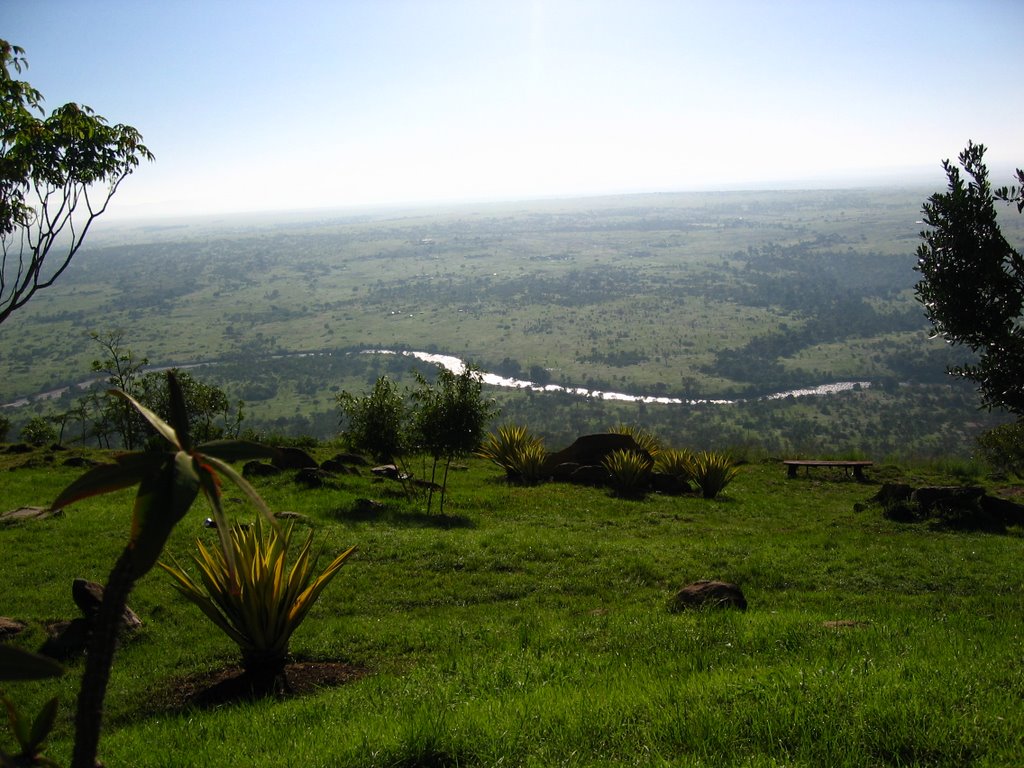
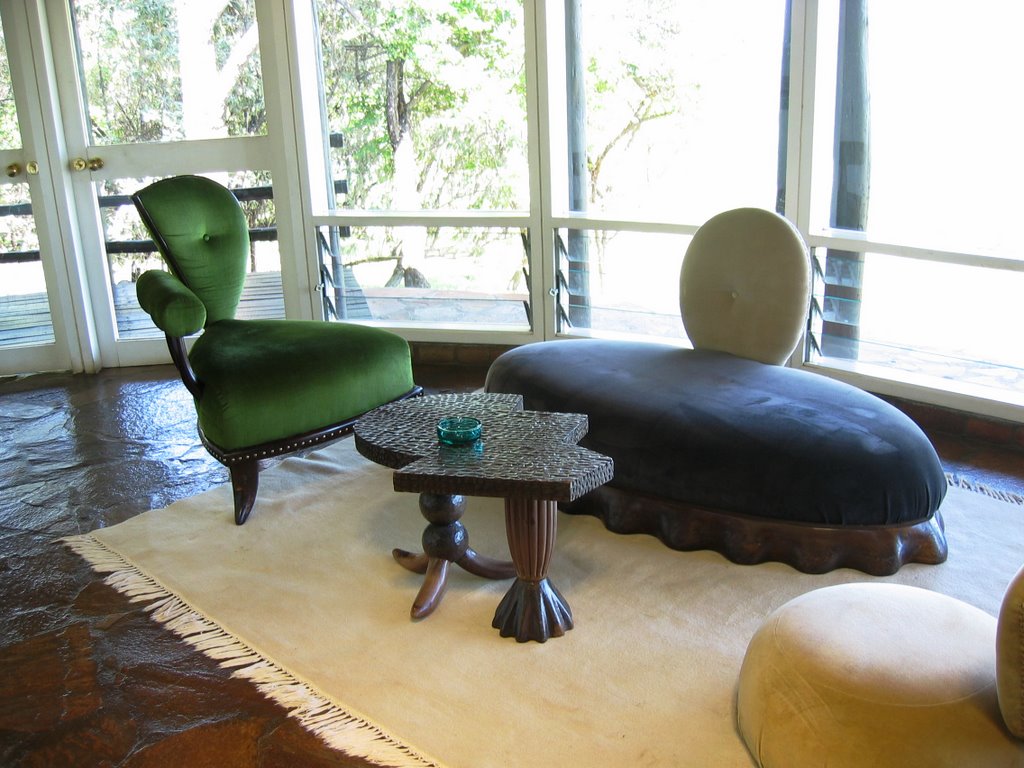
The Mpata safari lodge was built in the early 1990s by a Japanese architect. All the cabins are made of interlocking circles (like cross sections of snail shells) with odd shaped skylights. I believe that Beetlejuice was called in as a consultant on the furniture. And the view is unreal. We can see for miles and miles over the valley below. The suite we are staying in has a jacuzzi out back too, so you can soak in the hot water after a long day of safari and watch the sun go down over the vast expanse of green below before going to eat you five course French meal for dinner. My life is very hard, as you can see.

One of the most intriguing things about the camp is that it is almost completely Japanese. It is owned and operated by a Japanese company, and most of the other people here are on package tours from Tokyo. We can’t talk to anyone, but on the bright side it takes a little of the Colonel Mustard in the Drawing Room with the Lead Pipe edge of the isolated safari lodge life.

It poured all night.

Next morning we got up at 5:30 am to go on our morning game drive. We loaded up before dawn and headed down the mountain. When we arrived at the bridge we noticed something rather interesting. The concrete bridge was no longer there, replaced by a rushing torrent of water. Safari vans piled up and Japanese tourists took pictures. The drivers thought the fact that we were marooned on top of a Kenyan escarpment with now way to get out or for supplies to get in was quite possibly the funniest thing that had ever happened to anyone. Especially the whiteys that were pitching a fit about making it to the airstrip. No safari drive that morning. I have instead included a picture of our furniture.

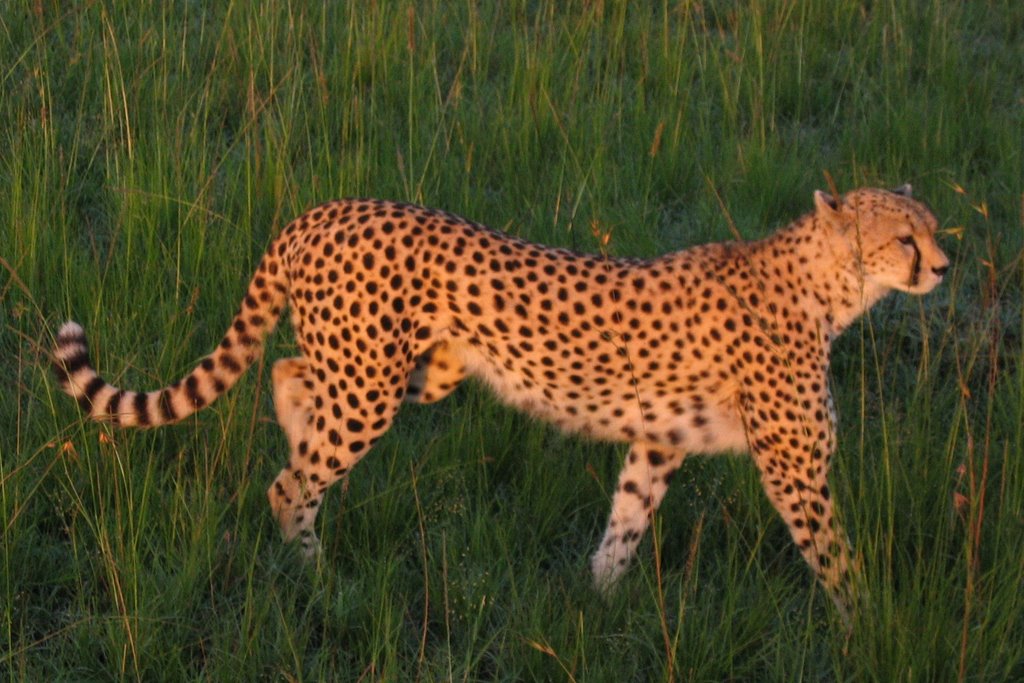
By afternoon the waters had receded enough for us to take an alternate route to the park. The wildlife viewing was incredible. We saw six cheetahs, including three lazy cubs, and two males running at full speed trying to take down a baby topi. (Topis are like smaller, dumber versions of wildebeests, about on the same size and intelligence of a standard household washer-dryer.) Momma Topi was having none of it though and cut the cheetahs off. They can only run at top speed for a very short amount of time though, and the topis were able to get away. The two cheetahs then strutted around for a while like a couple of gang-bangers at prep school, then took a nap in the grass.

We saw some other neat stuff too. A bunch of lions just waking up from their morning snooze and some really hungry elephants. We then went back to the lodge to relax in the jacuzzi and eat steak au poivre.

Over the next three days, we saw a bunch of other animals. Highlights included below:

Lions, in bunches. We saw different groups every day. They mostly travel in large packs of females, sometimes with one or so males present, but not always. And they are not receptive the big-maned brothers rolling in on their territory. One group of six females we saw was much displeased by the prospect. Similar to my girlfriends and I in a crowded downtown Boston bar on a weekend, their growls can loosely be translated as “I KNOW you are not trying that tired ass line on my girl here…”

We actually had somewhat of a close call with a lion too. We were down by the Tanzanian border – going to take our pictures with the border marker. As we rolled to a stop, the guide spotted a long fury tail slip into the bush next to the concrete marker. Lion. Older lone male – which are distinguished by the fact that they can’t run well anymore and are known to take out easy targets – like people. There are numerous stories about these old guys attacking railroad camps during colonial times – munching on the help. The guide was a little unnerved and took us to another marker in the middle of a huge open field. No bushes there to conceal predators.

Hyenas – which I had never seen before – are quite possible the vilest creatures to walk the earth that do not hold an elected office. They just slink around looking like they just ate a baby something. The Lion King portrayal was spot on.

At risk of boring you, I will stop there.

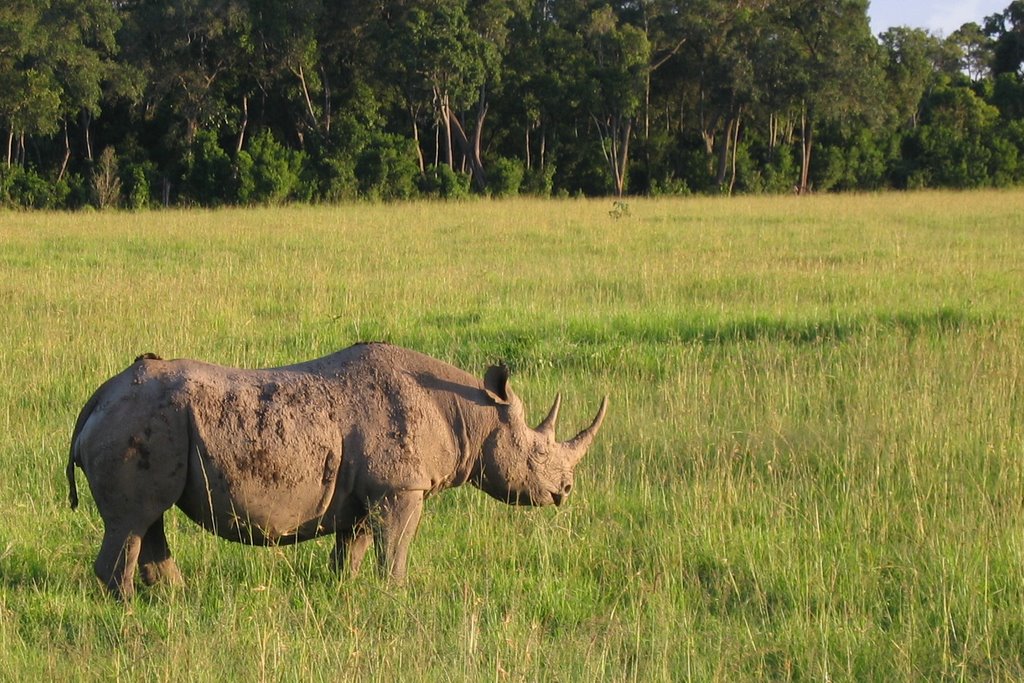
At risk of boring you, I will furnish an incomplete list of other things that we saw: black rhino, cerval cat, giraffes, zebras, Thompson’s gazelles, topis, wildebeest, hartebeest, baboon, African buffalo, waterbok, vulture, golden crested crane (among another billion species of birds that went by too fast to identify), hippos, crocodiles, and I know I am forgetting a bunch of stuff. There are so many things on the Mara that you couldn’t always tell where to look.

Well, that will be all for a while now – back to school. I will see if I can arrange something interesting for spring break in March.

Friday, January 19, 2007

Gorilla Tracks

So my two weeks in Kampala, Uganda working on my master’s thesis went smoothly. I had a few amazing discoveries in research, such as the fact the “farm gate price for coffee” refers not to the price a farmer receives at the village level for a kilo of coffee, but rather the price of a packet of imported Nescafe instant crystals, but that’s fine. There were the brief minutes where I heard my thesis crash and burn, but like a phoenix I rise from the ashes to hypothesize another day. In addition, I knocked out a couple other papers for classes due during the break, both written in Africa, by me an America, one about Latin America and another, co-authored with two Europeans, about the Middle East. High five globalization.

So we left at 2 am on Wednesday morning I left Kampala for Kigali, the capital of Rwanda. The bus trip was uneventful. As usual I spent the time admiring the scenery and speculating as to exactly what type of methamphetamines the driver was on. We arrived at the border at 9 am, and did the usual song and dance with customs. As I was boarding the bus again, however, the customs guy asked me to open my suitcase. He was looking for plastic bags. They were illegal in Rwanda. My heart soared. Having traveled in over 20 African countries to this point, my mind wandered back to the piles of plastic bags that litter the roadsides and villages across the continent. Disgusting. Marring the scenery. Harming the environment. I swelled with pride as I thought of the new generation of Africans, fostering development while still holding tightly to Mother Nature’s hand. Radiating this inner glow, I fished out the thin black plastic bag that until moments before had held my laundry. I held it high. I asked the inspector, beaming with hope, into which receptacle I should throw the offending hydrocarbon derivative.
He told me to toss it on the ground.

I sighed, tossed the bag on the ground, and got back on the bus. Onward to Kigali and Ruhengeri. We were only in Kigali for about two hours. Long enough to pick up our gorilla permits and accidentally try to check in to the Hotel des Milles Collines (from the movie Hotel Rwanda and the real-life genocide).

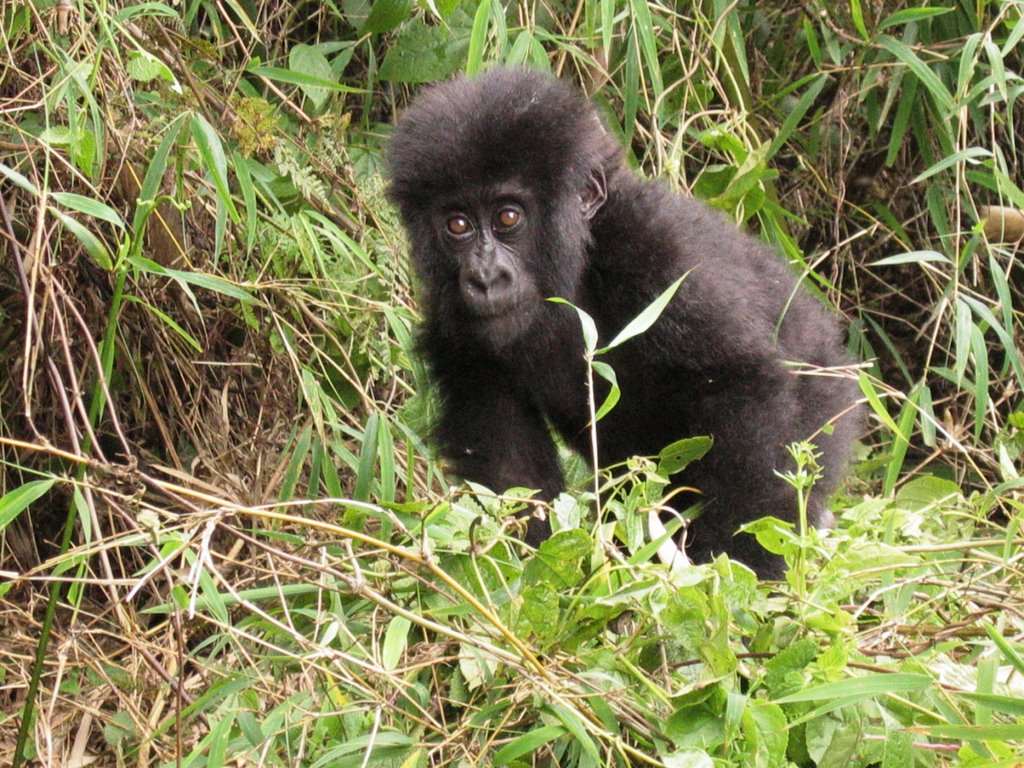
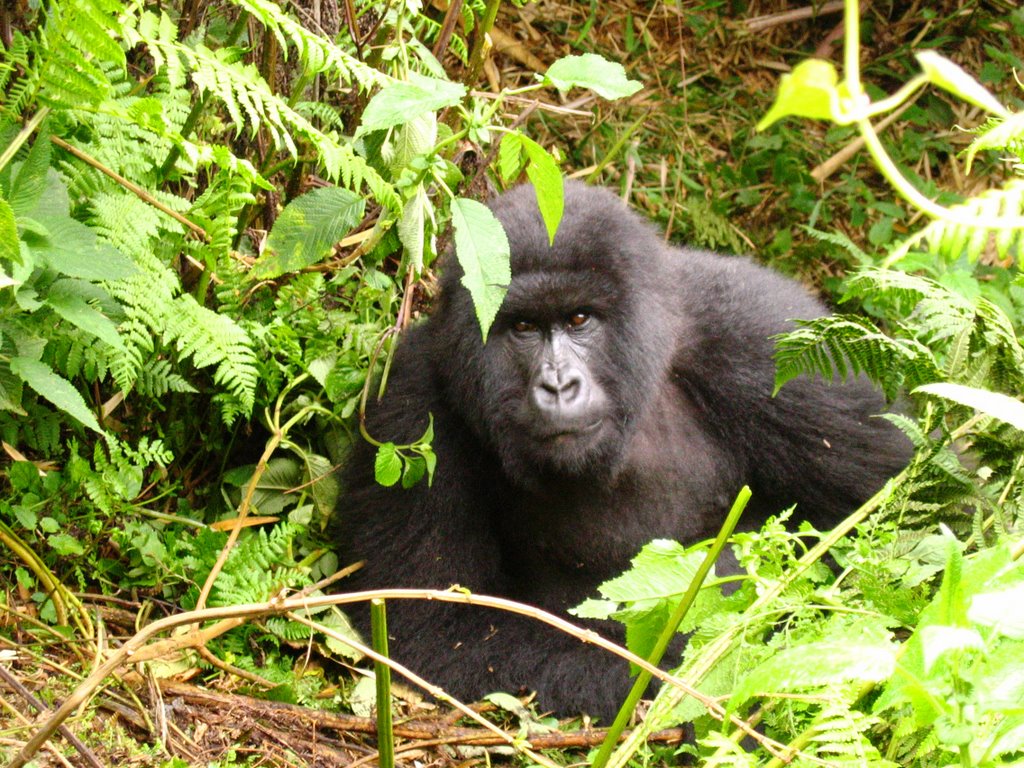
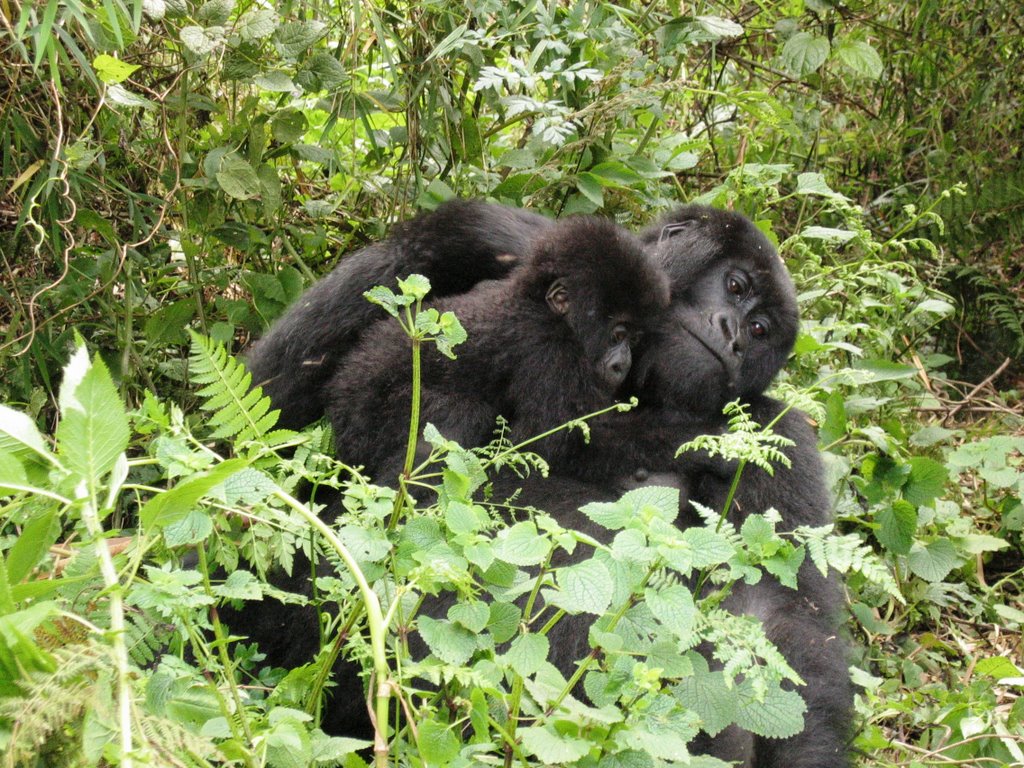
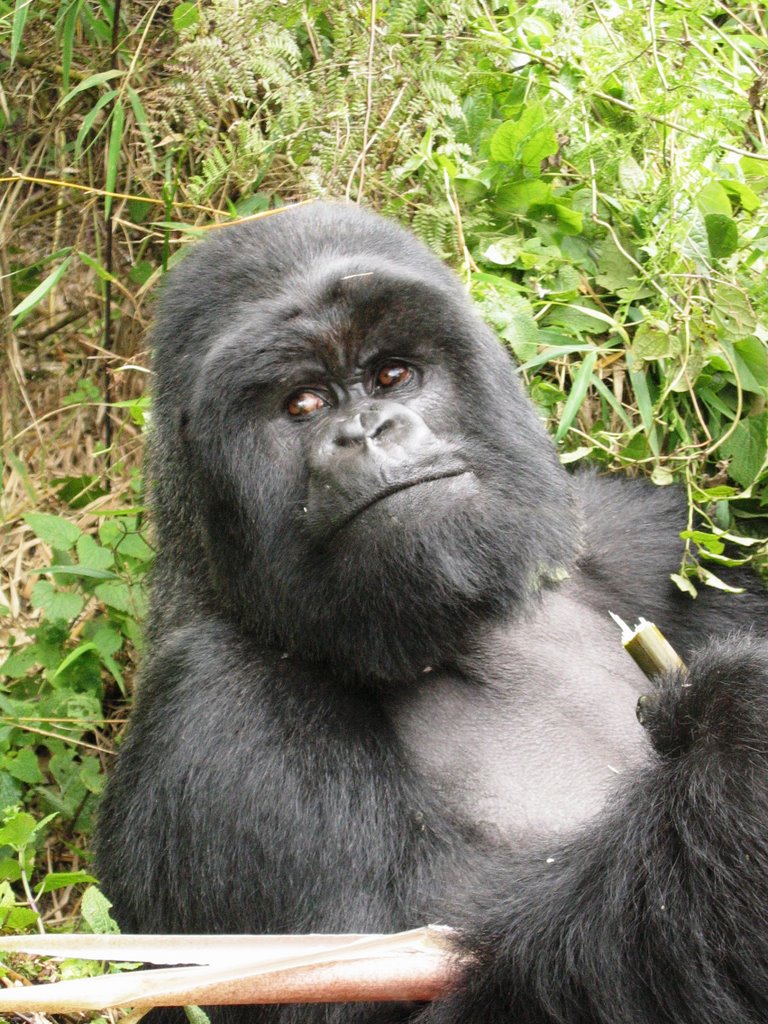
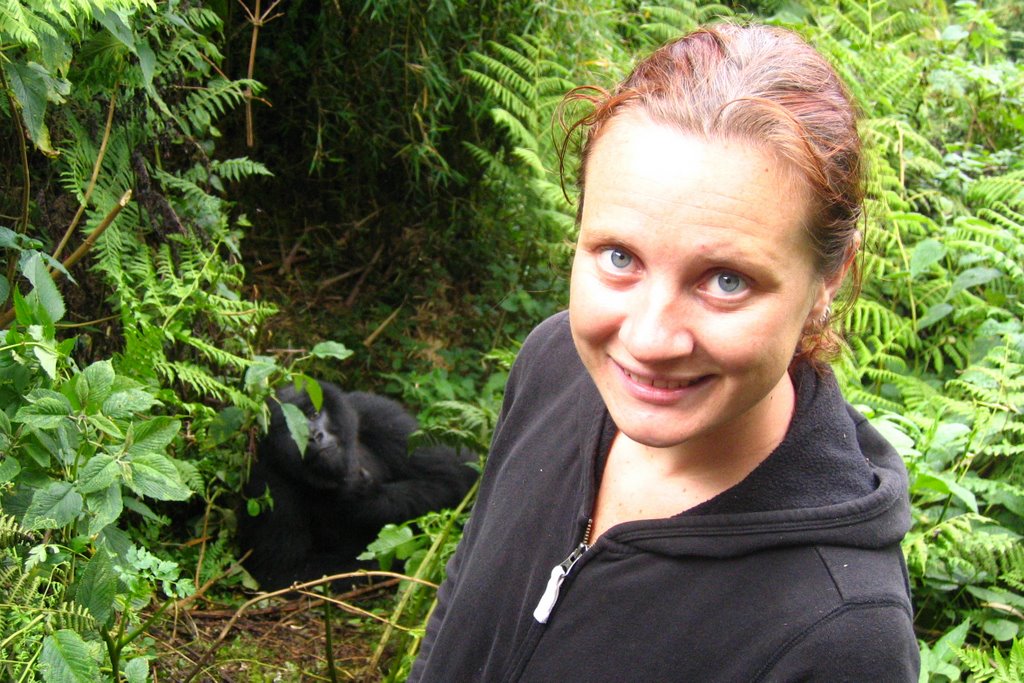
Ruhengeri is the town used as the base camp for visiting the mountain gorillas. You hike about 1 1/2 hours up - into the mountains as it were - and then spend an hour hanging out with a family of gorillas, then head back down. This was the single most incredible experience of any of the travel things that I have ever done. You get SO close. The gorillas aren't afraid at all. And the troupe we visited had 3 little baby gorillas. I could bore you to tears with every single second of the experience, but you really owe it to yourself to go yourself someday. I will stick to the highlights and let you check out the pictures. (Incidentally, I literally have 100s more, so let me know if you want to wallpaper your new bathroom or something...)

(1) We were walking down a path from one part of the gorilla group to the other. Suddenly the guide tells us to stop, and stand to the side. I turn back to see what happened. The others in the group stepped to the side and a 300 pound mountain gorilla with a baby on her back went walking by. She brushed against the legs of the person next to me. I had been the first on the lines and a little way down a rocky path. I stepped back as much as I could, but not quite far enough. She stepped on my toes walking by. Just the tips and not enough to hurt, but how many people do you know have had their toes stepped on by a wild mountain gorilla?
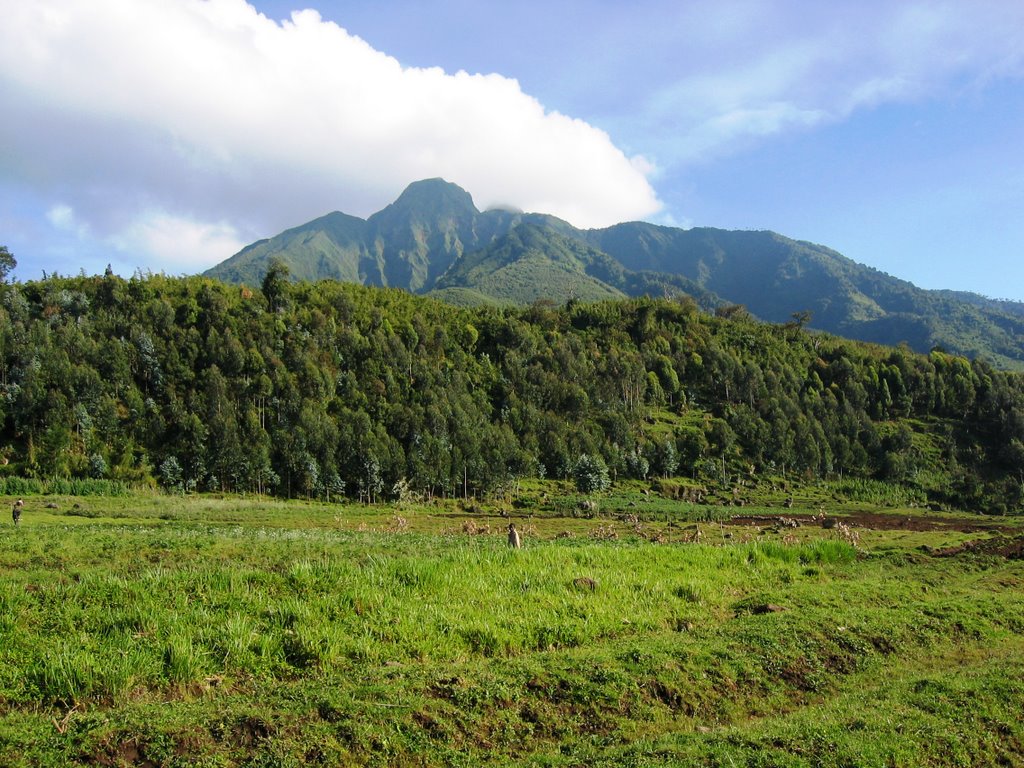
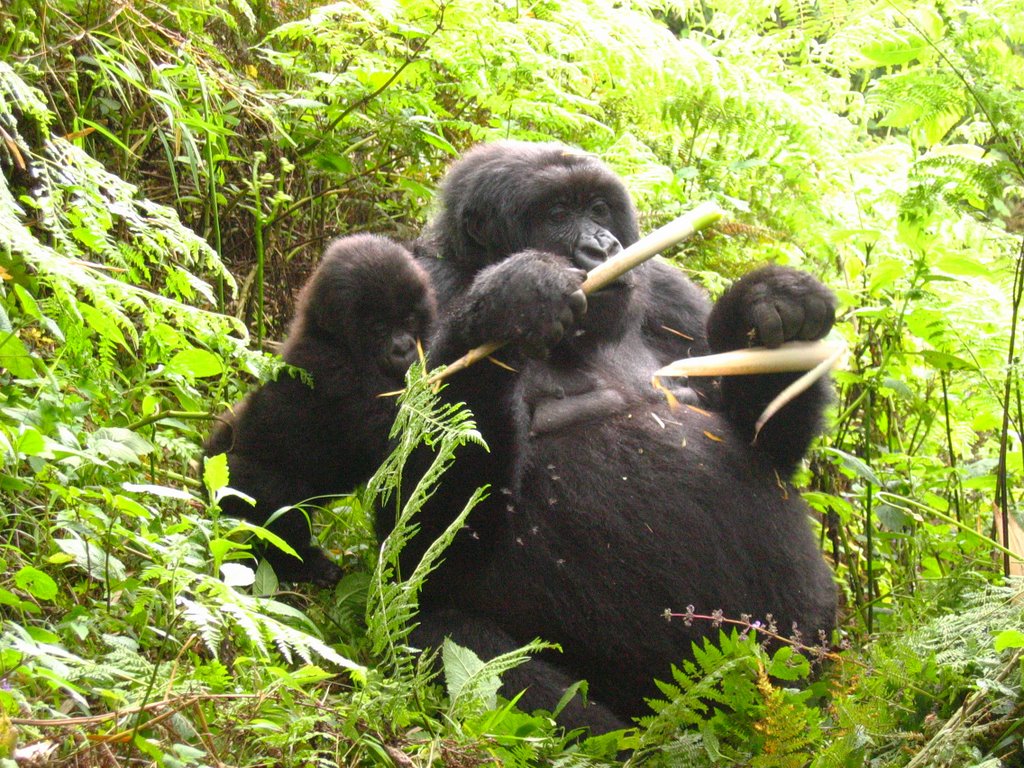
(2) The troupe had 9 members, 1 adult male silverback, five "wives" and three babies. The adult male is HUGE. We got within five feet of him while he was eating. They are so much like us. While he was sitting there, lounging in a tree eating bamboo, we had the same posture and expression as a number of adult male humans I have known in my life have while watching football. (You know who you are.) When we are that close the gorilla, you can't make any sudden movements. While is all well and good until he figures out there is no more bamboo within arms reach and decides to pull down a tree. You ever try to move slowly out the way of a falling tree? Twice I was smacked with branches. Damned inconsiderate to the guests.

(3) There was one female who was HUGELY pregnant. She was irritable and ate all the time. And there are people that doubt evolution is real.

(4) There was another female with a baby. The kid was about the human equivalent of the terrible twos. He was all over the place. He wanted to run in the trees. Then climb on dad. Then climb the bamboo. Then see what the deal with these weird pink hairless things with the cameras. At one point he got a little too close to the guide. The female walked up and slapped the guide on the shoulder, encouraging him to perhaps move his troupe of weird pink hairless gorillas away from the baby. Then the baby wanted to get a better view of use so he climbed in the tree on top of us and started to jump up and down. He hadn't quite gotten the hang of the working of all his limbs yet, so he ended up hanging by one arm. Mom grabbed him down, said something in gorilla that mothers all over the world have been yelling at their kids for millennia, and made him sit with her under the tree. He sulked.

I could really go one forever. I have added more pictures than usual this time because they really offer much more of an accurate picture of the experience. Absolutely incredible.

After the gorillas, we caught a minibus to the resort town of Gisenyi on Lake Kivu. Gisenyi is a cute little town right on the border with the DRC city of Goma. Most of the cars and people here are Congolese. (Editor’s note: Goma used to be a provincial backwater in the middle of war-torn eastern Congo. Then in 2002, the nearby volcano erupted, and Goma became the provincial backwater in the middle of war-torn eastern Congo half covered in lava.) We stayed at Hotel Kivu Sun, which is the nicest hotel in town, even if it is the former headquarters of the genocide government. You can't really swim in Lake Kivu. The guidebook says "it is very dangerous to swim, as volcanic gases are released from the lake bed and, in the absence of wind, tend to collect on the surface of the lake. Quite a few people have been asphyxiated." I took a pass on the experience. We only spent a day there, before coming back here to Kigali. We will take a look around town tomorrow, then fly on to Kenya on Sunday.

Wednesday, January 03, 2007

Paris and the Luggage

So for New Year's I decided to do something a little different, a little change for me, nothing drastic, but just give it a little go and see where it takes me. I went on vacation to the developed world. Paris specifically.

The four days were nice. Matt and I walked around Paris, ate crepes, talked French, etc. We only went to one museum because the lines were around the block because of the holidays. We went to the new museum of developing world art, which is Chirac's answer to the British Museum. The verdict: British museum is much bigger and has a much better collection of stuff, which Chirac's has really neat architecture, and in both cases, the countries from which the artifacts were taken would probably like them back. And the kids all say that colonialism is dead.

The other thing of note we did was New Year's. We went to this restaurant whose name translates to "In the Dark?" It is a restaurant run by blind people so you can see what it is like for one meal. The dining room is completely black. Not a pinprick of light anywhere. You are led to your seats conga-line style - being dropped off by your blind waitress as you go. There are no menus, you get what you are served. You fill your wine glass by sticking your finger in it and pouring very very carefully. You locate your plate by touch, and figure out which section is duck and which is butternut squash by sticking your fingers in it. (In a weird way, it was like the ultimate foodie test - it's amazing how much we rely on our vision to identify what we are eating.) After dinner, we went back to our hotel to watch the Eiffel Tower to light up the new year. Instead of the little TV provided in our hotel room, we snuck out on to the fire escape, went up to the top, then climbed this rickety little metal ladder to the roof. We had a beautiful view of the tower. I took the above picture of the skyline in the other direction. It was weird and bizarre being the only ones up there and with the light refelcting off the clouds.

Then I took a two hour nap and headed off to the airport to go to Kenya. My eventual destination was Kampala again, but it was cheaper to fly to Nairobi and then grab an overnight bus from Nairobi to Kampala. After all, once you have been on a plane for 9 hours, what's 12 more in a bus?

The only little snaffoo was that though I arrived safe and sound , the Luggage did not. So I faced the choice of being in one of the most dangerous cities in East Africa, at midnight, alone with no hotel and no luggage, or to get on an overnight bus departing from one of the nasty sections of the city, alone, with only my laptop bag. I didn't even have any toothpaste because the rat bastards at Charles de Gaulle confiscated it because it was 4 oz and therefore MUST be plastic explosives in disguise. Well, off I go. KLM assured me that this happened all the time and that Luggage would be along to K ampala on the next flight. (This happens all the time? Management should have a quick review of what to tell and not to tell the paying public...) So off I went. The bus trip went as smoothly as any 12 bus trip through a developing world backwater. I arrived and checked into the hotel. No Luggage. Next day, no Luggage. KLM has no clue what continent the bag might be on and can I please come back tomorrow? So I decided that the only sensible thing to do would be to camp out at the office until they found my bag. It took 30 minutes before they were calling baggage claim offices around the world to get the crazy white lady OUT of there. They found the bag. They would have it at the hotel by end of business.

Around 3:30 they called. Good news, Luggage had arrived in Kampala. Bad new, it had promptly been confiscated by customs and I had to go down to the airport (which is in another city 30 miles away) and get it out of hock. The round trip took three hours and I managed not to pay any bribes. Most of the time at the airport was taken up with a Kalfka-eque process of obtaining a security badge, which I didn't even need. There was no one manning the security check. But - in true African style - people still formed a somewhat disorderly mob to put their belongings down and pass through the metal detectors, even though there was no one there to look at what was in the bags or stop us if we set it off. I did the same.

So Luggage and I are back together again in Kampala. I will hopefully get enough accomplished on my second year thesis in the next two weeks to do some interesting stuff before I leave East Africa.

Happy New Year.