Saturday, August 26, 2006

Drunk Flying and Subsequent Central American Adventures

Just want to start this post with a shout-out to all the long time readers that I met for the first time at Katie’s wedding. It was great to meet you. I hope you all had a good time.

I returned safely from East Africa and in time to make the wedding, no coups or other disaster this time… The wedding was great. I had a pastel dress, pink nails and a French twist. Most of you wouldn’t even have recognized me. After the wedding, I stuck around long just long enough to have a couple Bloody Marys and then headed south to meet my roommate in Belize. The goal was to spend a couple days diving and poking around Mayan ruins before heading over to Indiana to don my red dress and drinking shoes for A&E’s wedding…

I arrived in Belize City after an unnecessarily arduous flight with a four-hour layover in Dallas. (Security in JFK is off the hook. In Dubai coming back from Dar es Salaam, I went through with a liter and a half bottle of water and an entire toiletries kit. In New York they call the bomb squad for a tube of toothpaste and half finished Snapple.) And it is a good thing that I had four hours in Dallas. It took me two and a half hours and two terminals to find a salad that didn’t have some kind of deep fried animal product on top of it. (Airports are up there with shady horse farms and India in the rankings of places that I don’t eat meat.) I eventually convinced the guy at the Asian food stand to give me just carrots, broccoli and fried noodle, but not before he tried to add fried pork, chicken, beef, etc…

Upon arrival in Belize City, I immediately bought a ticket to the island of Caye Chaulker, a backpacker hangout and diving mecca off the coast. I had an hour to kill officially, of course I actually had more because the plane was late, so I headed over to the airport bar. There I joined not one, not two, but THREE sets of honeymooning couples at the bar, also waiting for their flights. (You can tell the new couples because the girls all have “wedding nails” and the guys are fiddling with their bright shiny new rings.) The bar was run by this midget, Jet, that had been selling rum punch and beer to honeymooners for forty years. He wanted $5 US for a Dixie cup of rum punch. I asked him if he thought he was in Manhattan. We bantered back and forth for a while before I finally agreed to buy one. He walks over to the bar (which inexplicably had a bottle of Listerine on the top shelf…) and stops. He looks at me and says, “you know what? I like you. You are a pain in the ass.” He drops two ice cubes into the cup, fills it with dark brown rum and throws in a splash of juice. The drink was the same color as the bottle of rum. It was so strong that I could barely drink it, and I can usually do turpentine shots without wincing. So I had two of these while waiting for the plane and was already flying high when the eight-seater finally showed up.

Now Caye Chaulker is only a fifteen minute flight from Belize City. It actually is a “by request” stop, meaning that the plane to San Pedro will drop you off if you ask them too. Like a city bus. I asked the pilot if I could be the co-pilot if I promised not to kick the pedals. He said okay. One of the honeymooners was a nervous flyer and just about dropped dead when he saw (1) the size of the plane, (2) that I was the co-pilot, who he knew had just spent 90 minutes at the bar… But it all ended well and I hopped off with my backpack and went to meet Dennis at our cabana - which was only accessible by walking along the beach. Caye Chaulker was pretty small place. No cars. You walked everywhere or took one of the golf cart taxis.

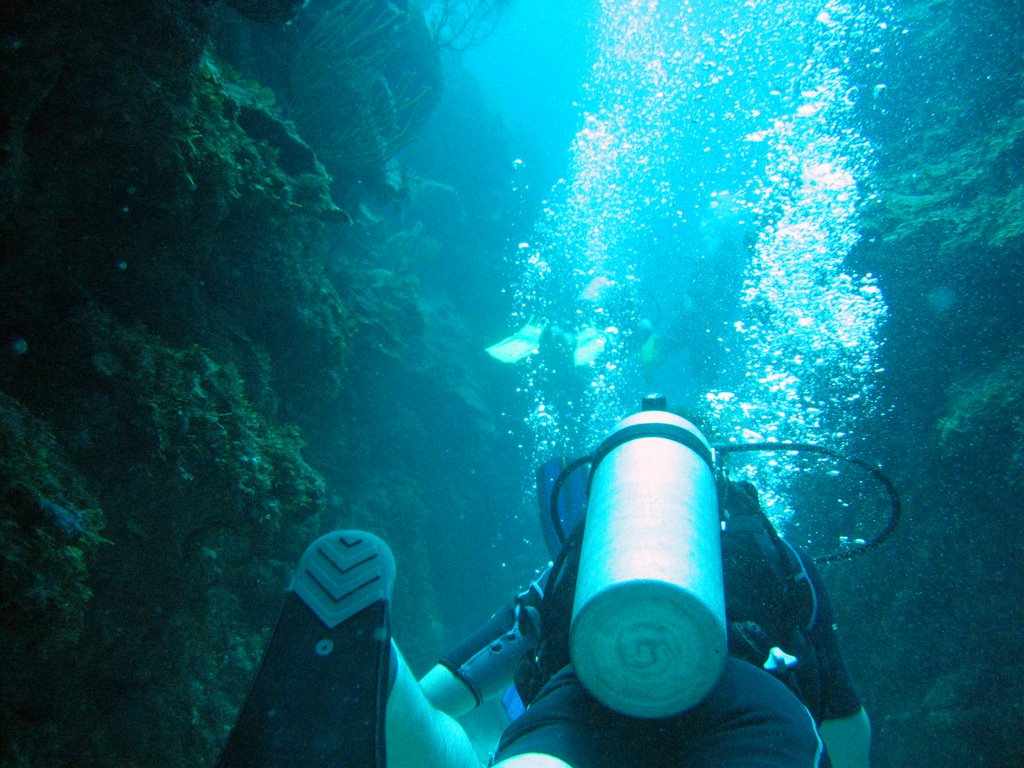
Next day we did a bit of diving. Nice, warm water, lots of fish… grouper, sea turtles, sharks… The day after that we decided to go out to Blue Hole, a deep collapse crater 60 kilometers out in the ocean. It was a really cool dive. You descended in a free fall where you couldn’t see the bottom, only sharks circling in the murk. You drop through the sharks (they are only Caribbean reef sharks – not really dangerous – but a little unnerving when the swim within inches of you.) When you reach the maximum depth of the dive – 140 feet down – the water gets crystal clear and there is a deep overhang with huge stalactites to swim between. It was one of the best and most eerie dives I have ever done.

After that it was back to the surface for a couple more dives and then back to shore. Next morning we began the long trip across Belize and into northern Guatemala to see the ancient Mayan city of Tikal. First we took the “ferry” to the mainland (some guy with a big open motorboat) and then got on the bus. The trip was long and slow and meals consisted of cheap corn chips bought along the roadside at the border. We arrived on the outskirts of Flores – where we would be spending the night – just in time to get caught in a dead stop traffic jam caused by student protests. We ended up walking, taking a minibus, and then walking again before we finally got to Flores and a place to stay. We ate dinner and crashed. We had signed up for the 3:30 am departure to see the sunrise in Tikal.

Of course neither Dennis nor I had brought an alarm clock. We bought a cheap Chinese plastic piece of crap in Caye Chaulker – which didn’t work. Dennis woke up at 3:20. I will spare you the details of the ensuing dressing packing and leaving debacle. We made the bus. After a 50 kilometer ride to Tikal and a 45 minute hike through the dark – we climbed the temple steps to wait for the dawn. We sat on the top, surrounded by mist and jungle in the dark, listening to the disturbing calls of the howler monkeys out in the bush. As the sun rose and it grew lighter, we saw the tree tops and tops of the other temples fading in and out in the mist. The monkeys and parrots screamed and toucans flew through the sky. Really cool experience.

We spent the rest of the morning hiking around and climbing temples. More toucans and spider monkeys. Just before lunch we set out on what would turn out to be a hot and long and hot journey back into Belize and south to do more diving. Most of the time we road in the back of converted school buses across the bumping roads. Dennis and I gave into our adolescent tendencies and sat in the back – where all the cool kids were – just like middle school…
So now we are in Placencia – a tiny dot of land on the bottom of a peninsula sticking out into the Atlantic that is less than 100 meters wide at points. We had hoped to be underwater by now, but stupid tropical storm Ernesto has kicked up too much chop so we are beached. There is a chance we could get out this afternoon, but it looks like if Ernesto doesn’t want to take a cue from his namesake and visit Fidel and Raul right soon, we are done diving for now.

Tuesday, August 08, 2006

Just another day at the office.

So despite the fact that I work for the World Bank, my office is in the Ministry of Finance here in Uganda. The ministry is in a fairly large block of government buildings: foreign affairs, communications, courthouse, etc. are all here. About an hour ago I am sitting at my desk, completely absorbed in the exciting world of statistical analysis of poverty indicators, when there is an EXPLOSION of automatic weapon fire right below my office. I pause and wonder if they have overthrown the government, always a concern when working in sub-Saharan Africa. It is quiet for a while so I go back to work, vaugely wondering if maybe I should do some regressions to prove how bad Museveni's government is/was. If it had been a coup and some heavily armed person should enter my little office, I better have something to offer the revolution, no?

My office mate came back a little while later. He told me that it was nothing special. A prisoner had just escaped from the courthouse next door and they needed to get him back, which they did. Then he started laughing as he told me the entire cafeteria had hit the deck when they started shooting because it was right outside the windows. Ha ha, joke's on them! Anyway, happens once in a while, nothing to worry about, back to work.

Monday, August 07, 2006

Conquering the Elusive Giraffe


Many a year ago now, myself and three fellow Peace Corps volunteers set out on an ill-fated trip to see giraffes in neighboring Niger. Just about everything imaginable that could go wring did, and I never got to see any giraffes.

But this weekend I was redeemed! I booked a weekend safari to Murchison Falls national park in the northwest of Uganda. I had wanted to go last weekend, but I couldn’t get Friday off work, and besides the park is only about 20 miles from the Congolese border which would not have been the greatest place to be if the entire region collapsed into armed strife (again) following the Congolese elections last weekend.

So I blew off work on Friday and joined 15 fellow tourists in two vans for an eight hour drive north. The other people in my van were a group of four Israeli tourists, who were very happy to have picked this particular part of Middle Eastern history to take a six month vacation, a Canadian medical student, and teenage American aspiring wildlife photographer, and a Kiwi Blue Helmet working in southern Sudan (Kiwi Blue Helmet: a United Nations Peace Keeper of New Zealand-ish origin). The trip was basically uneventful, except for the tsetse fly store we have to transverse right before we reached the lodge. As tsetse flies have painful bites and are carriers of river blindness, we had to close the windows. But as it was boiling in the van with the windows closed, we would open them just a crack to get some air. Which was fine and dandy until we hit one of the crater-like potholes on the road (occurring every five to ten feet), which would bounce the windows open, letting in the some of the swarm that followed the van. We would then have to slam the windows shut and try to kill the ones that got in. I had two kills. I Kiwi Blue Helmet had none, which just goes to prove the conventional wisdom that UN Peace Keepers couldn’t hurt a fly.

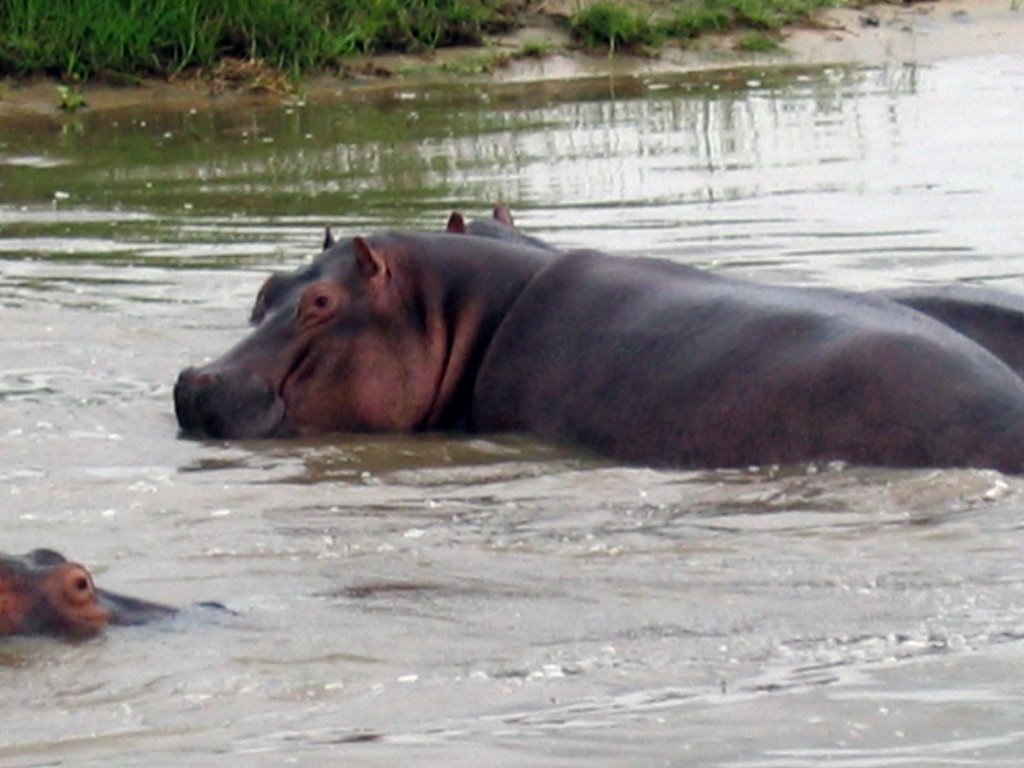
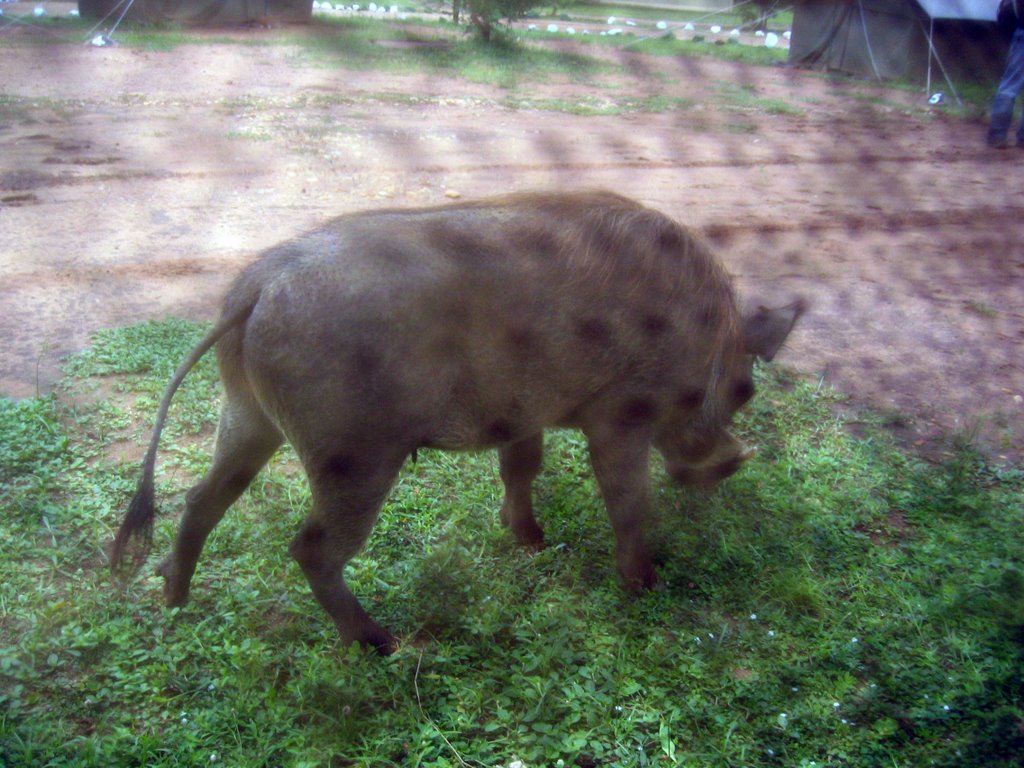
We arrived at camp and were shown to our tents. I got to share with Blue Helmet (who was, despite my constant teasing, an incredibly nice guy). We were given a stern warning that warthogs and hippos were common features inside the camp. Warthogs will find their way into any tent where there is anything edible. You are financially responsible for all warthog tent damage caused by edible things, including something as benign as an empty Snickers wrapper. Hippos were a bigger deal. They tended to feed on the grass in between the tents at night. Should you encounter one on your way to the bathroom at night, don’t approach it and climb a tree if it tries to approach you. (I don’t know about this. Hippos kill more people per year than any other wild animal in Africa. The trees didn’t look like they would support the weight of a healthy child, much less a full-sized adult with a determined hippo at the bottom, as hippos weigh as much as your standard SUV.) There was a poor older Dutch woman who was so scared that she insisted that a bucket be brought into her tent. Fortunately the rains had come recently so there was other grass to eat in places outside the camp. Midnight Hippo Bathroom Blocking is apparently a big problem in the dry season.

So Friday night Blue Helmet and I and a bunch of the other guests got rip-roaring drunk in the safari bar because there really isn’t anything else to do in a tented camp in the middle of no where in northwestern Uganda. We wanted a thunderstorm roll in across the forest and played guitar and drank Tusker, and just generally acted like colonialist frat boys.

This all caught up to us a few hours later though. After crashing in the tent somewhere around 1 am, somewhere before six am feel this blinding white light in my eyes and hear someone asking repeatedly if I am awake. Blue Helmet has his military issue flashlight two inches from my corneas. He is still drunk and thinks this is great. He jogs off to shower as I drag my bones out of bed and into my clothes. Blue-y and I had gotten a little too smashed and had forgotten to order breakfast for the morning. He had a couple of granola bars and a can of peaches in heavy syrup. We made do. Before you feel bad for us, we weren’t the most hard up of the previous nights drinkers. Xavier, an adorable little French 22 year old kid with a snaggletooth, walks over to us after we finish our breakfast and are hunkered down in the predawn light waiting for the van.

Xavier: Wot iz zis?
Blue-y: Its paa-ches, mate.
Xavier: Zwhere iz zit from?
Blue-y: New Zealand mate.

At which point Xavier picks up the can containing the remaining syrup and walks away contentedly drinking it.

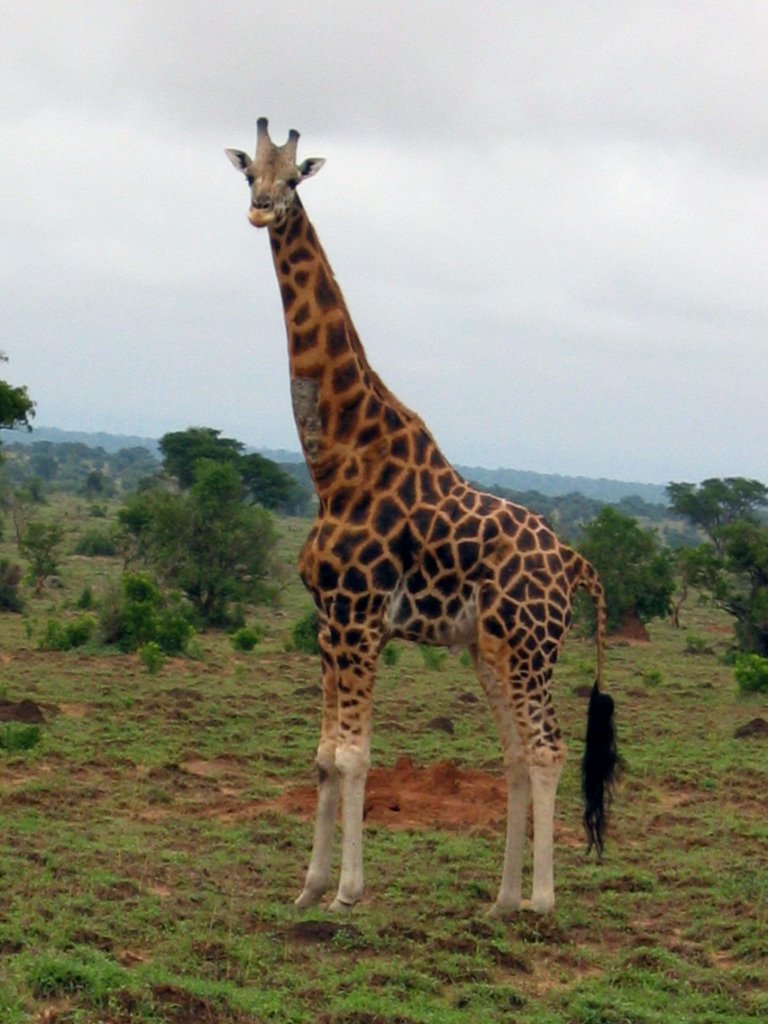
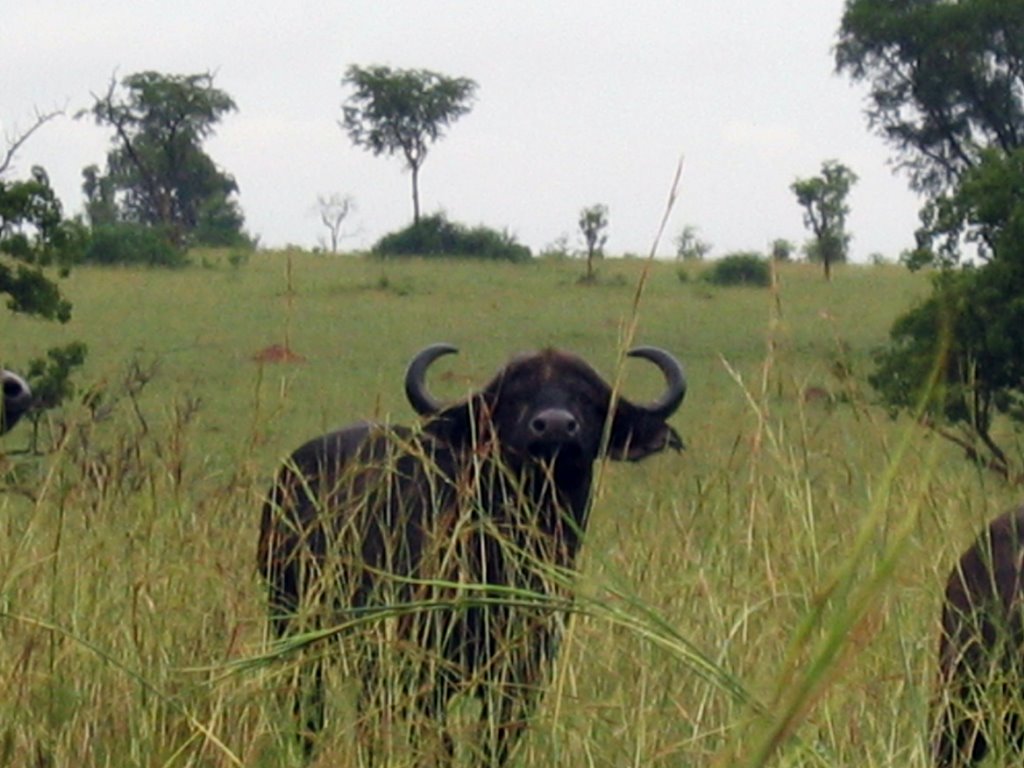
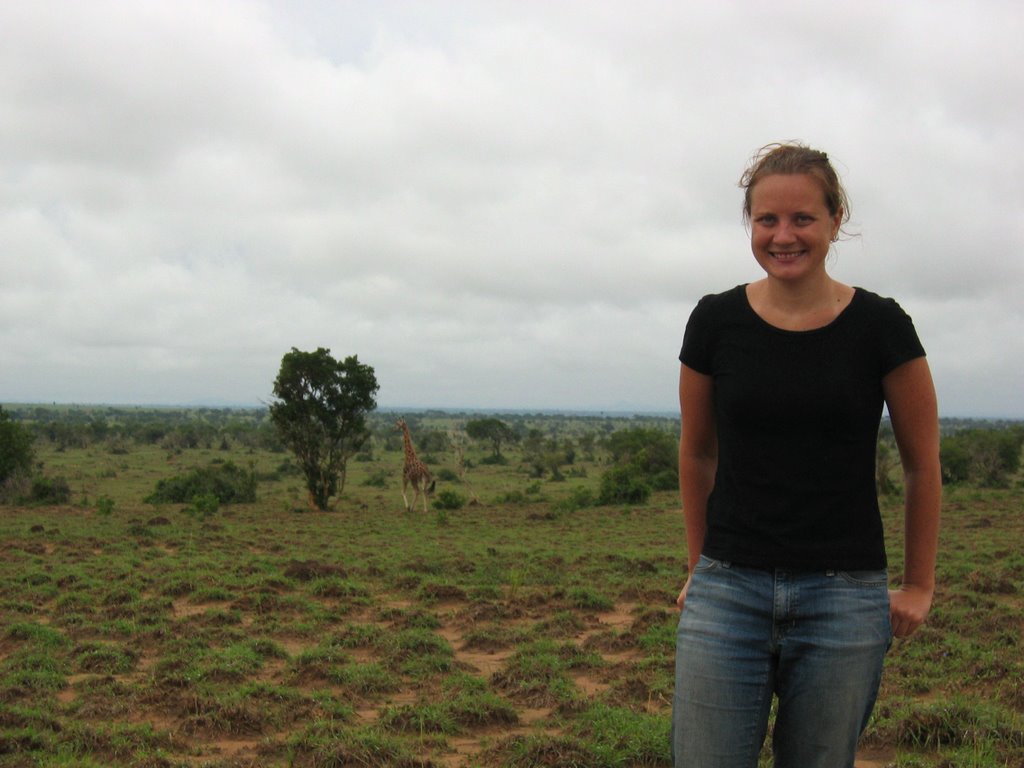
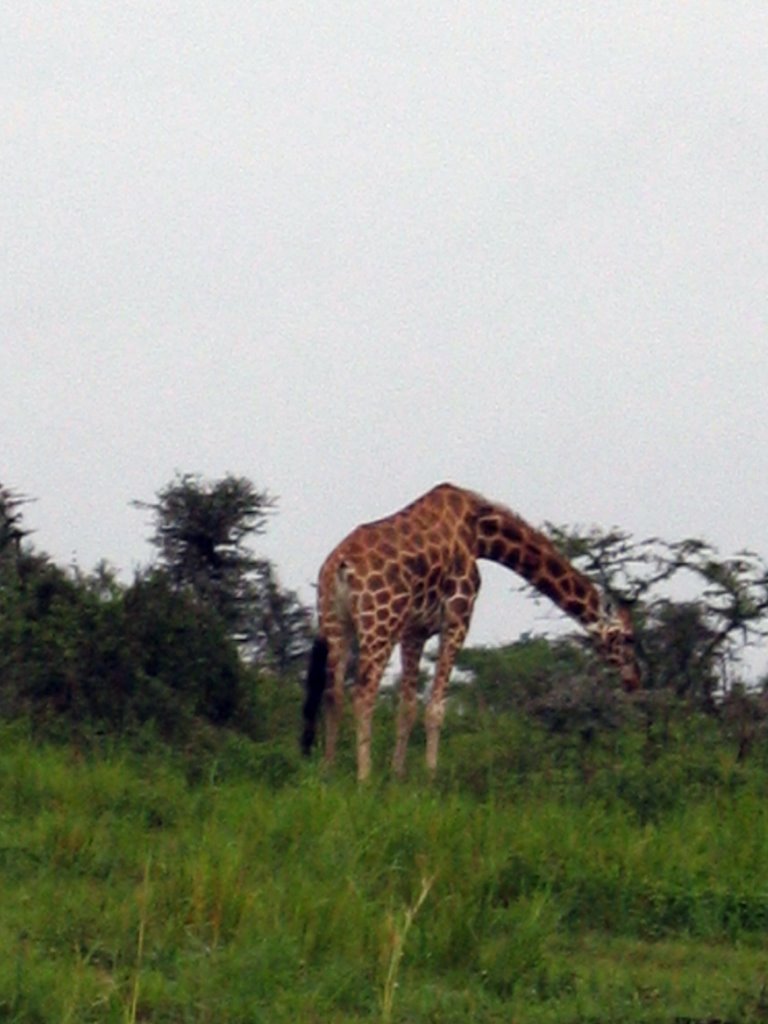
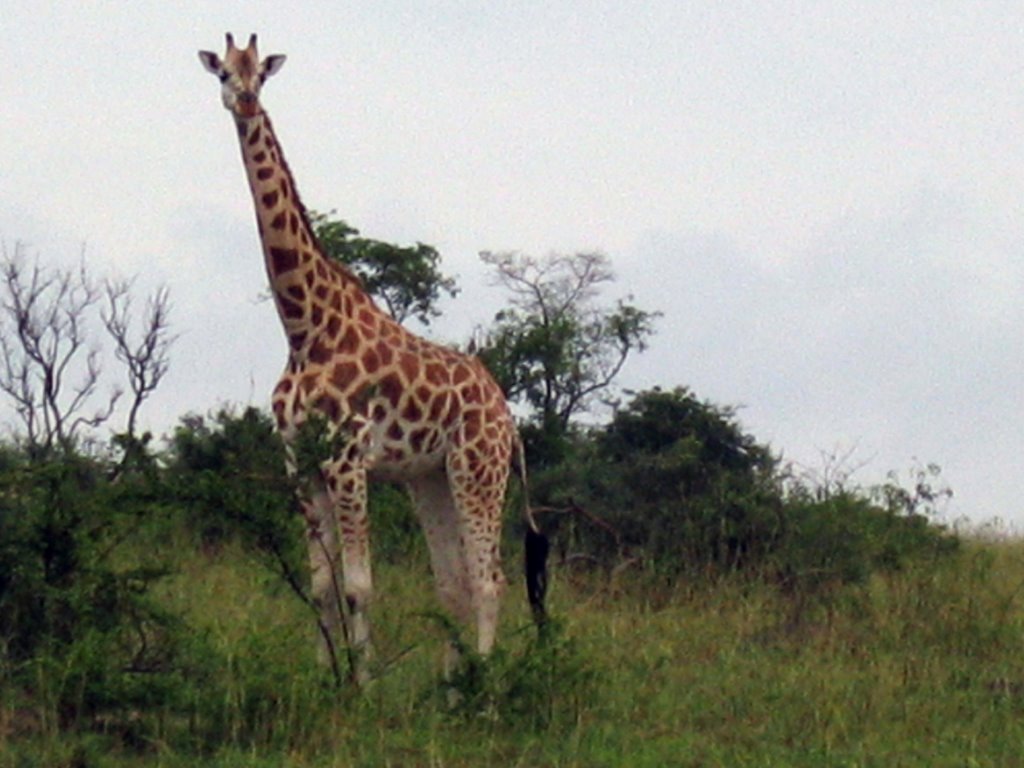
The safari game drive itself was incredible. We saw herds and herds and herds of giraffes, a bunch of elephants, cape buffalo and warthogs, things of varying sizes with hooves, a small pride of lions enjoying something that was until very recently in its abbreviated history something with hooves, birds of every color, ill tempered monkeys, etc etc etc. We had one really big score though. We saw a leopard. They are almost impossible to see in the wild. It was sleeping up in a tree until our van and the pack of gawking people with camera hanging out of it, scared it down. It dashed off into the deep brush, and, as if to prove my theory that pintades (guinea fowl) are the dumbest creatures in existence, four of them dashed after it.

After the game drive I went back to the tent to crash. I was hurting a bit from the night before and wanted to grab a quick nap before the afternoon trip to the waterfalls. I had been asleep for about a half hour when I feel the tent shaking and hear a grunting noise. I think that Blue-y is screwing around with me because he knows how hungover I am and how desperately I needed to sleep. I sit up with homicide on my mind and look out the tent window. A warthog is trying to eat the grass under my tent. I could have unzipped it and slapped him on his porky ass. He eventually walked off and I went back to sleep.

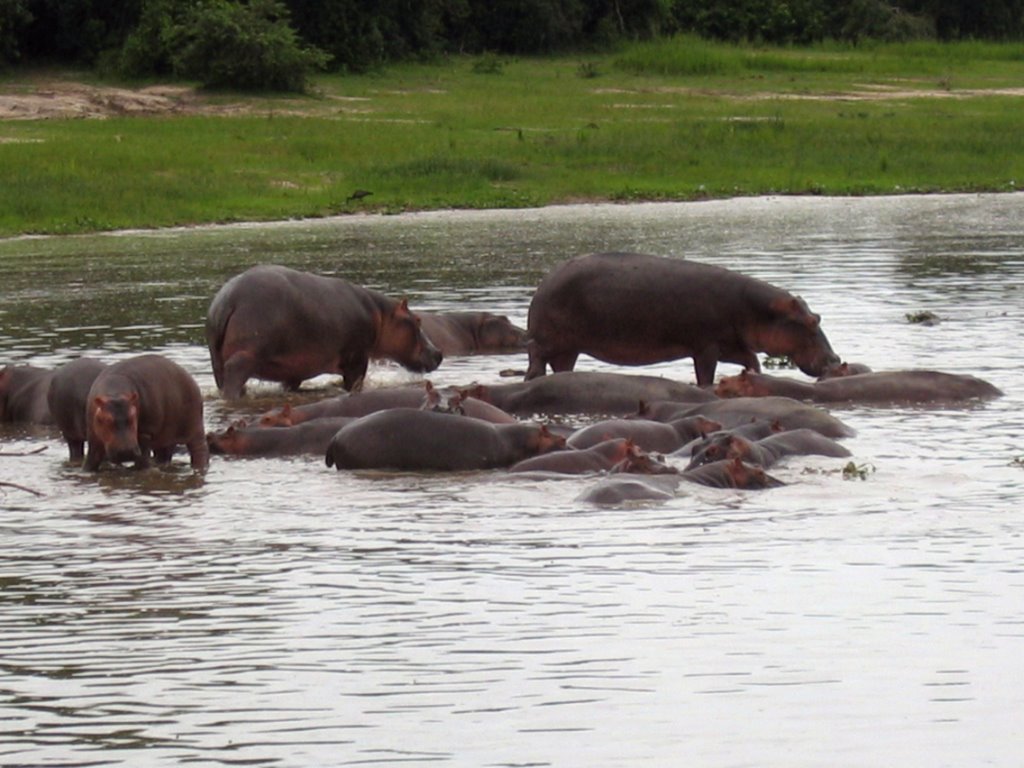
The afternoon was a boat cruise up to Murchison Falls themselves. As we boarded the fairly sizable boat with somewhat questionable sea-worthiness, the captain pointed out the life jackets. This was a mere formality as it turned out because we saw hundreds of hippos and nile crocodiles on the three hour trip. As I mentioned earlier, hippos are huge and dangerous, and the nile crocs are 10-25 feet in length. Drowning would be the least of your problems if you happened to end up in the river.

After a far tamer evening, I spent my second night in the tent, and then headed out in the morning. We were supposed to do some hiking around the top of the waterfall, but it was pouring rain so the trip was brief. Although Blue-y and I managed to get our act together enough to breakfast this time, Xavier apparently had another long night. He took a beer along for the morning hike in the rain.

Then it was back to Kampala. On the way out of the camp, we drove though a big herd of baboons, using their big bare red asses to show us that they thought of us driving through their morning hang-out. We stopped for matooke for lunch, the staple meal of Uganda (it is green bananas, cooked slightly, then mashed into a paste. With enough salt it and the appropriate sauce it really isn’t all that much worse than some of the things that Mom boiled or microwaved for us as kids…) And then back to the city. Then back to work for my final week in Africa (this trip).

Wednesday, July 26, 2006

You too can drown in a landlocked country!

So, as promised I did something death defying on the weekend for this dispatch.

After a relaxing day on Lake Victoria at Uganda’s only near-olympic size swimming pool on Saturday, I spent Sunday white water rafting on the headwaters of the Nile.

(The pool was built to be the first Olympic sized pool in this part of Africa, thereby allowing the resort that houses it to host international events, gain notoriety, turn a profit… But alas, due to the usual developing world attention to detail, the pool turned out to be two inches short. And was thereby relegated to being a “near-olympic-sized” pool, catering to Kampala’s well-healed ex-pat population.)

And now, without further ado, the death-defying part. I got up on Sunday at sunrise and boarded a bus filled with hung-over tourists and headed to the headwaters of the White Nile. Way up here the water is clean enough to swim in and wild enough to have one of the world’s highest concentration of class-five rapids.

We got to camp and picked out our equipment, lifejacket, helmet and paddle. The river guide was a Kiwi (New Zealander) kid that had thick blond dreadlocks and an expression that mad it clear that be believed himself impervious to drowning. He asked us to sort into three boats, regular, crazy and death-wish. I was one of the first ones in the death-wish circle.

He explained us to the basics of rafting, which basically consisted of forward paddle, back paddle, and swim if you find yourself in the river. AND DO NOT LOSE YOUR PADDLE if you get dumped. People are free to make more of, paddles cost money. We did a practice drill of flipping the boat in the still water, because he said that on average the boat will go over two or three times during the course of the day. (Yeah, we went over three times before lunch.) The drill was a little scary as I got stuck under the boat, and that was in still water. The guide told us not to panic if we find ourselves in the river. Just grab your lifejacket and count to five and you will be on the surface. Then swim to the boat, wait until still water, wait until the boat is flipped back over, climb in and do it all again.

So off we went. Through the rapids, laughing, screaming, getting soaked, getting tossed as the boat flipped. It was really good fun. Getting tossed is like getting caught in a wave when you are swimming in the ocean. You know when you don’t dive deep enough and get washed ashore… (I know this because Dad was really into bodysurfing when we were kids. I would go out into the waves with him. Six foot waves, six year old child, what could go wrong?) If you live in a landlocked place, or aren’t familiar with getting caught in a wave, just climb into an ordinary household washing machine and put it on the “SuperWash” setting.

The picture isn't me. They wanted $30 for a CD of the pictures of me drowning. The picture is the one they put on their promotional material. They are going for a certain type of client.

On the third time we went over, we flipped at the start of a long string of rapids. I was in the water, one… two… thr… pop! Back on the surface. I opened my eyes just in time to see the wall of water crashing on top of me, one… two… three… pop! This time I got two gasps of air before BANG, back down I go, one…two… three… four… Anytime now… Seven… Uh-oh. Eight… Hmm, better open my eyes to investigate… nothing but brown water… that’s not good (surface water is white)… ninetenele… pop! Gasp! Dunk! One… two… three…

This continued until I washed into the still water. I was heaving and exhausted when the safety kayak caught up with me. Boy was I glad to see him. He asked for the paddle that I had doggedly held on to for this entire ordeal. Then pointed and told me to swim for the boat. Upon getting back in, another rafter which had taken a similar trip down the river asked about drinking the water, because, like me, had just ingested a couple liters. Guide responded, oh man, don’t want to do that, that’s dangerous.

We flipped over once more during the course of the trip. Eventually an older woman in the boat (a horse trainer from Canada with, inexplicably, a diamond implanted in her left front incisor), asked the guide to stop flipping the boat. Chicken. Man, I hope I am not that yellow when I get into my 30s.

We got all the beer we could drink on the endless bus ride back to Kampala.

Other than that, I am living the quiet ex-pat economist life here in Kampala. I have a room at a guesthouse at the local university. I take a moto-cab (glorified moped with an extra seat attached to the back) to work. Because I am always in a skirt, I ride like the African women do, sitting sidesaddle, ankles crossed hanging over traffic and my laptop balanced on my lap. The way that most of these guys drive, zig-zagging through traffic moving rather in indiscriminant directions, all in all, my daily commute is probably more dangerous than the rafting trip.

Friday, July 21, 2006

Hello Mudda, Hello Fadda, Greetings from, Ka-amp-ala!

So I am in Kampala, Uganda. You can definitely tell that Uganda is a couple clicks down on the old development ladder from Tanzania. Kampala actually looks like an African city, with dirt and beggars. So much for the false glories of East Africa as exemplified by Dar es Salaam.

I haven’t seen much of the city yet, but so far the most interesting thing about this place is the Marabou storks. Some cities have pigeons, Kampala has Marabous. They are everywhere. On roofs, in trees, in the street, everywhere. Which would sound like a standard urban problem, but Marabou stork are quite a bit taller than I am (admittedly that is not to impressive for a human, but this is a frigging BIRD), with a six foot wingspan. These things are huge. They are taller than the TV antennas. I’ll see if I can get a good picture.

I left Dar at 6am on Saturday morning. In my infinite wisdom, I decided to take a bus instead of flying to save a couple hundred bucks and see some of the Tanzanian, Kenyan and Ugandan countryside. The trip was supposed to take 22 hours, but it ended up taking just shy of 30, counting the two hour midnight stop in Nairobi. Thirty hours is a long time to be cooped up on an African bus.

The countryside in Tanzania was beautiful though, through the foothills of Kilimanjaro. I was hoping to see a zebra out the bus window, everyone said that it was possible if not likely, so I kept up a quiet intense vigil for the 12 daylight hours that I had, carefully scanning the horizon for zebras. Except for one false alarm with some hoofed thing with curly horns just shy of the Kenyan border, I didn’t even see a dog. *sigh.

Since I have been in Kampala, I have been working with the Ministry of Finance to finish a World Bank study. It is interesting to work in a government office here. “Good enough for government work” is a decidedly lower standard.

Other than that, I have just been trying to find a place to live. I have been in five hotels in five different nights, before I just gave up and decided to pay through the nose for a really expensive one so I could get some sleep. The first one was nice, but in the suburbs, an hour from work, right next to a really loud bar TV playing Mexican soup opera dubbed into English, and strangely, had no sink. I had to brush my teeth in the shower. The second night was a dumpy backpacker joint that charged a (small) fortune for a room with no fan or openable windows that was a five minute slog through the rain to the bathroom, which was filthy. The third night was in a “tourist hotel” downtown, where my window opened onto the enclosed courtyard bar, where Rod Stewart and Linda Ronstadt echoed off the walls to all hours of the night. The fourth night I stayed a hotel conveniently placed between two huge open air discos. I could feel the base in my teeth, as much as Michael Bolton has base. Took a pair of sleeping pills to salvage that night.

So now I am paying a (large) fortune to stay at a nice hotel with a pool and excellent restaurant. I can’t keep it up for more than a couple days, but it is nice to sleep for once. I will try to do something death defying this weekend to make up for this whiny dispatch.

Monday, July 10, 2006

Pemba Island

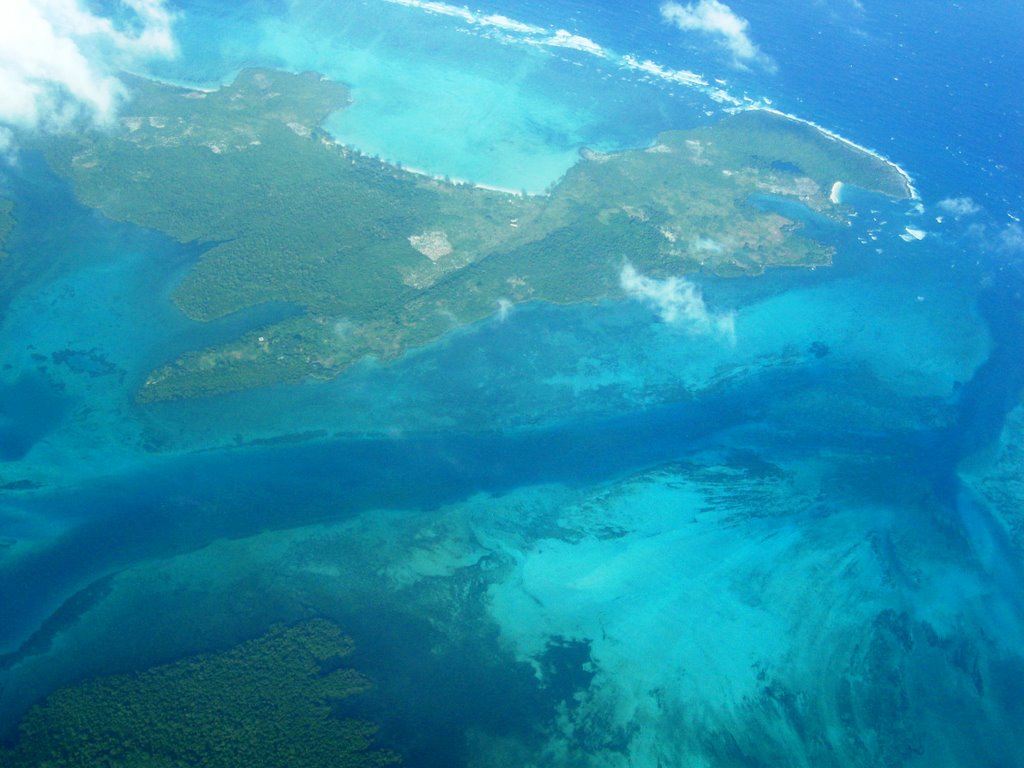
I spent the long weekend on the island of Pemba, off the coast of Tanzania in the Indian Ocean, north of Zanzibar, and as my archeologist buddy puts, on the bog end of no where. Pemba is a lush green island known for clove plantations, scuba diving and poverty. I was most interested in the second of the three, at least on this trip.

I flew out of Dar on the smallest commercial airliner I have ever been on. There were six of us on the plane. The pilot hopped into the plane, looked back at us, asked okay? Then starts down the runway, taxiing like a drag racer, trying to put on his seat belt while talking to the tower and jaggering with the guy behind him in Swahili. Total African cowboy. The flight itself was definitely noteworthy. You could look out the window to the blue-green water and coral reefs. And the flight was short so we only topped out at 3500 feet. And even that was uncomfortably far away from the ground. This guy wasn’t a particularly good pilot. I am pretty calm flyer, but there were moments when we were bouncing around the sky that I had my airplane mantra “People die during take-off and landing, planes do not fall from the sky” running through my head.

At the airport I got to again deal with my least favorite people on earth, taxi drivers. I was locked in a heated argument with a driver (over 80 cents and principle), when he made the cardinal mistake that any driver can make with me. What are you going to do? Walk? Listen buddy, it’s only 3.5 miles and I have two hours of daylight left. I told him to ask one of the other five passengers if they need a ride. And hitchhiked into town.

The place I stayed in was an old mission house turned dive shop. Pemba is 99.9999% crazy conservative Islam (little girls as young as four or five were veiled), so the mission was probably more profitable in its current incarnation. It was a very communal living type of place, with all of us sitting around a big table on the deck for evening meals. I stayed in the dorms with a 30 something Austrian guy who said he was European Commission diplomat. He about as much of a diplomat as James Bond was a special trade envoy, but live and let live.

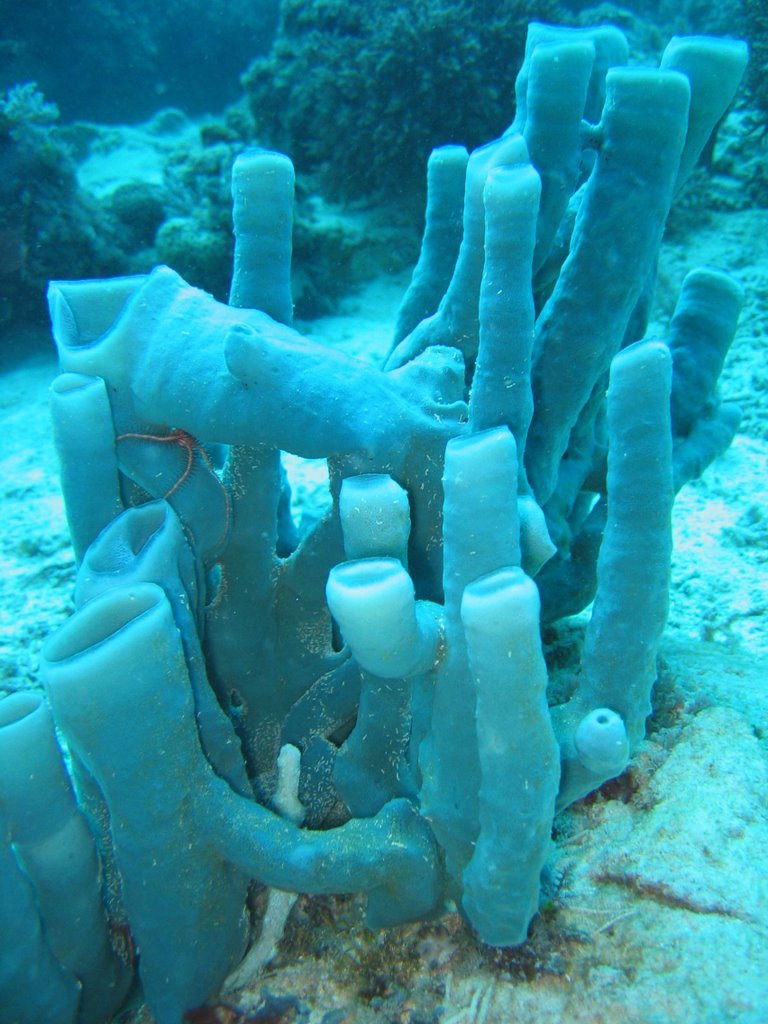
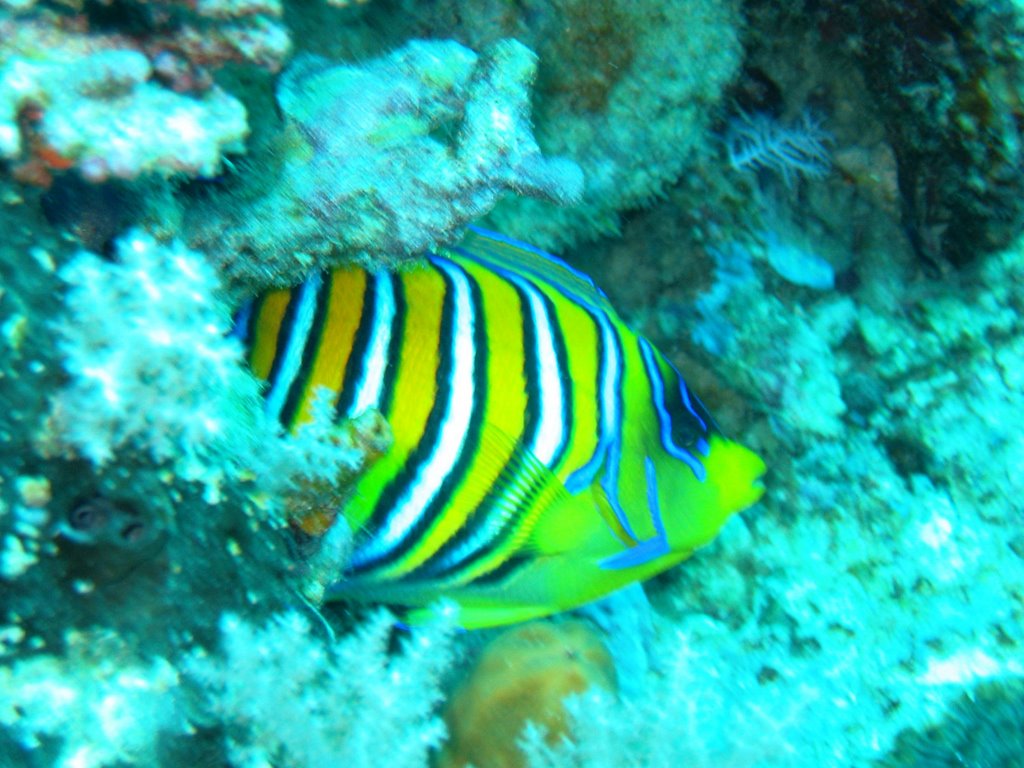
The next day it was out on the reef. It was a miserable morning with pouring rain, but it doesn’t matter much when you are underwater. The diving was beautiful. The water was crystal clear, there were no other divers and the reef was well-stocked with brightly colored fish. I tried out my underwater camera for the first time. Shooting fish underwater is like trying to take pictures of roving herds of puppies from the back of a motorcycle. You move, the current moves and the god damned fish will not just hold still and get their picture taken. My first day’s work was met by the divemaster with the comment, maybe you should stick to coral, sponges and fish whose defense mechanism isn’t flight. But the diving was fun anyway.

That night we all hung out on the deck and drank beer while the sunset over the banana plantations. The view was only marred by the cloud of mosquitoes that hung in the air. Occasionally a Pemba native “flying fox” would swoop through the air. (Flying foxes are bats that appear to answer the age-old question of what happens when a vampire gets it on with a werewolf.)

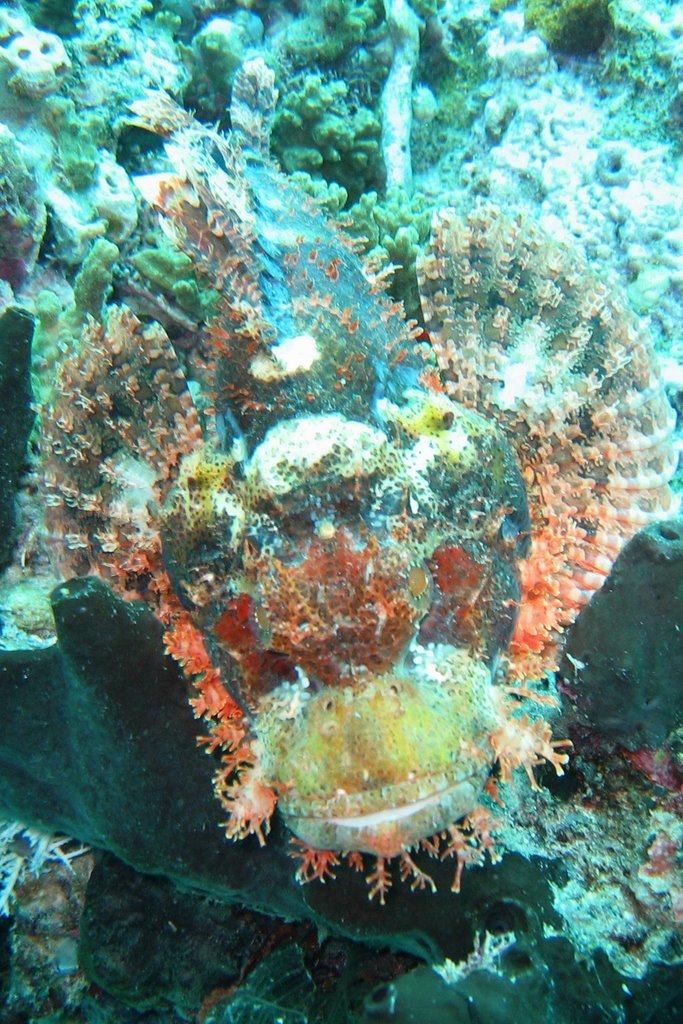
Next morning it was back out to the reef. The diving the second day was even better, there was less current and I stuck to shooting pictures of sponges. And a scorpion fish, who is so mercilessly poisonous that he didn’t seem to mind my camera six inches from him.

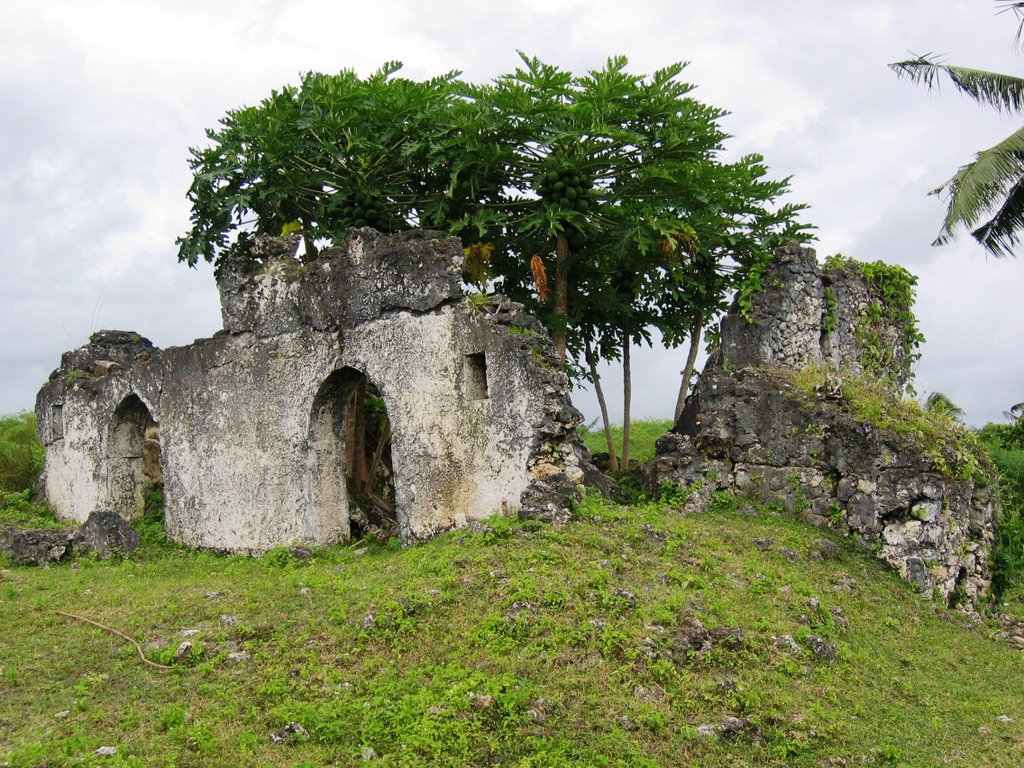
That night was more of the same with beer and balconies and flying foxes. Next day I couldn’t dive because I was flying out that afternoon, so I decided to go see Mark the archeologist at his dig site at the north of the island. I got on the daladala (public pickup truck) that ran north. I explained to the driver where I wanted to go by pointing to a picture of a ruined mosque that was in my guidebook. It came in handy as I was dumped off on the side of the road in a rice paddy. I eventually found some women washing clothes and two children were promptly dispatched to lead me through the rice paddy and mint fields to the dig site. Mark and the other archeologists apparently don’t get many visitors because I was very well-received. Mark and the other head archeologist gave me a tour of the site, showing the 14th century mosque they had under excavation, and the other mosques they had dug up in years past. Their special mission this year was to figure out how the common people lived. Rather unfortunately for the archeologists, the common people lived in mud houses. So they are digging centuries old mud out of current mud. Again, live and let live.

Mark also showed me the old fort and an excavation he was working on of a 9th century mosque. As we careened through the knee-high grass and fields (Mark never walks anywhere), he pointed out the hundreds of bits of broken pottery that littered the field. People were planting in a place where they had apparently been breaking pots for over a millennium. He lets me keep a couple of the nicer shards I picked up, which I am sure will lead to an amusing story in a couple weeks as I am arrested at the border for smuggling antiquities out of the country.

Then I got to spend a half hour digging. You take a little trowel and very carefully dig very slowly. Then another team shifts what you have just dug up. I found three pottery shards and a broken piece of ostrich egg. Which leads me to believe that perhaps Indiana Jones movies are a bit edited for the general audience.

Then it was back to town to shower, grab my bag and head to the airport. Flying back I discovered a new cost saving method that could be huge boost for the struggling domestic airline industry. Stay with me here. So you buy a plane that seats fifteen passengers. Which is good. But what would be better is to buy a plane for fifteen people and put sixteen people in it anyway. You really only need one pilot right? On the way back they wanted to seat me in the copilot’s seat, a common practice on overbooked planes. (“Madam, copilot, yes?) You just have to be careful not to hit the pedals on the floor. I was tempted, but I decided to let one of the kids sit there. He cared more than I did. I would probably feel less guilty if he took out a plane full of people because he was trying to take a picture out the window.

So I am back in Dar, finishing my last week here. Next week it is on to Kampala, Uganda…

Monday, July 03, 2006

Zanzibar

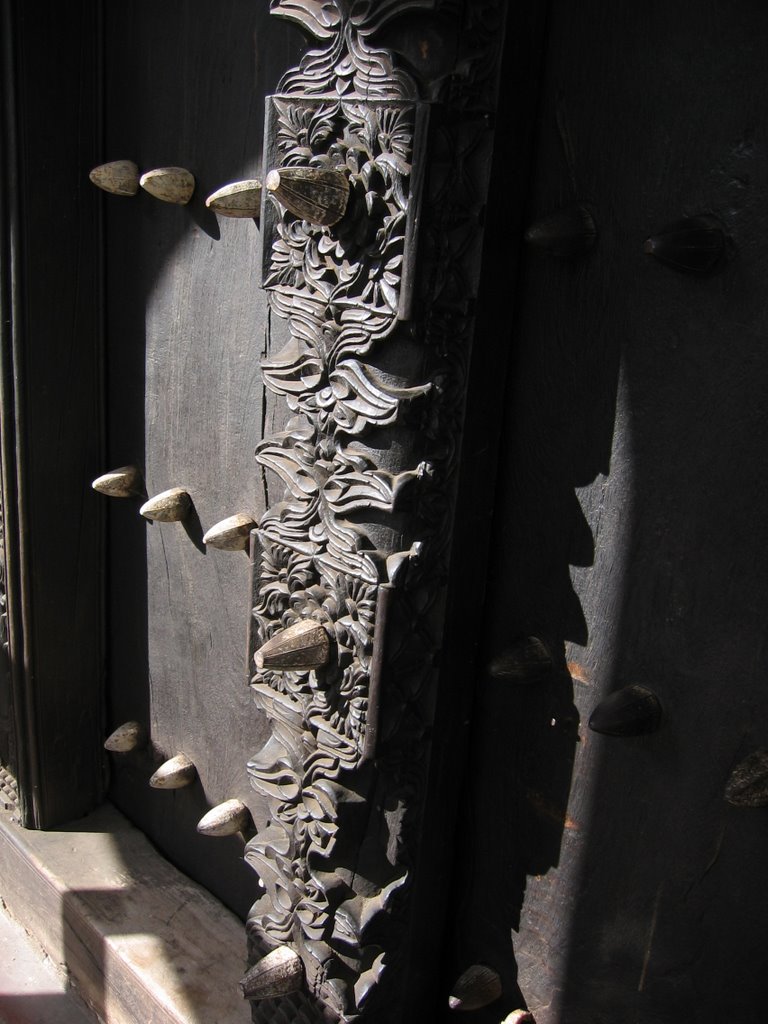
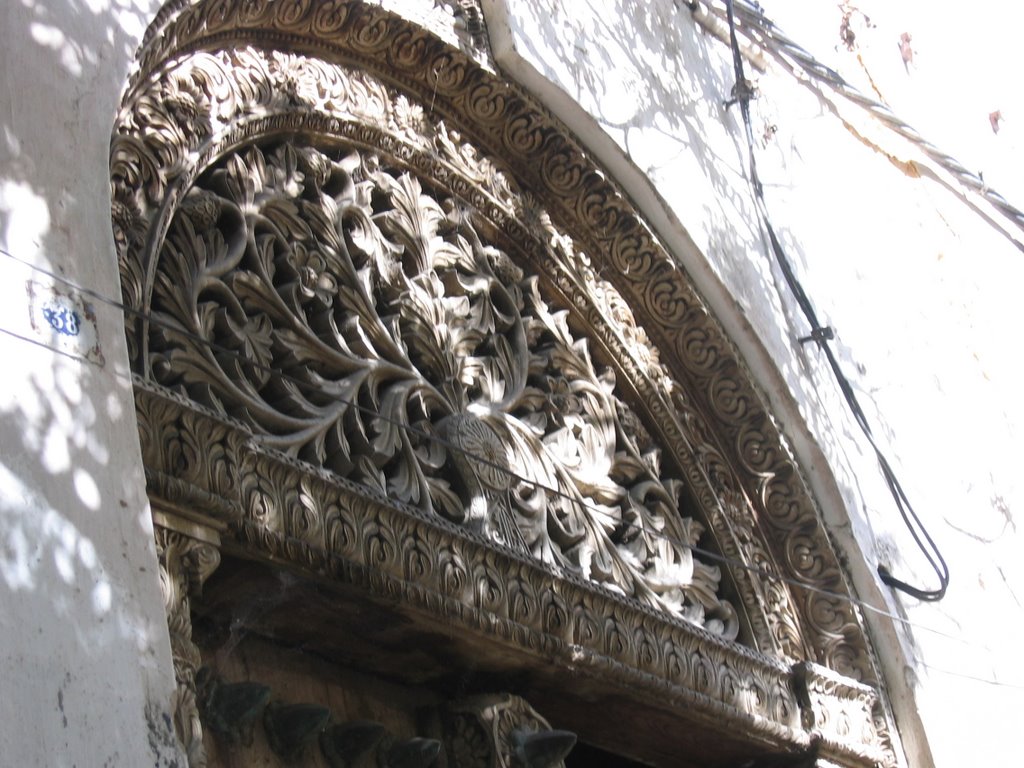
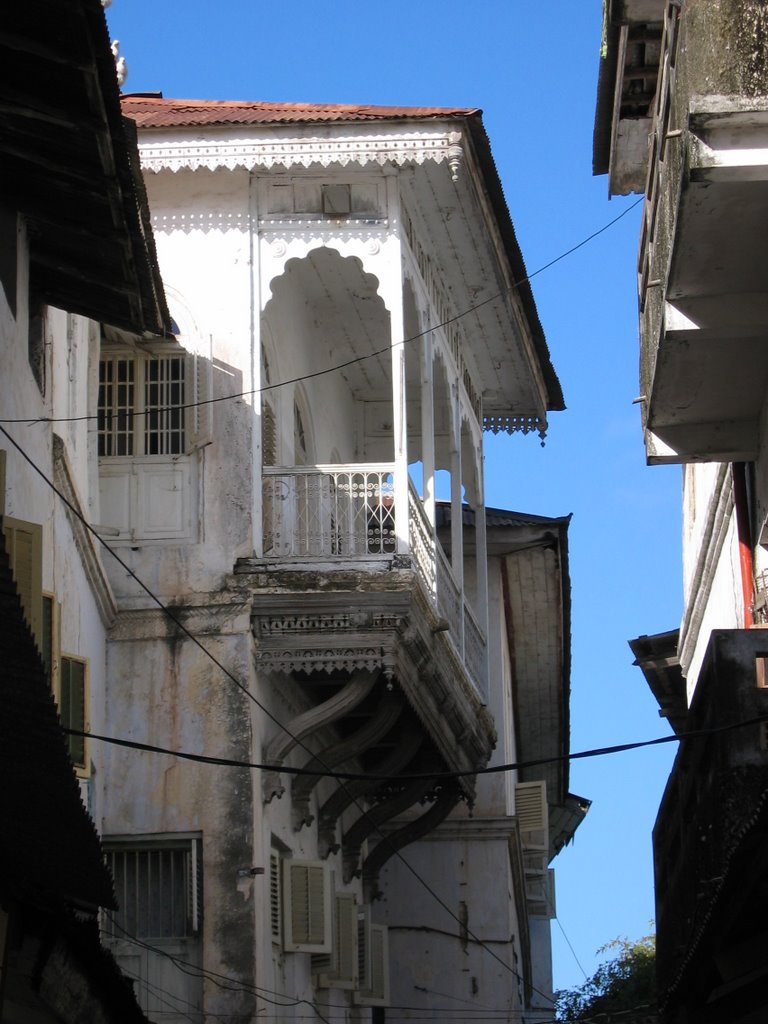
So in an effort to escape the boredom of a weekend in a city where you know no one, I caught the 4 pm ferry on Friday from Dar es Salaam to Zanzibar. Zanzibar is the main island of an archipelago that, along with the mainland of Tanganyika, make up the country of Tanzania. Zanzibar has a history of kind of funny unions. It was part of the sultanate of Oman for a couple centuries. And, yes, your working knowledge of geography is correct, those two are not even remotely close to each other. Then it got to be its own sultanate for a while before being a British protectorate. Then it started had a revolution and started making all sorts of Marxist rumblings at a time when Marxist rumblings got you a large dose of CIA intervention. Instead, we just bought off the right people and, instead of turning into an African Cuba in the Indian Ocean, it became part of this weird hybrid union, Tanzania. The Zanzibaris are still a little pissed off about this and make you gets your passport stamped coming onto the island. The culture itself is really interesting. It used to be an Arab ruling class, an Indian merchant class and then an African peasantry (which also serves as the main export – slaves). Then there was a revolution bit and heads rolled (literally) and things got a bit more mixed up. The city is still a hodgepodge of different neighborhoods and architecture. Most of the (crumbling) center of the city is called Stone Town, and is a maze of little alleyways, much like a Middle Eastern souk. And they have really intricately carved doors. In different styles. Mark told me.

The boat ride over was uneventful. We watched Craig David music videos and some weird movie in Swahili about a white tribal chieftain and a black American pro-golfer (you feel like someone in casting didn’t get the memo…) that had lots of safari animal humor. I arrived after dark in a really dark port. You had to walk through narrow lanes in the shipping containers to get to the exit, all filled with the most wretched of Africa’s creatures, taxi drivers. There was no way that I was running the gauntlet alone, so I waited for the biggest meanest African lady I could find, and followed her. If she only had an umbrella to beat them with…

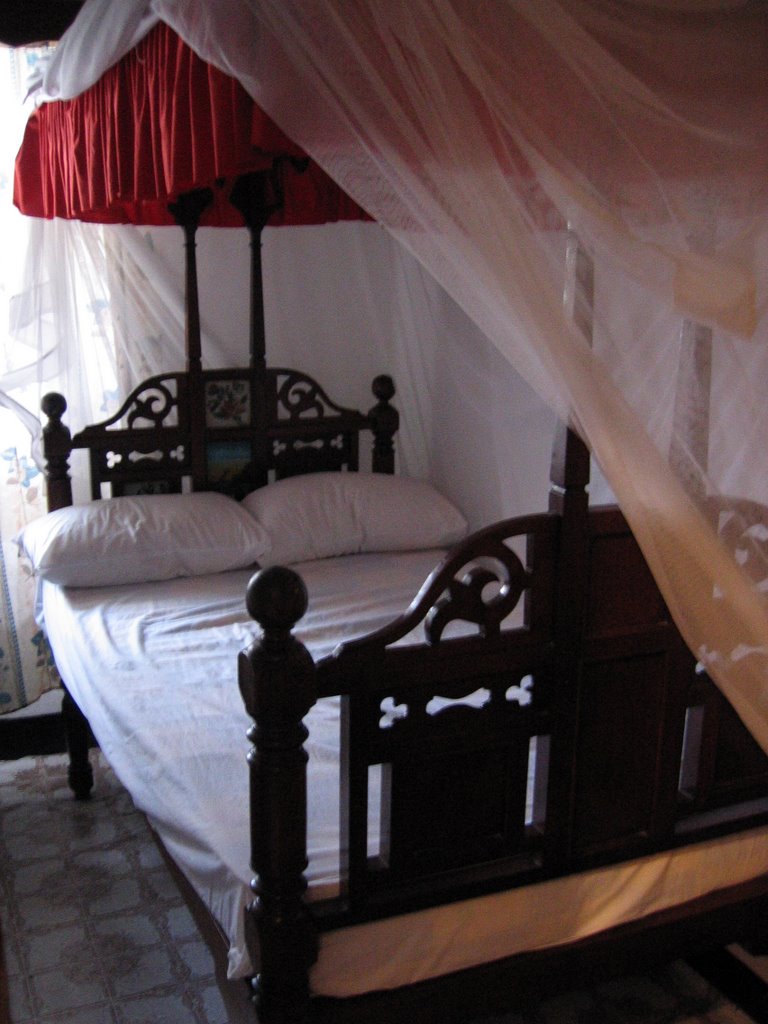
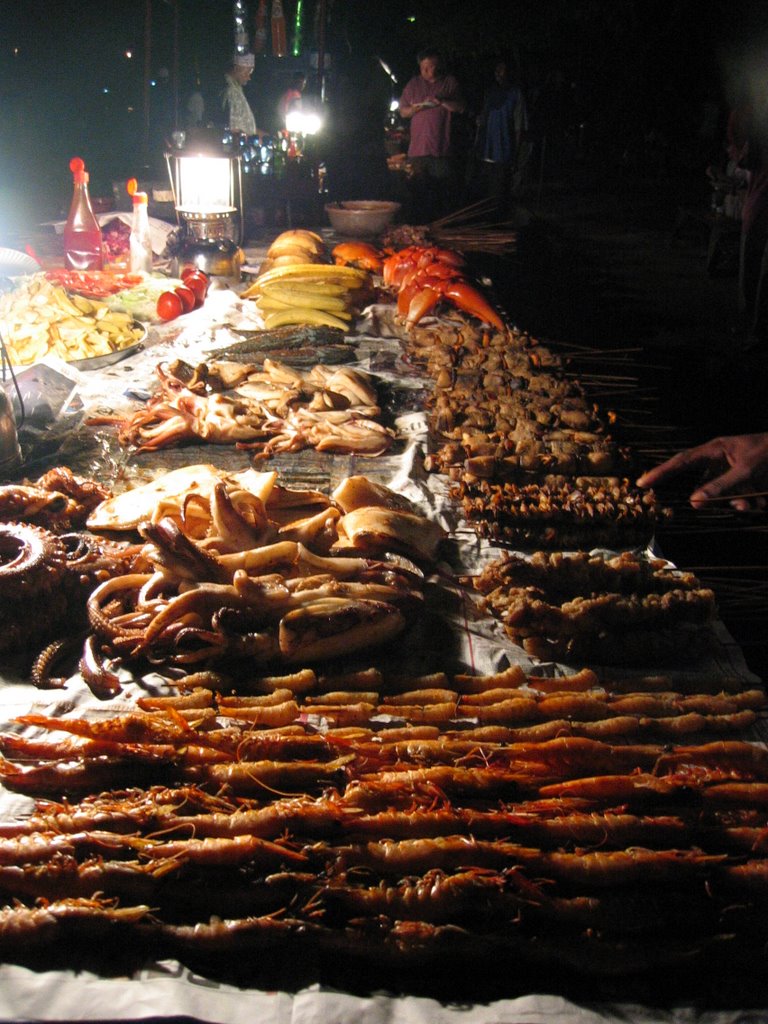
I found my way to the Pyramid Hotel, politely waited until the World Cup match went to commercial, and checked in. The hotel is a remodeled traditional house, and my room was on the top floor, so it involved a staircase that was more ladder than staircase. But the hotel water and ceiling fan worked most of the day, and I had a traditional Zanzibari bed, so I couldn’t complain. For dinner I walked down to the fish market to find a good selection of grilled aquatic creatures on sticks. The market is famous for tables covered in all sorts of seafood, you could get lobster and crab if you were confident that it was fresh enough… I settled for tuna and prawns. The problem was that it was well after dark and I had to negotiate the narrow alleys of the old city in the dark. The alleys are only about 5 feet wide and don’t go in any one direction for much for than a couple yards. You could get lost for months in the old town. I eventually made my way out and got something to eat, but I had no idea how I was going to get back. Then I spied Purple Shirt. Purple Shirt had been in the lobby of the guest house and I had followed him part of the way out. He was about my parents age (so OLD), had a bright purple shirt, pink shorts, black socks and brown shoes. (If you look very closely at the seafood picture, you can just see him in the background.) He also had this really distinctive walk, like a penguin with hemorrhoids, but fast. I went up to him and asked if I could follow him home. He looked at me skeptically, but agreed. Somewhere, some old actor said this is going to be the start of a beautiful friendship. So that is how I met Mark. Mark is an archeologist, and as I discovered over the course of the weekend, a minor British television celebrity. (People kept coming up and saying, excuse me, aren’t you…) He has the mannerisms of a cartoon British academic, but was unbelievably interesting. He had been “digging up the place” for about twenty years and consequentially knew every bit of history of the town. He had found a good chunk of the local museum. So I started asking him questions. He started telling me stories over a glass of sugar cane juice (Katie would love this stuff – they squeeze fresh sugar cane right in front of you into a glass, it is so sweet that you have to put lime juice in it to make it palatable.) Next thing I know, I am chasing after him all over town as I get a nocturnal tour. We are peering over fences, running around the alleys, and he just lets himself in to the historical sights like the fort, all while giving me a running history of the place in this very hushed whisper. The whole enterprise had an air of a junior high mystery story (like Big Sister and the Missing Hairbrush), but was incredibly entertaining at the same time.

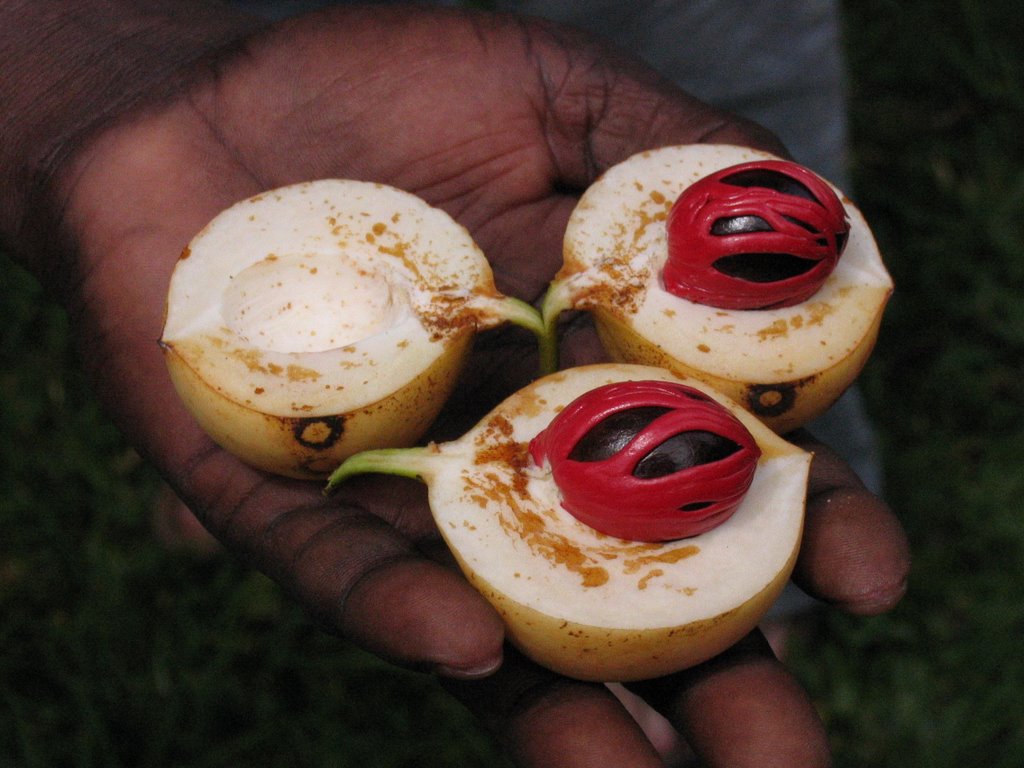
The next day, Mark wrote his paper for some keynote speech he is giving next week, and I went on a spice tour. Spice tours are the requisite tourist activity on Zanzibar, and involve going out into the countryside to see how vanilla, pepper, cloves, coffee, nutmeg, ginger, turmeric, etc. etc. etc. are grown. The nutmeg was the most interesting one. It is the alien looking thing in the picture. And I learned if you take enough of it it acts like an aphrodisiac (or “make ‘orny” as the guide put it). I think if you ingested the require amount of nutmeg for it to work you would likely get cancer or die of nutmeg poisoning or something – probably why it hasn’t yet overtaken Spanish Fly on the commercial market. Then it was fish and coconut milk over rice for lunch (I was on this tour with 25 other western tourists, some of which actually left the tour and took a taxi back to town rather than sit on a plastic mat and eat rice and sauce – stupid stupid people.) Then a weird 40 minute drive to look at a beach for 10 minutes, and then an hour back to town…

I got back and left word for Mark that I would be at the Africa House Bar. It was the refurbished version of the old English colonial club. It is much better now because anyone willing to pay the exorbitant prices to drink Tusker beer and watch the sunset is allowed in, unlike the olden days when you had to be in the social register in addition to paying exorbitant prices. Mark eventually came in and we sat around drinking and discussing Zanzibari history (we had gotten back the 9th century by this point…). Then dinner, ice cream, and more late night running though the city to look at churches, mosques, caravan houses, etc.

Next day I went sightseeing while Mark finished his paper. I saw all the things he had told me about, but it wasn’t near as interesting. I met him for lunch and he promptly took me to all the places that I had missed during the morning. Then a quick lunch (who knew that octopus went so well with spicy tomato sauce…) and some fast souvenir buying before heading to the boat. Mark was great at negotiating. He had been in Zanzibar longer than some of the merchants and was having absolutely none of this price gouging… I bought a really neat Zanzibar chest. Then back to the hotel, grab my backpack and dash to the ferry. I made the last boat home with 10 minutes to spare. And unfortunately, I now have to work all week until I can go and do something more interesting again.

Thursday, June 29, 2006

Nothing Special, Just Testing this Blog Thing

I have just been hanging around Dar. I wanted to go scuba diving this weekend, but I got bacteria dysentery. I wasn’t going to let that ruin my weekend though. Popped a couple pills and went off to one of the islands off the coast to lay on the beach for a few hours. Hit the local market (which has a frigging ATM, East Africa is different.) Went to the pool at the swanky hotel on the ocean. (I am not sure who designed this pool and the accompanying hotel, but I am pretty sure the name on the checks he was cashing started with “Sheikh” or “Prince Al-Something.” I have seen less ostentatious architecture in Ottoman harems.) All in all, nothing exciting.

I spend my days working on a World Bank report about how to move out of poverty in some distant province. One major problem I've come up against in the regions is "man-eating lions." They have a tendency to pick off household livestock and small children. Got any policy suggestions? Using my crack knowledge of development economics, coupled with Geoff Klock's encyclopedic knowledge of Warner Brothers cartoons, we came up with the following policy recommendations: (1) Stop filling children's pockets with raw meat. (2) Do not season children after dark. (3) Stop dressing them like gazelles. I am getting promoted for sure. Or fired.

I know this isn't all that interesting, but I am trying to figure out how to use this blog thing. If successful, I will try to post pictures (the reason for this unseemly transition from e-mail), and the back issues of my wanderings. Therefore Mom can stop worrying about getting copies of them for her bridge club, and instead focus on more important things, like taking care of everything that is traditionally done for a wedding by one (very absentee) maid-of-honor.

Wednesday, June 28, 2006

Kilimanjaro Pictures

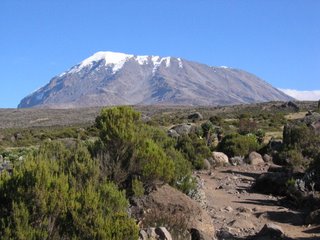
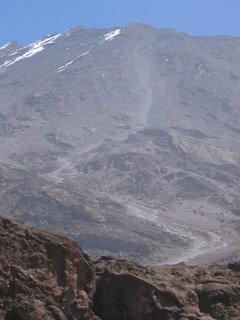
This is the view of Kilimanjaro from about day two of the hike. We are already well out of the thick undergrowth and above the cloud line. I hiked for a day and a half on a mountain that I had never seen because of the thick cloud cover. Uhuru Peak is behind the glaciers on top.


This is from the middle of the second day. We had just (well, maybe a while ago) crossed the cloud line.


This is the top bit of the peak climb to Gillman's Point. The 4 kilometer (2.5 mile) hike takes about six painful hours of weaving back and forth on the swithchbacks.


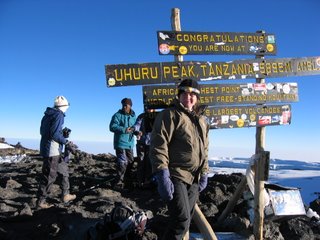
This is me looking like I just got finished with a death march, but standing at the highest point in Africa.

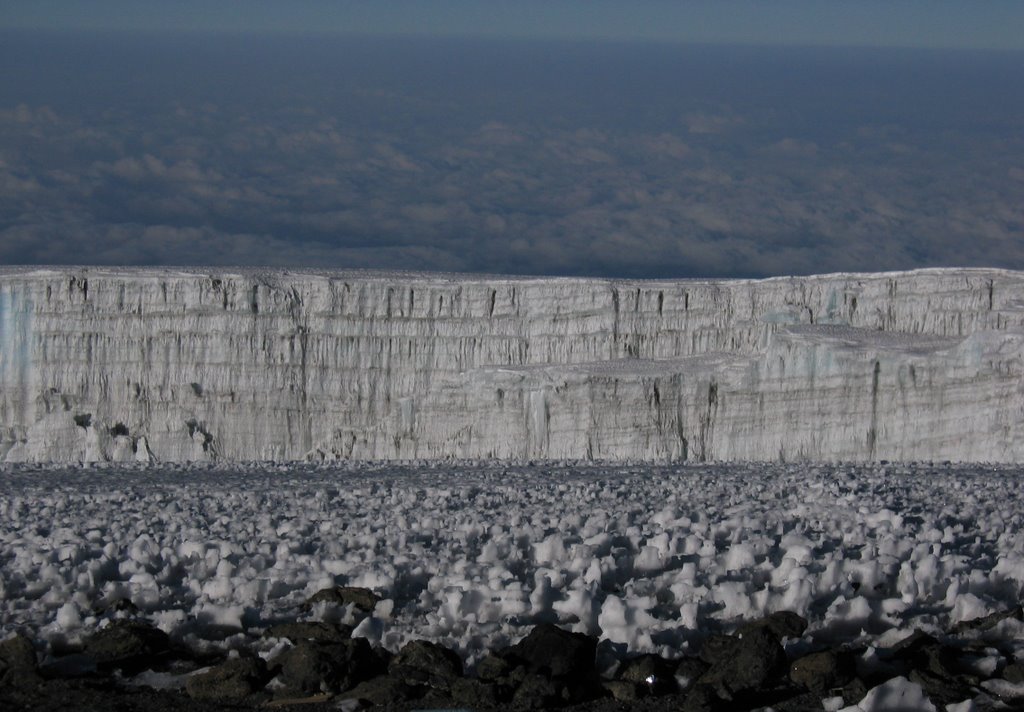
This is the top of the mountatin. Rocks, glaciers and clouds. And not much else.

These are the lodging on the hike. Nothing short of luxurious.


Wednesday, June 21, 2006

Kilimanjaro

So I am sitting my little office in Dar Es Salaam, Tanzania. I am supposed to be working on a document for the World Bank, but it is downloading rather slowly, so I will take this opportunity to run out a few words on the latest stupid thing that I have done.

I arrived last Sunday in Dar, took a cursory look at the city out the taxi window, slept the night at the YMCA, stashed my bags and headed out towards that crazy overgrown hill, Kilimanjaro. Standing at just shy of 20,000 ft , it is the tallest peak in Africa and the tallest free-standing peak in the world (it was apparently a particularly bad-ass volcano a few millenia ago.) And I was going to endeavor to climb it. Kristen Anne Markers-Mark-on-the-rocks-and-can-you-toss-another-of-those-cigarettes Himelein was going to climb a mountain. I figured that I was in pretty good shape from spending a measurable portion of last semester at the gym, and really, at 26, I am not getting any younger, so now is the time.

I arrived at the Nija Panda junction just short of Moshi after harrowing bus ride. The drivers here go way too fast and pedestrians walk on the road to avoid the knee deep mud of the rainy season on either side of the road. The bus following mine from the same bus company hit and killed a 15 year old girl while making the same trip. And buses here have that distinctive third world characteristic of passing on blind hills. Which makes for really gruesome traffic accidents, though I only saw 3 on the 9 hour journey. But I lived and, as this story's protagonist, that really is what is important here.

Upon arrival at the hotel, I learned that I would be climbing with another, some English guy. I met my fellow climber over dinner. Young, cherubic head of blond curls, and the thickest lambchop sideburns this side of the disco era. After about three days, I was able to decipher his accent enough to ascertain that his name was Michael and he was a builder from southwestern England.

The first day was easy enough. It was only a three hour walk (though we ascended quite a bit) though thick rain forest. The most exciting bit was when I stopped to drink some water a little too close to a red ant colony. They were less than amused and I spent the next 2 kilometers on the trail bouncing around like an epileptic cheerleader trying to kill them all. Bastards bite you know.

The first night was at the Mandara Hut (9,000 feet). The huts were built by some Norwegian NGO a couple years ago, so they are these little A frame deals made out of something only slightly more sturdy that posterboard. The beds were straw (only maybe not, but it sure felt that way) mattress on the board floor. It was the first of many nights that Michael and I would spend staring at each other across the 2 meters of board that was our little house. Dinner was excellent because we were on the first night, soup and vegetables and fried chicken.

The next day was a bit more of a slog. We were out of the rainforest and into the "alpine" terrain, which meant coniferous trees of diminishing size as we progressed. By lunchtime the clouds were far below and I was quite a bit taller than any of the remaining "trees." We spent the night at the Horombo Hut (12,500 feet). The air was thinner here and it was cold. I slept in flannel pants, tee shirt, heavy sweater, two pairs of socks, two sleeping bags and a knit cap. Midnight trips to the outhouse were an adventure. You wanted to run as fast as you could because it was freezing, but running more than three or four steps left you gasping for air. In the morning, when I went to brush my teeth in the community water spigot, it had frozen.

That days walk wasn't particularly difficult, but it was slow. You plodded along with one foot barely coming in front of the other, making sure that you didn't do anything to get winded because it could be a long time gasping before you were ready to go on again. The only "vegetation" around were lichens and a few confused wildflowers growing very very close to the ground. By the time we reached Kibo Hut (15,500 feet), the flowers were gone and there wasn't even much in the way of lichen. There weren't even ants up this high. The air was really thin. I spent most of the rest of the day sleeping and trying to force myself to eat (altitude kills your appetite).

At 11 pm, the guides woke us up. We layered on literally every article of clothing we had to start the summit push. You have to start that early to get across the glaciers on the crater rim before
the sun melts the upper layer of ice to water. You are pretty much guaranteed a gruesome fall to your death if you are up there when that happens. From 11 pm to 5:30 am, I climbed very very slowly up the switchbacks through the volcanic ash towards Gillman's Point (18,635 feet). The four mile climb takes over six hours. Gillman's Point is the top of the crater. To reach there you are considered to have reached the top of the mountain. You earn a green colored certificate and a pat on the back. I never thought I would make it. I was huffing and puffing the whole way through the ash. Glacial patches glowed in the moonlight to the sides of the trail. In my oxygen deprived mind, I thought they must be halogen lights being used to light up Gillman's Point. (Don't worry, I get crazier as the hours progress.) The last hour is way way above anything that could be growing, so there is nothing to break up the large boulders. You pull yourself up and over until, finally Gillman's Point. I curled up in a little ball and drank a cup of hot tea. I had made it.

Then the guide asks me if I am ready to go on to Uhuru Peak. Uhuru Peak is on the other side of the crater and the highest point on the mountain, and in African in general. It is the ultimate goal of most climbers. (You get a gold certificate for that one.) Although it is only 600 feet or some higher (and when you are around 20,000 this is trivial), but it is up and down over the crater rim, and across the glaciers, to get there, about another two hours. I haul myself up. It took me nearly the full two hours, but at 7:20 am, I made Uhuru Peak. It was a glorious scene. I panted on my hands and knees for a few minutes, pulled myself up to take a picture (in which I look like I am about to be executed) and headed back. I was there no more than five minutes. Then back down.

And then I saw my salvation. There, not 100 meters in front of me, was a donkey. He was nibbling at the grass. Oh happy day! The DONKEY will take me back down. This is perfect. Wait. We are 100 meters about the lichen line. There is no grass here. What could the donkey be eating? Oh. I am seeing things that aren't really there. (It is really common to hallucinate that high up.) The donkey turned back into a rock and I trudged on.

The trip down, once you get to Gillman's Point, was quite a bit faster. You "ski" down the volcanic ash, using your climbing stick as a brake as you go. Unfortunately you end up inhaling a bunch of ash, which your already strapped respiratory system doesn't appreciate. I made it back to Kibo Hut and collapsed. I had an hour before I had to eat dinner and then walk back down to Horomo Hut where we would spend the night. I was hurting when I got back up, pulled on my pack, and started down. The night at Horomo was cold, but I slept like a rock through most of it so I didn't notice until the morning.

The next day it was up at 6 am and back down the rest of the way to the gate. I was never so happy in all my life to see a motorized vehicle than when I walked into that parking lot. I signed the log attesting that I had reached the peak, bought a phone card to tell me mother, and went back to the hotel. After my first shower in nearly a week, and a few icy cold Tuskers at the bar, I was feeling pretty damned good about me and my gold certificate. I had walked 60 miles and ascended (and descended) 15,000 feet in the last five days.

The next day it was back on the bus and back to Dar. Currently I am living in a cold water YMCA, looking for housing that I can afford in this god forsaken city. I have looked at a number of things that I either cannot afford, or are brothels. Other than that, and the fact that the city is basically under water from massive late season rains (can you say cholera anyone?), I am having a good time. Work is fine and I am trying to pick up a bit of Swahili.

Wednesday, January 25, 2006

Blame Ollie North

So it has been a while. Sorry to not really finish this summer's African adventure. There was a coup in Mauritania and my schedule got all screwy and I ended up taking all sorts of weird Eastern European carriers, but I did eventually get home. And went to Graduate School. And then on vacation to Central America.

I have always avoided Latin America because I can't speak Spanish. But I got a really sweet cheap flight from New York to Honduras, practically free, so I figured I had to learn at some point... I landed in Tegucigalpa, Honduras and figured out just how little Spanish I spoke. I was able to mime my way through directions and ordering dinner (if you moo repeatedly at the counter staff of the local tacoeria, you eventually get a beef taco. I thought that was more dignified than the Chicken Dance...) Next morning I headed out for the coast. Bay Islands, beautiful weather, great diving...

Sort of. The weather was disastrously bad. (I spent the whole ride over on the ferry flipping my stomach inside out.) There were mosquitoes by the billions, and the diving was sub-par. There was one decent wreck but the island caters too intro divers so they have killed most of the coral... I didn't stay too long...

Back on the mainland I decided to have a day of "Adventure EcoTourism." I always hate this after I do it because I spend too much money and never really get that much of a rush, but I continue to do it anyway... I was picked up from the hostel in something that was one part truck, one part school bus, one part tractor and one part armored personnel carrier. The most likely possible explanation is that is WAS actually one part all those things and just soldered together by a creative mechanic. It got me up the steep "road" into the mountains though so I guess I shouldn't complain.

My first "extreme eco-sport" was canopying. This is were you hike around a mountain, occasionally zip lining across rivers, ravines, etc, hoping not to hit the surrounding trees. I wasn't very good at this sport and would continuously start spinning dangerously like a top when I was over water. I managed not to fall, break any bones or piss off any of the fire ant communities along the way, so I suppose it was worth the thirty bucks.

Then I went rafting. This was not the most organized eco-lodge in the jungle, so they misplaced the group I was supposed to go rafting with. Instead, because they couldn't lose my fee by not taking me out, they sent me out with two "guides-in-training," which is Spanish for, "Kids who don't speak English." Apparently though they too dream of hoping in the adventure tourism moneytrain, so they needed to learn. We set off in our little boat through the class IV and V rapids. What could go wrong right? Well, the "guides-in-training" haven't gotten to "left" and "right" in their English classes yet, so when the actually Guide yelled commands, they usually go it wrong, sending up dangerously spinning in the wrong direction. This led people to get thrown out of the boat. Which is really funny when it is one of the "guides-in-training." Less funny when it is you. Completely ruined my pedicure getting dragged across the boulders in a class V. I headed out the next day.

I needed to catch the bus to Nicaragua from the un-picturesque and slightly dangerous regional capital of San Pedro Sula. Of course I am staying at a $5 a night flop house in the middle of town, which doesn't improve the situation. I spent most of the afternoon walking around the market, haggling of stuff I really didn't need, then read my book until it was time to go to dinner. I went out onto the street to see every commercial establishment was guarded by people in uniform with pump action shotguns, or without uniform and sawed-off shotguns. There was a little man that sold handmade saddles and rope from a glorified cardboard box of a stand. He had a, I kid you not, Wyatt Earp era six shooter, with extra ammo in his belt. I ate a plate of chicken and beans across the street, returned to the hotel, shoved a chair under the door, and went to sleep.

See how careful I was? See what common sense I had? Fat lot of good it did me the next day in Managua, Nicaragua.

I am not green. I have been doing this a long time. I trust my instincts and keep my guard up. I check into a hotel in Managua that was a little off, but Matt was flying in from Paris to meet me there so I was stuck with it. I needed to go to the ATM to get some Nicaraguan currency and I wanted to make sure I could do that, hit the internet cafe and grab a bite before it got dark. It is not safe to walk around at night alone. I didn't trust the desk, so I took everything worth stealing and put it in my purse. Then set off on a crowded street, in the middle of the afternoon, to the ATM.

Two guys saw me coming (or, more likely, were tipped off by that SOB at the hotel). They ran up and tried to grab my bag. No way bastards. What I lack in size I make up for in sheer stubbornness. They could break my damned collarbone before they got that bag off my shoulder.

I guess they figured this out, or maybe got nervous because they were trying this on a crowded street in the middle of the day. Or they were just high. In any case the bigger of the two takes out a big shiny handgun and puts it against my throat.

I gave them the bag.

Man was I mad. It never occurred to me to be scared. But I was furious afterwards. I lost everything. Wallet. Passport. Credit cards. Camera. MP3. Watch. Everything.

A butterfly flaps its wings in Toyko, and it rains in Boston. Oliver North and Ronald Reagan send boatloads of arms to Contras, I get mugged in Nicaragua. See what happens when you vote Republican?

Matt arrived a few hours later and bailed me out. I got a new passport the next day and Prince Charming had me sleeping on 300 count sheets in a beautiful restored hotel in the colonial city of Granada by the next evening.

The next day we set out for the island of Omtepe. Omtepe is an island in the middle of Lake Nicaragua formed by two volcanoes, and, as far as I know, the only black sand, fresh water beaches in the world. We took a rickety old fishing boat out. We could have waited for the nice car ferry, but this thing looked sturdy enough, especially if you sat on the upper deck where the life jackets were. We checked into the Hotel Aly (a backpacker dive, but the price was right) and set off to explore the town and surrounding area.

The next day we wanted to climb a volcano. Conception is the taller of the two, and our first choice. Unfortunately it has been spewing noxious fumes for months (the island has been evacuated four times in the past year because they think she is going to blow...), so we couldn't climb it. That left Madras, the smaller, wetter and quieter of the two.

As we were driving out that morning, the guide was talking a blue streak, mostly about guide crap that no one cares about. Then he says, "Well we are not really supposed to tell tourists this..." (we thought it was going to be another stupid story) "... but the ferry sank yesterday..."

Holy Crap. Good thing we took the fishing boat! Apparently they overloaded it with plantains and down it went. Oops.

Matt ended up not going on the hike because he didn't feel well. (We were both drinking the tap water, but as I have been doing that all over the world for years and likely actually have a negative ph in my stomach, I didn't get sick.) So I slogged up the volcano in the rain (they said "cloud forest", they didn't mention the accompanying downpour) and ankle deep mud with a Hungarian woman and her German husband who looked like a cross between Ice Man in Top Gun and the breeding stud down at the local dairy farm.

Needless to say, they were in better shape that I was... They were also better equipped that I was. (Did you know that volcanic mud and the soles of Converse All-Stars form a perfectly frictionless surface? One for the physicists....) And man was it wet. The mud was the only thing not growing moss. There was moss that grew specially on other moss. It was truly impressive. There might have even be moss on the white face and howler monkeys, but we didn't get close enough to check.

We headed out the next day, back to Granada. It took FOREVER to get off the island. Apparently someone discovered a book of "safety precautions" for the boats.

Once in Granada, we set off to see the Volcan Massaya. It was supposedly easier than Madras, mostly because you took a bus to the entrance, paid your fee, hitchhiked your way up to the crater, walked around a bit looking at the lava fields and taking in the noxious gases, then hitchhiked back down. We stopped in the "bat caves" while were were up there. They were old lava tunnels with blood bats in them, which the guide assured us were unlikely to bit humans but not to poke them nonetheless... We took the tour with a guy about our age, Nicaraguan-American, and his little blond girlfriend from New York. He had a car and took us around a little bit after the hike. We went to the top of another volcano (noticing a trend here?) and watched the sunset while eating traditional Nicaraguan snacks (fruit, cheese and meat, in various concoctions, deepfried...) (He was very sympathetic about my robbery. Lots of guns in Nicaragua. He carries a Glock himself...)

Next day Matt headed back to Paris and I headed down to San Juan del Sur on the Costa Rican border. It was a surfer hangout. I don't really dig the surf but I like the beach. The best beaches were a couple km outside of town, so you had to get a pick-up from the hostel to take you out there. The kid that drove us out was Canadian and man was he dumb. Or fried. Or both. We spent the day in the sun. On the way back, the other group was running late. I told the kid I would be on the beach and come get me when before they left. He forgot. Short-term I suppose... It took me FOREVER to hitchhike back to town... I went to the hostel to tell them about getting left. They responded, "again?" and gave me my money back.

That night after I was all showered and aloe vera'ed, I was sitting around shooting the shit with the other backpackers. They were talking about the Hotel Aly on Ometepe. Yeah I stayed there too. No, what happened to you? You too? Massive tarantula problems? Size of dinner plates? I promptly excused myself and shook every article of clothing out of my bag.

Next day I spent on the beach and using the Lonely Planet as my primary source to write an overdue research proposal for a spring trip to Cuba. I am going to study tourism, not surprisingly...

Next day it was back north to Esteli. Lonely Planet says it was a picturesque little town damaged heavily in the war. I didn't find it picturesque. And maybe it was war-damaged as compared to, oh, I don't know, Toledo, but it has nothing on Dubrovnik or Brazzaville. Lonely Planet Central America is about as up-to-date and useful as Christopher Columbus' journals.

Next morning I began the long and arduous journey back to Tegucigalpa to go home. This was comprised of 6 local bus trips. I made the journey with a Swedish kid named Marcus. He didn't know too much English and our two days together was straight out of a Beckett play, but the company was nice.

Then I headed for home. I had bought a couple pieces of ceramics and I packed them up in a cardboard box that I stole from a grocery store, and headed out.

Now I don't check luggage when I fly because I never have anything big enough that requires it. So I had my Box and my backpack and a 9 hour layover in El Salvador. Like hell I was staying in the airport.

I went to the Immigration officials, that assured me that all I needed was a pass and I could leave without having to pay the $32 tourist tax to re-enter the airport. I should get that pass from my airline. When I asked for said pass I was told the following things by a sequence of people leading up the food chain (I had nine hours, I could ask to speak to supervisors all afternoon...) (1) Passes are only for people who missed connections. (2) Passes are only for people with layovers shorter than 10 hours - when I pointed out that in fact my layover was shorter than ten hours, I was told that the hours were not regular hours, but aeronautical hours, which were different and my layover was longer than ten hours. (3) Passes do not exist. Come and go as you please.

So Box and I left. The taxis wanted almost $30 to take me to the local beach resorts. Forget that. I knew the word for beach in Spanish, so Box and I walked down an exit ramp to the intersection where the public buses were. We jumped on a bus to a little town called San Luis where we waited at a roadside stand for the pickup truck to take us to "la playa." I loaded Box onto the front with the eggs and sacks of corn, climbed in an off we went.

After about 15 km, we did indeed reach a beautiful coastline. The others on the pickup assured me that I wanted the hotel at the end of the road. So Box and I bumped along the dirt track through little Salvadorian villages until we reach this huge yellow compound. I let myself in. It was incredible. Beachfront bungalows, decks, pools, restaurants, marina, birds of paradise... and no people. I wandered around until I found a kid working construction who spoke slow enough for me to understand. The hotel is only for North American on package deals. It is only open from Wednesday to Sunday. Would I please come back then? Box and I asked to sit on the deck for a while. We sat long enough for me to finish my book before I got bored and we headed back. I had lunch at the little sandwich stand where I had waited for the pickup that morning, and headed back to the aeropeurto, back to New York.

Saturday, July 30, 2005

Picture from Elephant Safari in Gabon

I never got a chance to write this little adventure up. Maybe I will someday. Until then, there are at least some pictures. I just liked this fruit stand.

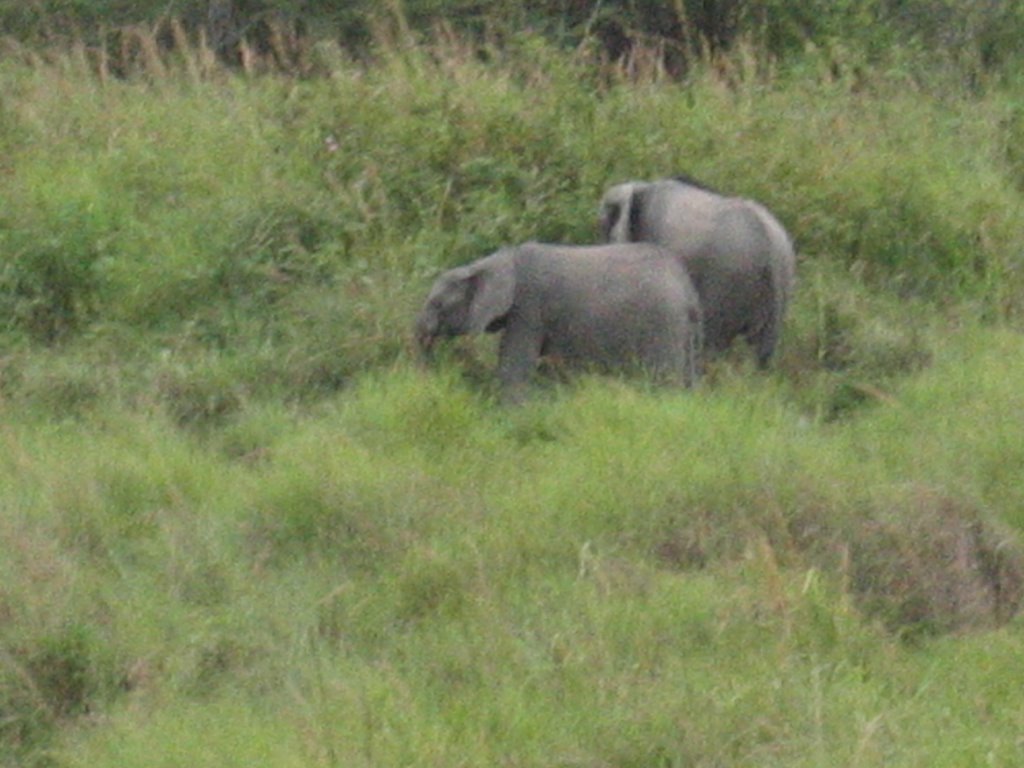
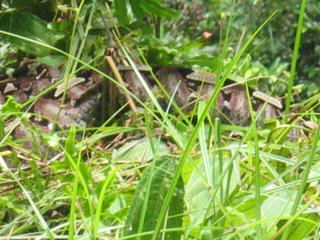
This is a forest elephant. It is fairly little for an elephant, about the size of a minivan, but the most deadly for humans. I think this is because they look cute. They are highly aggressive though. Which we found out when taking this picture. They are also loud.Very large snake in the grass.
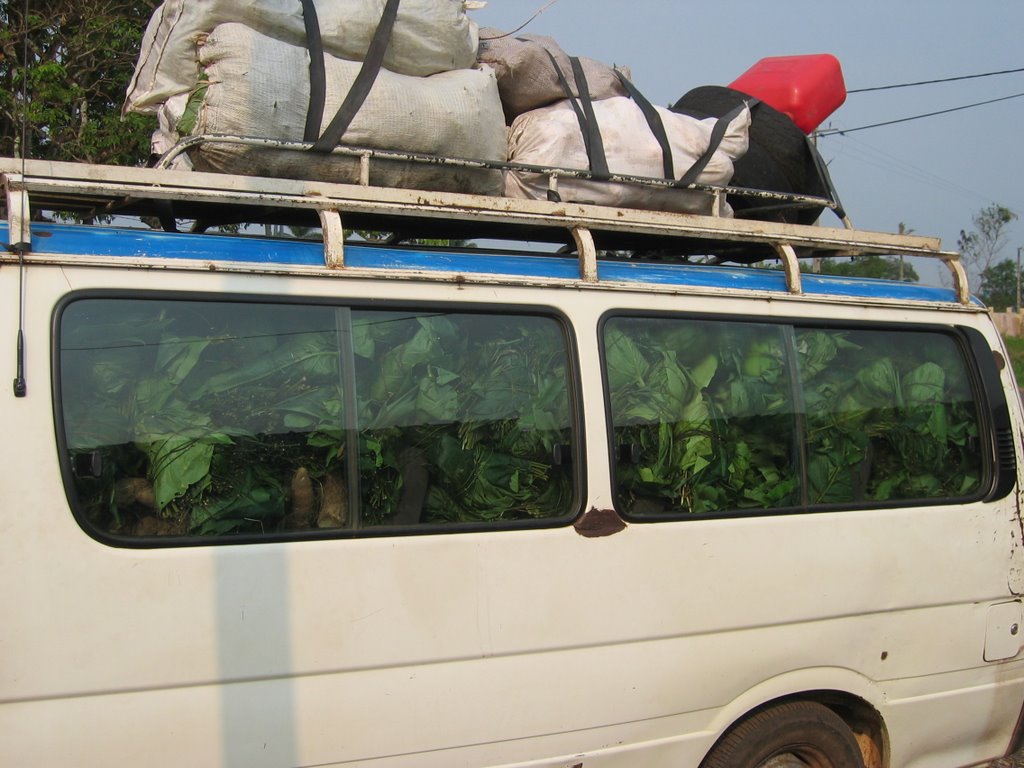
I actually road in this van with theh manioc after getting stranded on teh Gabon-Congo border for a couple days. It is a really long story...

Saturday, July 23, 2005

Very much not dead: a calm week in paradise

Just as the blender masters at Smoothie King are always able to get just the right amount of bananas, strawberries and yogurt to make an Angel Food the best tasting thing in the world on a hungover Sunday morning ride to Long Island, Sao Tome exists as an ideal blend of the Caribbean, Africa and Portugal to break up an at times arduous journey in Central Africa.


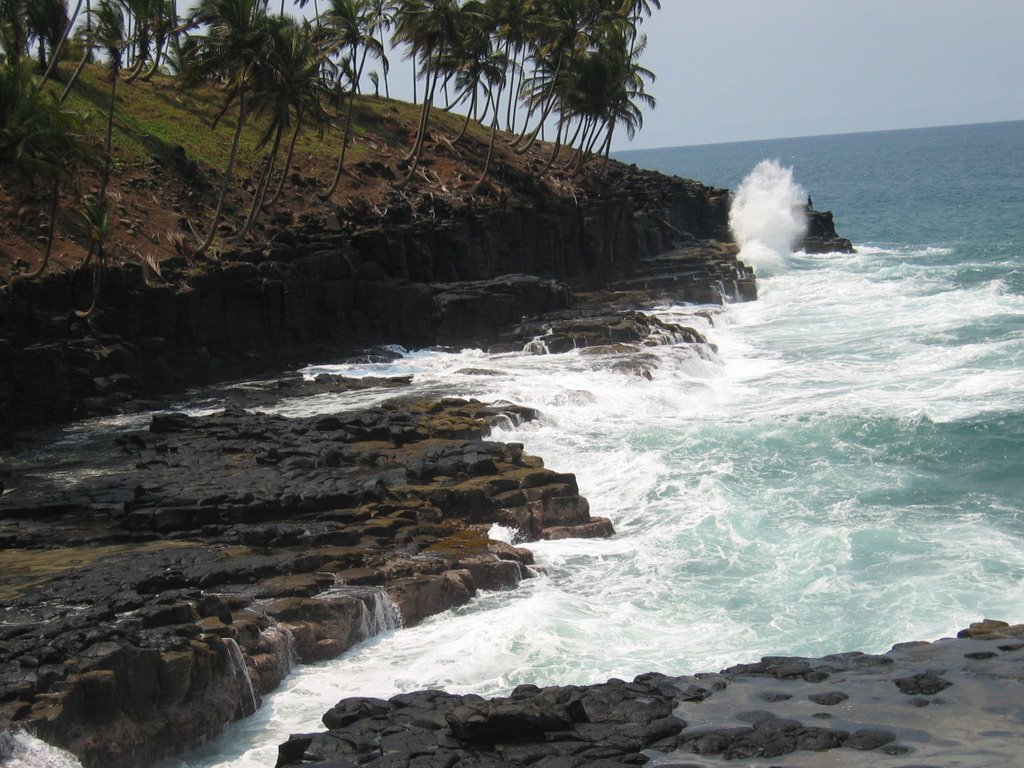
Sao Tome and Principe are a pair of small small islands off the West coast of Africa in the Atlantic. The second smallest country in Africa and only 30 years independent from Portugal, they couldn´t find the beaten path with a GPS. The people are completely guileless and incredibly helpful, and the scenery is beautiful. Even the Nigerians here are honest, one drove us in from the airport for free!

So we set up camp here in Sao Tome town. We rented a little house and a motorcycle (though we never did figure out the Portuguese word for "helmet"). The house came with a dog named Jimmy. Jimmy isn´t very smart and likes to bark. But other than that the house is great. It is an old colonial right on the beach. 15 foot high ceilings, two bedrooms, living room, dining room, kitchen, porch, bathroom bigger than most of my college dorm rooms, if only it were in Boston... We have spend the days scuba diving (hanging out with sea turtles and sharks and whatnot) and running around the island on the bike. The coastal roads are incredible, jungle rising on one side, black sands beaches with crashing waves on the other, twists and turns the whole way. Little villages to stop and eat bivalve brochettes (and bananas). Climbing up the mountain to the old overgrown plantations. (Historical background: The Portuguese found these volcanic islands uninhabited and completely covered in jungle in 1480-something. They landed, looked around, said looks good, go get the slaves, and started clearing the land for plantations. They cleared about 25% of it and started growing coffee, cocoa, vanilla, sugar cane, etc. When the Sao Tomeans got there independence - in 1975 - they looked around, said looks good, high fived Karl Marx, and nationalized everything. At which time the Portuguese left and the jungle came back. Things have since swung back the capitalist direction, greatly helped by the discovery of oil.)

The scuba diving has been great. It isn´t the best in the world, but there are NO other divers. In addition to the usual assortment of little colorful things, there are big sand sharks (6 feet or so long) and sea turtles.

Other than that not too much is new. We hang out with the small expat community here (they are SO excited to have someone new to talk to here) and go to their parties. We went to the American party. Boring. I forgot how dull these things can be in countries where proselytizing isn´t punishable with something primeval. The ambassador gave some long and boring speech because the crew of the USS Bear - some Coast Guard boat we sent over here - was in town to help "preserve the Sao Tomean and Principean national integrity" - layman´s translation - keep the Nigerians´ fucking hands off the oil that rightly belongs to Chevron.

That's pretty much it. I am headed back to the mainland tomorrow to look for gorillas. I will be home in less than two weeks.

Friday, July 15, 2005

Almost Dead: Malaria and Shots Fired

Your heroine had a long couple days since the last message, but all is well now. I am in Libreville, Gabon, a majorly developed city on part with Dakar, with a belly full of speghetti carbonara, a working keyboard and soon plane tickets to a remote island nation with excellent scuba diving. Things are looking up.

We decided to head overland out of Pointe Noire up through Congo to Gabon. The first leg of the journey was a 5 hour train ride from Pointe Noire to Doulisi. The train was supposed to leave at 9 am, but as it was the maiden voyage of a new route, they didn't want it to be late and changed the departure time to noon. This decision was announced at 10:30. The train left at 1. The trip itself was comfortable enough. The train wasn't crowded and the surrounding countryside was incredible. There was a little excitement about an hour into the trip though, with a quick blast of automatic weapon fire rattling through. Matt and I ducked a little until the shooting stopped, then I went back to quietly shivering in the corner from the mild case of malaria I had picked up in Brazzaville. What happened is that the train was full of Klashnikov-armed gendarmes that were supposed to fight off any invading Ninjas or Cobras that might happen to drop by. Basically they just waved their guns around a lot and acted like big men. Anyway, there was some poor bastard kid, maybe 19 or so, that didn't have enough money for the trip, so he tried to give the guards all he had as a bribe to ride to Brazzaville. He was unsuccessful. The guard yelled at him for a while, and when he didn't seem to be getting the message they shot off a couple rounds to make their point. Happily they were shooting off the train not at it as we originally feared. An old guy on the train took up a collection among the passengers to pay the rest of the kid's ticket / bribe and that seemed to solve things. And we went on our merry way.

We spent the night in a Protestant mission in the dying town of Doulisi. It must have been important at one point in the colonial era, with more French-built buildings than a number of Africa capitals I have been in, but that time is long past and the city is quietly and sadly crumbling. Goats and chickens inhabit the ruins of the former Hotel Intercontinental, circa 1950. In the morning we went to the garage to find a ride north. We were about 250 km (150 miles) from the border and hoped to be there that afternoon. The only vehicle heading that way was a massive camion loaded to the gills with cases of beer, sacks of flour and hundreds of people. Okay, hundreds is an exaggeration, but more than 100. Matt and I watched the mad scramble to get into the back, with people kicking and puching to get the best spots on top of the beer crates and long the side wooden benches, and that included a 70 something year old man using his cane to fight people off as he climbed the side of the truck and tried to squeeze between the wooden slats. It was the most disgusting expression of human nature I have come across in all my years on the road. Matt and I paid and extra couple dollars and sat up front with the driver and a nasty little woman who kept telling us how miserable she was and how a truck had crashed on the same route last week killing 5 people.

The ride took 19 hours. The overloaded truck crawled along the road, having to offload all its passangers every couple hundred meters to get across a rough patch in the road and then load everyone back on. People would get bored and climb down off the top to stand on the running board and talk to Matt and I. Just disembodied heads trying to speak English. Then there were the police check points where drunken officials got endly pleasure out of hassling the two whities and trying to get us to pay bribes. (My favorite dealing with these idiots was the guy that demanded "proof of tourism." We offered to show him vacation photos.) Eventually they car got tired of dealing with this and would send someone in with us to brow beat the official into hurrying up. One official tried to get cute at 3 am and demand to offload the entire truck full of luggage to get to our bags and search them because we would buy him another drink. When he told this to the ensemble at the car, they ran him off in three languages.

Eventually we got to the border, and despite the fact that we wouldn't give the guy any whiskey (it was 6 am for god's sake), we crossed into Gabon. The next 12 hours were spent on three different taxi brousses making our way north and fighting with border guards. Things got a bit easier though as most people assumed we were Peace Corps volunteers. We got to Lambréné just after sunset. Matt heard the word "Sofitel" and we were on our way to hot showers and grilled gazelle for dinner.

Lambréné was a nice little tropical island town. It was where Albert Switzer had his hospital. We spent in after the previous sleepless night and spent a quiet day sightseeing. This morning we headed up to Libreville. The only thing of note was that as soon as we crossed the Equator, from winter to summer, it immediately switched from dry season to wet season, and started raining. Bizarre.

So, depite the shooting, and the malaria, which despite being mild is something I would not recommend to anyone any time soon, we are having a good time. Gabon is filled with Gabonese and Chinese people. The Gabonese living in the forest and the Chinese cutting it down. We are heading out on Sunday to Sao Tome for a week, a nice little tropical island off the African coast, so that should be less stressful.

Sunday, July 10, 2005

Still in Congo, Still not Dead

I am now in the oil boom town of Pointe Noire on the Atlantic Coast of the country. Matt and I flew down from Brazzaville on Friday. That was a trial. We wanted to take the train. It is a 24 hour ride through what is supposed to be some of the most beautiful scenery in the country, but due to "rebel activity" whiteys aren't allowed to ride right now. You see there are two rival heavily armed militias that control the Pool region which surrounds Brazzaville and they support themselves by ripping off trains. Straight out of the Wild West huh? It gets better though. The names of the two groups are the Ninjas and the Cobras. So basically it is like an old episode of GI Joe without the good guys. There are soldiers, but if they don't get paid on time, they rip off trains too. Resulting in gun battles as to who gets to rip off the train. So we decided to fly. The airport if the 7th circle of hell. It took 3 hours of wringling and writhing through the unwashed masses to register for a 40 person flight. The plane was of course something old and Russian. We were a little worried about the condition after the mess that flew us from Freetown to Conakry, but the other option, as I mentioned, involved battling Ninjas. But as soon as we got on, everything was copasetic. The interior of the plane was completely covered in faux suede black and white cow print. The magazine holders were leoperd print and the curtains and head rests fire enginge red. It looked like the set of a hip kitchen show. How can you worry about crashing down in a ball of flames in the Congolese jungle when there are faux suede cow seats to pet? After our arrival we have pretty much hung around with the sister of a firend ouf ours from Nouakchott, exploring the town and surrounding countryside. Tomorrow we are heading out to the bush, so hopefully we will have more interesting stories about gorillas next time.

Wednesday, July 06, 2005

In Congo, Not Dead

For all those who where convinced that I would be killed upon arrival in Congo, you fears, once again, are unfounded. Matt and I left Nouakchott on Monday night, flew to Bamako, where we had a six hour layover, from 1 am to 7 am, hanging out in the airport parking lot, smoking cigarettes, eating cookies. Then we flew down to Brazzaville. The trip was one of the better ones on African airlines, Matt knows people so we got bumped up to 1st on both legs, and he got to ride in the cockpit during takeoff. The father in law of one of our friends in Nouakchott met us at the airport and took us to a hotel. All is well.

Wednesday, June 08, 2005

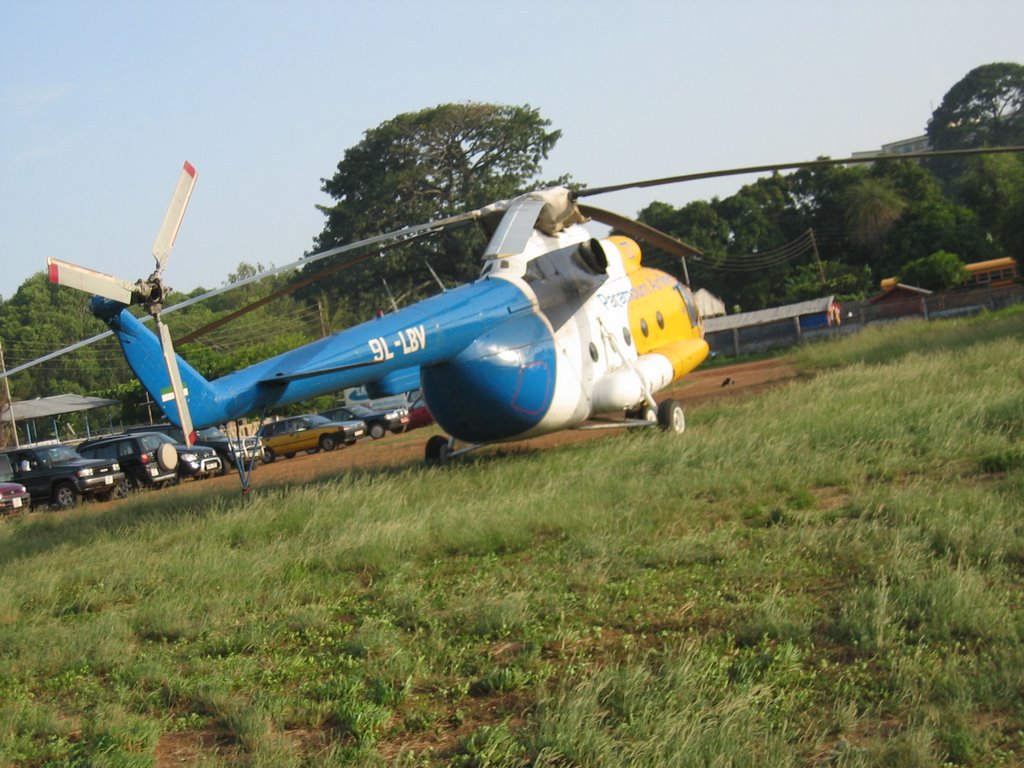
Out of Sierra Leone in the Whirly-Bird

So I just got back form a vacation in Guinea and Sierra Leone. (That sentence is a complete lie. I got back almost a month ago, but I have been so busy that I haven't gotten a chance to finish this thing.)

There is a joke in the State Department about why they so heavily recruit former Peace Corps volunteers. For example, tell a normal person that they are going to have to spend two years in Ethiopia, they blanche a bit. Tell that to a former Peace Corps volunteer and they will likely respond, "cool!" Tell that same normal person that there has been a change of plans and they will actually be going to Liberia, their resume will be on Monster.com by time you finish the sentence. The former Peace Corps volunteer pumps their fist in the air and says, "Even better!" Perhaps this partly explains what prompted us to decide to vacation in the one of the poorest and the recently strife-torn poorest countries in the world.

Eventually we did take off from Nouakchott for the hour and a half flight south to Conakry, arriving late Saturday afternoon. Taking one look at the breeding pestilence that is Conakry, we had wanted to go hiking right away, but were stuck in the capital until we could get our visas sorted out. There is a consulate in Nouakchott, but, despite the fact there are direct flights between the two cities 4 times a week, it has been out of visa stickers for three months, so we got a promissory letter and they took our passports at the airport. We decided to spend the next day on the Isles de Los, the beachy islands about an hour's pirogue ride outside of the city. [Editor's note: Pirogues are traditional wooden canoes with motor boat engines slapped on the back. They are found throughout Africa and are universally leaky.] The docks are notorious for hustlers scamming tourists, but we fell in with the "right" company fairly quickly. There were two American contractors there with a group of their workers. They apparently work six day weeks on the new US Embassy, and then go out to the islands to blow off steam on Sundays. Ray and Tony apparently make an ungodly amount of money, as they had no problem paying an ungodly amount of money for the pigoguier's services. In addition, they speak not a word of French or any other the local languages, and are about as ugly as Americans can be abroad. They cursed at the boat master. "%&$* you! I give you too much money last week! Me no payee more understandee?" The boat master cursed at them. For about an hour. Each. But they took us along for free, happy to have someone to speak English with, and to perhaps translate all the things that people have been saying to them all these weeks. We loaded up the leaky boat with the four of us, plus 10 or so of the Guinean construction staff, a couple beautiful but disconcertingly young girls, one guy with long dreads and a spliff permanently attached to the side of his mouth, and a couple of inexplicable Turks, that spoke only Turkish and were deathly afraid of the water. Matt and I ditched the circus as soon as we hit shore, enjoying the day in the sun on island, then caught a ride back with these clowns. Rasta, the dreadlocked character, ran out of smoke and promptly fell asleep. We hit a wave and one of the Turkish guys through himself across the boat to avoid getting wet, directly into me, just about sending us both overboard. Everyone yelled at each other in languages that they couldn't understand. And a good time was had by all. Did I mention it was free?

An interesting tidbit about transportation in Guinea (and Sierra Leone). Did you ever wonder what happened to your beloved school bus for grade school? Where is good ol' St. Pat's Bus F these days? Well let me tell you. They are plying the roads of West Africa, filled to capacity with people and livestock and baggage. Roof racks have been soddered to the top and the sides plastered with Bob Marley and Madonna stickers. Yes, City of Manchester, Middle Valley Union Free, Plainbrooke, your buses are here. Just in case you cared.

Next day we settled the visa problems, got our visas for Sierra Leone (a bargain at $100 each, payable in hard currency only please), and generally made plans to head up-country the next day. We found what we gambled was a respectable guide at the tourist office, and made plans to depart the next morning. It was a cramped and not surprisingly uncomfortable ride up to Pita, where we spent the night. Pita is a town of traditional weavers and pygmy goats, neither of which were all that keen on getting their picture taken. Next morning we grabbed a ride out of town about an hour, our guide riding on the roof of the car because the driver wouldn't let him smoke, and started walking. The first day was about two hours, nothing to strenuous. We arrived at the village where we would spend the night and were shown to our quarters. We were staying in the home of a prosperous villager living in France. You could tell they were prosperous by the number of pots in the bedroom. [Editor's note: A common wedding gift if a set of pots and dishes for the new couple, not unlike the United States. They have yet to adopt our bridal registry system yet though, so everyone just kinda brings pots. The more people at you can afford to invite to your wedding, the more pots you get. The more prosperous people you know, the more pots they can afford to give.] It was like something out of Alice in Wonderland, floor to ceiling, everywhere stacked with brightly colored pots. It was a little disconcerting to sleep in. You felt like the pots were watching you. That and it was filled with mosquitoes from the screenless windows. That afternoon we hiked around a bit, seeing the natural rock bridge and some large waterfalls. It felt so good to be in a place where there was more to look at than endless frigging sand dunes.
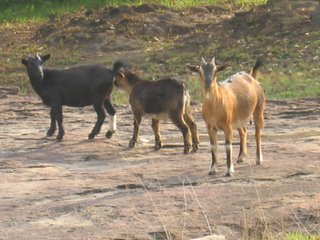
Next day we hiked over to a little village about two hours away, spending the afternoon hanging out in a traditional hut, which was pretty much all the village had to offer. It was nice, perfectly round and made of smooth mud, with a high conical thatched roof. And lots and lots of really really big spiders living in said thatch. I have to admit I wasn't too upset when the guide decided to move along to spend the night. We headed out across the fields to the next village. Upon leaving the village we had to cross one of the many little rivers in the region. On a bamboo-vine bridge – straight out of a Tarzan movie. Two metal cables are run between trees on opposite sides on the river, about 20 feet off the ground. Then vines are tied to the cables in a v-shape, spaced about six feet apart. Bamboo is then used to connect the vine loops, forming a bridge. The problem is
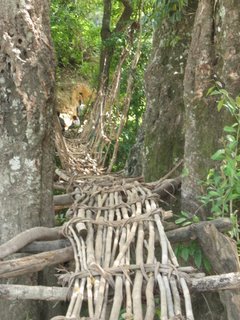
that the bamboo is just sort of piled there, not attached in anyway. So you gingerly picked you way across, reaching from vine to vine, hoping to god that the bamboo doesn't move under your feet while you are reaching for the next vine, sending you plunging to the river below. This was frightening.

We arrived at the next village for a "surprise" wedding. Apparently some tourists get a kick out of these things. Matt and I felt intrusive, largely because the chief of the village had a meltdown when he saw us. But the guide wanted to drink and dance, so we ate our rice and went to bed early in our little mud house. And slept about 20 minutes due to noise. Also fun in this village is that I got to shower in an open field. Everyone baths in the river and I was having none of that, so I got a bucket of cold river water and a field. Price you pay for being picky.
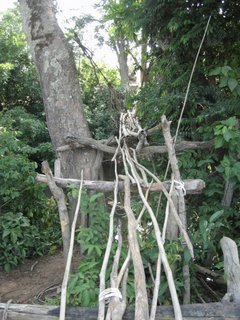
Next day's hike was beautiful but brutal. I am not a hiker-person and it was bleeping hot out. The "highlight" of the day though was crossing yet another bamboo bridge, this one in a much more deteriorated state. I have to admit, this is the most scared I have been on a backpacking trip – I think ever. The bridge was higher. The bamboo was only one 3 inch thick piece in the middle, and even that was badly splintered. I held on to the cables and vines quite literally for my life as I crossed. I was shaking pretty badly when I hit the other side. When we came to the one we had crossed the day before I just about skipped across, it seeming so sturdy in comparison. If my life were a movie, this definitely would have been a good time to contract a stunt double.

And on we went, back to Pita, back to Conakry, spending the night before setting out the next day for Sierra Leone.

We got a bush taxi for Freetown. The trip was uneventful enough, only one flat and we got across the border in less than three hours. Coming into Sierra Leone was interesting though. We cross the Guinea border and drive a few kilometers down the road. There we came to a hand-painted sign (not unlike the ones that would be on a childhood clubhouse) and a tent. The sign said, "Welcome to Sierra Leone." We walked into the tent. There were two men in uniform with guns taking down passport information. These guys were, um, a bit off. Bulging eyes, twitchy, spoke only in halting sentence at full volume. Definitely not good candidates for decommissioning. One of them took our passports and shouted at us, "Why are you here?" We responded, "We are tourists." They looked at us funny. Finally the first guy asked, "Tourists? Can you spell that for me?" As we walked out Matt turns to me and asks, "So do you think they are naturally crazy or just fucked up from all the people they killed?" Dunno brother. We repeated the process three times as we traveled down the road. Have to do something with the former soldiers I guess.
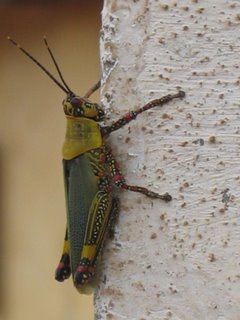
And I really thought vacationing in the poorest country in the world wouldn't bother me much. I lived for two years in the third poorest, had already been in the second poorest, how much worse could it possible be. Ooh. The feeling was slightly similar to arriving in Burkina on the first day of Peace Corps. The sheer level of poverty was disorientating. As far as I can tell, the country is largely constructed of razor wire and tarps from the UNHCR. All of the children are underfed, their hair red from advanced malnutrition. It was the kind of thing that makes you re-examine your priorities. I am at the point with my dealing with the third world were I want a laminated badge and a minister to talk to about increasing direct foreign investment through regulation reform. This place made me want to hop out of the bush taxi, ask directions to the nearest functioning school (which judging by the state of the infrastructure, might have been a healthy walk), and start teaching. Anyone. Anything. I couldn't make the place much worse.

So we arrived in Freetown as the sun was going down. There is no electricity in the city so the whole place was lit with lamp and torch light. It looked eerily like a medieval kingdom as you looked at the flickering lights climbing the hillsides. Except for the NGO and UN residences, glowing brightly in fluorescent light. We checked into a little guesthouse, with an armed guard, a generator bigger than the apartment I had been living in in New York and enough razor wire to intimidate Sing-Sing. Home sweet home.

The next day we looked around town. The place was swelteringly hot and the mid afternoon rain did nothing to break up the humidity. We registered at the American embassy and went out in search of the sights. There were a couple of aging relics from the colonial period (which, when put in the context of the rest of the crumbling infrastructure, are completely unidentifiable without a guidebook.) There is a big tree. An earnest but sad little museum. That is pretty much it. We spent the rest of the afternoon trying to find a new hotel (there had been some sort of altercation outside our room the night before and we were seeking greener pastures.) We went to the two largest (and according to the guidebook, nicest) hotels in town, but they had been converted to camps for the UN troops monitoring the ceasefire. There was a sole-less Chinese built monstrosity, but you can't blame them too much, they were working with the remains of the rebel hilltop strong-hold. We might have even stayed there too had they not explained their credit card billing system as being routed through the First National Bank of Zimbabwe. Eventually we found an overpriced but nice enough place on the beach-edge of town. We made plans to move there soon.
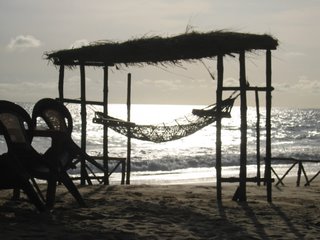
The next day, however, we were bound for the beach. We caught a taxi out to the supposedly best known resort on the Freetown Peninsula. We got there to no guests, no staff except for a bartender, and a bunch of people hanging around trying to either sell us things or be our friends, neither of which we were particularly interested in. Apparently the staff was off at a funeral in a neighboring village but we could wait a while. So we sat on the beach until it started pouring. Then we caught a bus back to town, arriving at the hotel hours later, soaked, cranky and frustrated.

Next day it was all about the chimpanzees. We went to the Tacugama Chimpanzee Reserve. It is a home for chimps that have been too screwed up by humans to return to the wild. Getting there wasn't too bad. We took a mini-bus about 10 kilometers from the middle of town (while might as well have been 1000 for all the infrastructure out there), and walked the last 4. The chimps are in large sanctuaries blocked off by electrical fencing. They looked happy enough. We puttered around with the tour guide for about an hour, listening to the care that they gave them, how they got them, how many they had, etc., and took pictures of the happy monkeys. As we came to last enclosure, the guide warned us that this group had an Alpha-Male named Bruno and he could be a little surly, so pay attention. We were snapping away, not paying too much attention, when this MONSTER monkey comes charging out of the forest. The thing was the size of a gorilla. Holy shit. He jumps up on a stump and raises his arm to throw a rock at us. The guide yells, "Bruno! No! Nice people! No rock Bruno! Nice people! Tourists!" Bruno glares at us again, then throws down the rock like a pissed off three year old. A tense moment passed. He folded his arms. We went back to taking pictures.

The next few days were uneventful. We hung around the city, which was a truly beautiful stop, surrounded by lush green mountains. It will be a hell of a tourist destination in a few years, if they every rebuild the infrastructure. We went back out to the beach, in nicer weather this time. Hung out by the pool. Relaxed. Took pictures of the signs outside things like hospitals and nightclub saying, "No Arms Allowed Inside," with pictures of Klasnikovs with red lines painted through them. As we were checking out of the hotel a few days later, the Hungarian manager comes up to say goodbye. He asks what we had been doing here. We explained that we were tourists. He looks at us incredulously and tells us that in his 10 months of managing the biggest hotel in Sierra Leone, we are his first tourists.
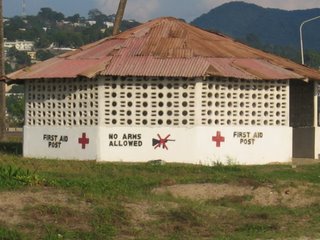
Then it was time to go back to Guinea. We decided to fly back, as driving took 10 hours with no major mishaps. Now the only way to get to the airport in Freetown is by helicopter. I shit you not. So, at 7 am we are at the UN compound to take the helicopter to the airport. There are large numbers of people milling around. There is a guy playing the balophone. Kids are selling snacks. There is a guy in a clown costume trying to explain helicopter safety to people. No one is listening to him. About 15 people at a time fit into the copter, and it takes off straight up over the city. The windows open so you can reach out and take pictures of the city and surrounding countryside. It was really frigging cool.
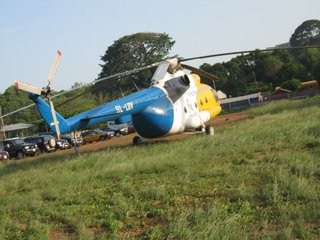
The plane was less cool. The airline was some less than reputable Lebanese outfit. The plane was old and Russian. The pilots were the same. I hoped to god they were sober. Everything was written in Cyrillic script. There was no safety briefing. No cabin staff. No ventilation (the cabin reeked of mildew), but not to worry, because the seals on the windows were so loose, you could see the water vapor streaming in as we passed through the clouds. But we didn't die, so that's okay.

Then back to Guinea for the night and back to Nouakchott. It was good to be back in the desert.