Sunday, August 08, 2010

It's Always Sunny in Morogoro

So I am in Morogoro for three weeks.  In the dry season.  Hence the title of this post. 

I am going to be honest with you, there isn’t much going on in Morogoro.  This is where the government decided to hold the training because it is close enough to Dar es Salaam (3-4 hours) that you can get back there on short notice if you need to, but not close enough that anyone expects you to do it regularly.  And, to be honest, you want to make sure you pick a town that isn’t too interesting because you want the 70 people that you are training to be in their guesthouses at night reading their training materials – not of out having a good time.  (It is perhaps also not an accident that this is one of the more staunchly Muslim cities in Tanzania.) 

But that still leaves me.  In Morogoro.  For three weeks.  In the dry season.

And things here have been extra special uneventful in the past week.  I have managed to locate a decent hotel, find a place to run in the morning (as long as I am careful of the snakes), stumble on a place that sells a fair variety of South African wine, and am steadily, through process of elimination, trying to locate a decent restaurant.  Some monkeys got stuck in my ceiling early one morning – making a god awful racket.  That’s about as exciting as it is going to get in Morogoro.

So I took the research assistant and snuck out yesterday.  Just for 24 hours.  And just an hour and a half down the road to Mikumi National Park.  (Mikumi is probably the most visited and least exciting of Tanzania’s national parks but whatever, at least I wasn’t working.)   The game drives were a little lackluster (“guiding” prerequisite seems to be a driver’s license), but there were a couple of good lion and hippos sightings.  It was also “baby season” in the park, so you will notice a fair number of little ones in these pictures.  The lion sighting was actually pretty spectacular.  Mother and three older cubs with a fresh wildebeest kill.  You can see from the pictures how close you can get.  (Note that we are actually driving in my little Rav 4 for this.)  We also invested afair amount of time at the hippo pond – waiting for some sign of movement.  Hippos are basically nocturnal, so other than a couple of yawns, all I got was tsetse flies in my hair. 

Monday, July 26, 2010

Little Pockets of Oddity

So I just returned to Dar es Salaam after a week offline and roaming around the country for the final pilot tests before my fieldwork training starts next week. It was one of those throwback to Peace Corps weeks, with little villages, dusty roads, flat tires, dirty hair, and bucket baths. But successful – project is progressing and we haven’t missed a single deadline (which in African statistical equivalent of drawing an inside straight).

One of the villages we worked in is a former sisal (a jute-like plant used to make sacks that was Tanzania’s number one export earner at independence before collapsing after the removal of government subsidies to the industry) plantation that the government nationalized a few decades back. I immediately noticed something was a little off about this place… The houses had chimneys. African homes don’t have chimneys. Ever. People cook outside. They were also made of “colonial stone” (a chalky yellow-white cement mixture that was very much the de rigeur of late colonial construction). The sisal plants still grew in the fields, but were now inter planted with maize and cassava, the main local food crops. The houses were still in their neat rows, but mud brick extensions and patchwork came off at crazy angles. The multi-story processing plant is quietly rusting into the ground. It was a weird place.

And then there were the fuchsia chicks. They were like hatched Easter eggs. The family had set up shop on the crumbling porch off the town’s main square – next to a family of ducklings. We drove by them multiple times during the day shuttling between the different field teams and each time I would ask what the hell was up with the bright pink chickens. Oh mzungu, you don’t understand anything, that is so no one steals them. Chicks all look the same, so some people dye their colors to identify them. I shudder to think about what the original purpose of the dye was that ended up on those chicks. (I am thinking car enamel.) In any case the chicks themselves seemed happy enough – pecking around with their mother at an old corn cob. And they are very liberal minded little chicks because the ducklings also were tinged slightly pink from fraternizing with their neighbors.

That night I stayed at a gas station hotel at the midpoint between two of our work sites. It was a very modern hotel for a gas station. Electricity, running water, restaurant, the works… It was even modern enough to have one of those “insert key card for power” gizmos on the wall by the door. Which would have been more impressive had the actual door locks not been key based. I looked all over that room for a light switch. I asked my colleague staying across the hall – his room had regular lights. Eventually we solved the problem by sticking my driver’s license into the slot. Lights came on. I am not sure I get it.


Sunday, July 18, 2010

Expat Growing Pains

So adapting to any new situation can have its movements of transition and I have had a few of those getting used to ex-pat life here in Tanzania. Whereas previously I have lived in hotels, now I have an apartment. Where I previously took taxis, now I have a car. And where I previously could always depend on the staff or one of the societal misfits at the hotel bar to talk to me, I now have to try to make “friends.” These last few weeks have been a whirlwind of trying to do all of these things, plus get this project off the ground.  Hence the lack of blogging.  I will do my best to remedy that.

The car has been a particular transition moment. Those of you who know me know that I am a notoriously terrible driver. Seriously bad. And traffic laws here are mere suggestions. (For example, as far as I can tell, red lights do not apply on weekends. People behind you will lean on their horns if you stop at one.) That coupled with the fact that I have to drive on the opposite side of the road here – with all manner of children, bikes, carts, animals, etc, running all over the place – means that I drive fairly slowly – at a pace that I consider reasonable but that most of my fellow motorists apparently consider actual stasis. In addition, the town is littered with huge nasty speed bumps. But while there is sufficient enough left over pavement to build a speed bump, there does not appear to have been enough funding to paint said speed bumps. As a result, there are times when you hit them going mach 1 (particularly if you are driving at night along Carjack Beach). All four tires of my Rav4 airborne probably looks cool from the outside, but from the driver’s seat it is a bit nerve wrecking.

Yes, I have a Rav4. It is considerably newer than my bucket of bolts back in DC (but the unpaved streets and speed bumps have been taking a toll). And it is white. This led to a movement of sheer personal hilarity when I came out of the expat grocery store on a Saturday morning, lugging a 12 L bottle of water and a week’s food, only to find a sea of white Rav4s and Range Rovers. Since it is a rental and I am not one to ever mentally log where I park, I had to wander a bit before tracking it down. I stopped on the way home to order a Tinga Tinga spare tire cover. Maybe a bit tacky, but at least I can find my ride…

Other than that, Dar is about traffic. Rush hour traffic here is as bad as anywhere in New York. It takes me 45-90 minutes to get the 5 miles from my office to the apartment in the evenings. All sorts of interesting things are going on around you though. People are selling fruits and vegetables, carvings, etc. There was a new one yesterday though. I was stuck in dead stop traffic next to a gas tanker. Two enterprising young men with custom wrenches ran up and opened the valves on the underside of the truck, filling plastic bags with contraband gas. When the bags were full, they closed up the valves, climbed down a drainage ditch and back up the other side, and then sold the gas at the taxi park. Then they sprinted back across to fill the bags again at the tanker still stuck in traffic. (This amazed me so much that I took a picture - which drove one of the gas stealers into a rage. Was he made that I took a picture of him engaged in a criminal act? No – just that I wouldn’t give him 1000 TSH for the privilege. I shook my head, he told God to curse my progeny, and then traffic started moving…)

To combat the traffic crisis, I joined the gym next to the office. That way I can just look out at the traffic and, it is still backed up to the turn off, just go spend another 20 on the treadmill. (At this rate I am going to be *cut* when I get out of here.) But because my workout strategy is built completely on traffic avoidance, I don’t go to the gym where all the other expats go. I am in fact the only white female I have ever seen in there, and I am usually unique in both of those respects. But the gym is okay, it has working elliptical machines and treadmills, plus weights and a couple classes. I was particularly excited about the 30 minute “intensive core workout” class. I am such a slacker about doing my abs, but with a class, I am sure that I would be better. Then I met the instructor. This guy apparently learned to speak English watching Full Metal Jacket. And as the only whitey, there was no way that I was going to make America look bad. So there I was, tank top and running shorts, pouring sweat, while these beautiful South Asia women, in their long flowing “gym burka,” effortlessly cranked out another set. They looked like elegant jellyfish on the mats. I looked like a farm animal.

Other than that, things have just been moving along.  Been out in the field mostly, doing pilot testing and training, taking the occasional break to shell some corn...  There was a bit of a break in the action last week when I spent three days in Addis Ababa, Ethiopia, working with their Central Statistical Agency.  I like Addis.  It has a bit more hustle and flow than sleepy little Dar, good traditional food and some excellent pizza, nice silverwork, and a fleet of blue Ladas that serve as the city's taxi fleet (a leftover from their flirtation with communism).  If it weren't for the truly amazing food poisoning that I got from the Hilton Hotel's room service, it would have all and all be a great interlude.

I am back off into the hinterlands today for another week in the field.  Sorry there isn't anything in the way of pictures this time...

Sunday, June 20, 2010

Kristen for Kibera

Kibera is the largest slum in Africa.  It is about one square mile of unpaved alleys, rusting tin shacks, and open streams of sewage.  Approximately one million people live in Kibera (roughly 1 in 5 Nairobians, and 1 in 50 Kenyans overall).  The HIV prevalence, crime, and chemical dependency statistics are clear off the charts.  The name literally means “jungle” in one of the local languages, and is synonymous with just how bad urban poverty can be.


But it is still in habited by people, and people as a general rule are a resilient lot.  Kenyans in particular are similar to Americans in the dogged belief that this bad day is just a stepping stone, and with the right amount of hustle, better days are just around the corner.  One of these people is Lucy.  Lucy runs the St. Vincent de  Paul Day Care & Nursery School (http://vincentdepaul-organization.jimdo.com), a pre-school and kindergarten for at risk kids in Kiberia slum.   She provides them with small classes, motivated teachers and a solid foundation for primary school, something comically lacking in the local public school system.

 
She also does outreach in their homes, checking up on which parents – often single mothers – are on the edge.  She encourages them to seek regular medical care for their children and for themselves if they are pregnant.  She tells them about drugs with can prevent mother-to-child HIV transmission.  She encourages them, whether they are married or not, to try to start some kind of small business, because waiting for a man to come home (or not) with some money is not going to get your children out of the slums.  She has recently started a rescue center on a piece of donated piece of land outside the city, for children who were abandoned or just could no longer remain at home.  And she does all of this on a few thousand dollars a year given in mostly small donations over the internet.


I am one of her small donors (very small – literally a two digit donation once), and took a morning off while in Nairobi to join a few other visiting donors to meet her and see her school first hand.  We also visited the home of two of her students, getting a firsthand walking tour of Kibera.  I like to think that I am not easily impressed by people anymore, but what Lucy manages to do on so little is incredible.  Even the non-monetary resources, getting college student volunteers from Holy Cross for the summer, convincing the UN spouses group to donate food, have the huge challenges of coordination.  I am no slouch at developing world logistics, and I couldn’t organize a taxi where she works.

 
In any case, I am going to skip the funny anecdotes for this time, and just recognize a dedicated woman’s achievement.  It was a much needed Barack style shot of hope – after two weeks of listening to taxi drivers tell me whose tribe is better than whoseother.  And having six people be killed in a grenade attack at a political prayer rally across the street from my hotel last week.  And working 12 hour days trying to help a country that seemed hell bent on screwing everything up.   Here’s to you Lucy, for making me think that maybe this country isn’t total *%&$ed.

Sunday, June 13, 2010

The Wisdom of Bobby Kelly

Bobby Kelly was an outfielder for the Yankees in the later 1980s. According to baseball lore, one off-season, he and his agent walk into the general manager’s office and Bobby tells the GM that he has played well this season and thinks that he should be the starting center fielder (I think he was platooning behind Dave Winfield at this time). The GM is quiet for awhile, then nods and tells him, you know what Bobby, you are right, you do deserve to be a starting center fielder. I will take care of it. Bobby and his agent leave and go off to celebrate. Starting center fielder for the New York Yankees. Next day Bobby is traded to Cincinnati – where he was in fact the starting center fielder.


I love that story. In fact, most of you have probably heard me tell that story before many times over the years. So I should have known better when I walked into my boss’ office last January and announced that I wanted to travel less. I got traded to Tanzania.

So for the next few months I will be based in Dar es Salaam. I gave up my apartment in DC, packed everything into storage, and now here I am. Well, actually right now I am in Nairobi, but that is just until Saturday, then I go back to Dar for the next couple months. But in the meantime, a few noteworthy things that have happened in the last 8 days…

Last weekend I was still in Dar, on a 48 hour stopover to desperately unpack into my apartment, and then repack for two weeks in Nairobi. But one night a few people I know decided to sneak me into a party at the ambassador’s residence of a certain northern European nation. The party started out how they all do… sipping tepid white wine in the heat while the ambassador gives a painful speech highlighting whatever the country’s current development policy of the week is, then the two national anthems, and making chit chat while you polish off whatever tasty little national morsels come by on trays. All according to plan. At some point though, the night took a turn for the weird. The cultural attaché had booked a lively hip hop band. Which cleared out a good chunk of the crowd, but the booze was still flowing so we hung around. At some point the ambassador got up on the stage and started shouting for everyone to shut and listen to him because he was the ambassador (I think he even still only had one drink in his hand at this point). He said anyone not drinking and dancing should get off his lawn. Then proceeded to physically herd us towards the bar, after which the cultural attaché dragged us onto the dance floor. The interns at this point were drunk enough that they were physically dangerous to dance near. One actually sweated completely through his suit coat. But in the end, no one got hurt and when we got tired of dancing we got the hell off the ambassador’s lawn. With a free CD from the hip hop band.

Then I flew here to Nairobi. The flight is only an hour (about the distance from New York to DC), but as with all these things, it was a fiasco. So I got to the hotel and just grabbed my shorts and sneakers out of my suitcase and went down to the gym to run it off a bit. As I stepped out of the elevator, I immediately noticed that something wasn’t quite right. Usually it is me, a handful of BA stewardesses, and one out of shape Dutch guy. The gym was packed to the gills with American dudes. Too old to be embassy Marines, but obviously not just regular joes. After my run I asked one of the staff what was going on. Oh, I was so lucky, the American VP Joe Biden was arriving tomorrow. Oh. Shit. It turns out my compatriots at the gym were only the advance team. Over the next 24 hours, at least a hundred more showed up. The Nairobi InterContinental was going on full lockdown. We had to enter and exit through the parking garage. No taxis or within 100 m. Metal detectors in every door frame. Bomb sniffing dogs in the corridors. A sizable portion of the Kenyan military decamped to the car park. All adult males wearing those stupid little earpieces. Wait lists for treadmills. Interminably slow room service. This was a problem. I kept going up to random meat heads and asking, nay pleading, to be told when he was leaving. “Who’s leaving ma’am? I can neither confirm nor deny there is anyone here.” Three days. The last of the Secret Service cleared out just in time for the World Cup to start and the downstairs sports bar to fill with embassy Marines.

But today I decided to take the day off, get out of the hotel/office loop, hire a driver, and see a couple of the remaining Nairobi sights on my checklist. This included the Kitengela Glass Factory and the Nairobi animal orphanage. The glass factory was way out in the middle of nowhere in the suburbs, but was totally worth the trip. It is run by some insane white dude who bought a farm and started teaching the Kenyans how to blow glass using recycled beer bottles. One thing led to another and now there is an artist colony out there… complete with Gaudi style mosaics and giant metalwork sculptures. You can wander around the workshops and they do glass blowing demonstrations. I was amazed enough to buy a pitcher and glasswear set (for an obscenely low price given the rising dollar). My driver, who accompanied on my wanderings, was just floored. He just couldn’t believe how glass was made or that Kenyans were making it. We gave a couple of the workers a lift to the main road, and in exchange the workshop manager gave the driver a small gift. Over the moon. You would have thought he was the one that paid me to take him out there.

The animal orphanage is part of the Nairobi National Park system, and to the naked eye, just seems like a really depressing zoo. (All of the animals have little placards about how their parents were killed.) But, for those in the know, it is a golden opportunity to bribe your way into the cheetah cage. (Something else the driver was incredulous about – he could more readily understand bribing your way *out* of the cheetah cage.) I have a couple of other pictures of me smiling and looking at the camera, but I like this one because it is more true how I actually felt about the experience.

Well, that is all for now. Ghana just beat Serbia and the entire country just lost its shit. I am going downstairs to the bar for a Tusker and to see Germany mop the floor with the Aussies. (Less than two weeks and I already care about soccer – this trip might leave a scar.)

Sunday, June 06, 2010

Swedish ABC's

So this year the cleverly named ABCDE (Annual Bank Conference on Development Economics) was held in Stockholm. One of the papers I had co-written was slotted to be presented, and luckily for this junior co-author, the other two were otherwise occupied last weekend. So I got to go attend lectures, eat salmon, meet interesting people, and just enjoy the beautiful Stockholm summer. Unfortunately I did not have as much time as I would have liked to check out the city, but I did manage to seek out to stroll around a little.


And in honor of the Bank footing the bill for 4 days in Sweden so that I could deliver a 20 minute presentation and answer one question at a session that started at 7:45 am (seriously – Swedes are nuts – though fair play the sun rises at 3:45), I will do this blog entry in powerpoint slides.


Slide 1 – “Stockholm as a Beautiful City”

Stockholm is beautiful. Apologies to any loyal Norwegian readers, but it has got it all over Oslo. The city is built on a series of 14 islands, connected by bridges and surrounded by water clean enough to swim in. The old city (like many old cities admittedly) is a maze of narrow alleys, colorful buildings, and old churches. Everything is spotlessly clean and perfectly preserved.


Slide 2 – “Common Swedish Delicacies”

When people ask me questions about places that I have been, they inevitably want to know “what did you eat?” And, as I didn’t want to waste my precious lapses from vegetarianism on a common Swedish meatball I could get at IKEA, I sought out some alternatives. I ate lots of salmon – smoked, grilled, broiled. Lots of herring. Which to me was always this nasty creamy goop we had to eat on New Year’s Day for good luck, but the Swedes to some amazing things with it. The tangy mustard version was particularly good. (I should note that these are all breakfast foods. I was almost beside myself with joy when I went down the first morning. You should have seen the look I gave the waiter when he asked if I wanted *eggs*.) I also ordered the elk prosciutto at a restaurant. Eh. Elk should stick with whatever it is that elk generally do, they are a little lackluster as a designer meat product.


Slide 3 – “Royal Gossip”

I love monarchies. The whole idea in the information overload age is inherently dangerous. In America, the spotlight is on the president and his family for 8 years. And with enough spin control and armed minders, you can keep pretty much anyone in line for 8 years. After that, the fascination fades. (Would any of us care if Amy Carter were to be caught smoking crack with underage chimpanzee?) But royals have to stay in the spotlight their whole lives. Eventually something is going to be newsworthy. And in Sweden right now there is royal gossip fever! The crown princess is marrying a gym teacher. The nation is scandalized by her choice. Even worse, it was leaked to the press that her father was going to walk her down the aisle. The nation is aghast. How dare such a role model capitulate to outdated patriarchal traditions! Sometimes I think conservatives are really funny, sometimes I think liberals are even funnier.


Slide 4 – “Really Big Boat in a Box”

At these things, there is always a conference dinner. They are usually held at impressive venues and offer the unique opportunity to get drunk enough that you can’t show your face at *next* year’s festivities. Our dinner was in the Vasa Museum – which houses an intricately carved double decked gun ship that sailed for about 20 minutes in the 17th century. “Ballast” was apparently an idea still in the development stages back then, and one stiff breeze sent the whole kit-and-kaboodle down to the bottom of the bay for 400 years. Fortunately the freezing water makes it too cold the for the little microbe beasties that usually eat wooden ships – so the Vasa is amazingly preserved. And huge. Makes for an impressive backdrop for a fancy dinner.

Slide 5 – “Holy Shit, Did You Know Who Alfred Nobel Was?”

So something that they don’t much mention at the ceremonies, but Alfred Nobel, the man who endowed the famous Nobel Peace Prize, was a weapons manufacturer. No joke. The guy developed high explosives at the turn of the century – accidently killing his brother in a “lab incident.” The Nobel museum casts this somewhat inconvenient truth in the idea that everyone has the chance to redeem themselves. I guess, but man if Fox News got a hold of the idea that Obama accepted money from a socialist foreign arms dealer, Glen Beck would fantasize him into a muhejeen in the Afghan highlands in a matter of minutes.

Slide 6 – “Conclusion”

That pretty much sums it up. Following the conference I went to the airport to get my luggage out of hock (SAS lost my bags again – but as I learned from my trip last month to Norway, I should not expect SAS to deliver my baggage at the same time when it delivers me. Therefore this time I was smart enough to pack everything I needed for the conference in my carry-on), and headed down to East Africa. I am currently on a flight from Dar es Salaam to Nairobi, and I went to a really amusing foreign embassy party this weekend, but you will have to wait on that (I need to keep some things in my pocket for next week’s post.)

Sunday, May 02, 2010

Oslo and Out


This short posting is really just a vehicle for the seal pictures that I haven’t put up yet.  Nothing too much interesting happened since the last entry.  I went to the bar, didn’t see any polar bears, flew down to Oslo for the weekend, did the tourist sight rotation down there (National Museum, opera house, Viking ship museum, Vigeland Sculpture Park, etc…), had some drinks with some friends, then hopped on the plane back to the US.  The weather in Oslo wasn’t very good, so the light wasn’t right for taking many photos down there.  (Also, while Oslo seems to be an immensely livable city, it isn’t that photogenic…) 

Thursday, April 29, 2010

Hvor er alle isbjornene?

So let me get this out of the way at the outset - we were unsuccessful in our quest to see a polar bear.  Which is a little bit ironic because this week there have been four different polar bears sighted in the tiny town of 3000 in which we are staying.  It has made national news.  Residents have Facebook status updates saying things like “Arming myself to run to the store.”  It’s like the polar bears are mocking me.
 
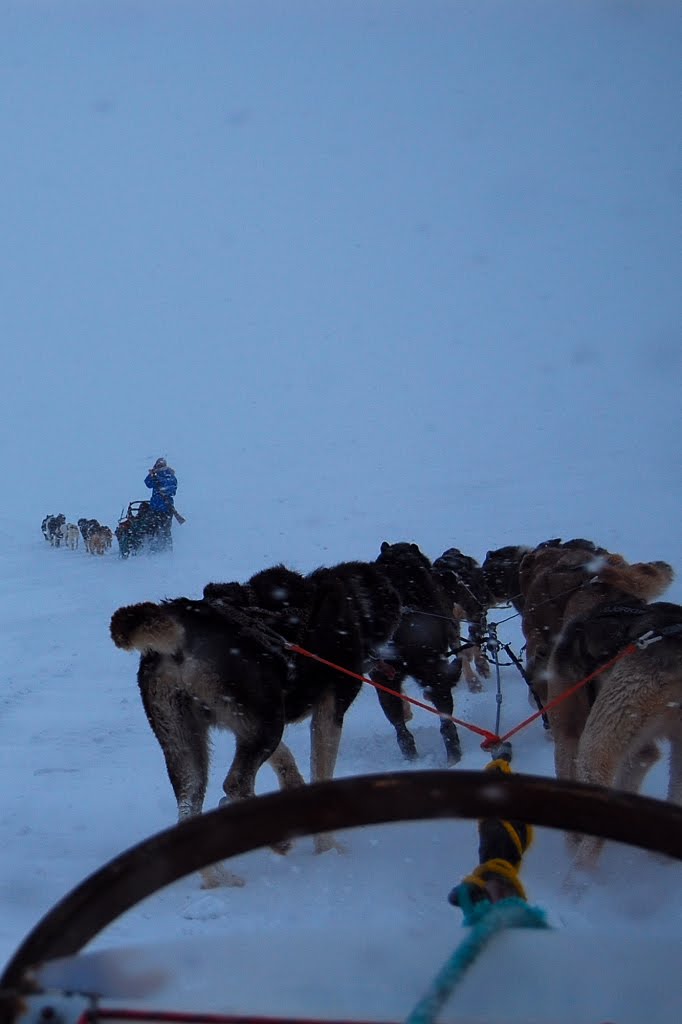
One of the major hindrances to polar bear viewing turned out to be the weather.  The snowstorm that started at the end of the last blog post continued throughout the next day.  Which certainly made the next day’s dogsledding activity slightly less pleasant, but did give it a certain air of authenticity.  Johnny Norseman and I took turns driving our six dog team through the blinding snow.  I couldn’t see anything at all without my sunglasses.  The sled would get stuck in the fresh powder, necessitating the driver hopping off and pushing to get the dogs started again, jumping back on quickly before the dogs ran off with the passenger.  And as well trained as the dogs were, they were still dogs.  At one point, our team hooked a sharp right and took off after a reindeer.  I have to say that it has greatly increased my sympathy for polar explorers.  It would truly suck to have to do that for weeks at a time just to see your compass spin. 


The next day was our big snowmobiling trip to the east coast - polar bear country.  It was a long day, nearly 150 miles roundtrip, driving a snowmobile across tundra, glaciers and sea ice at speeds up to 55 miles per hour.  It was a cold day too - the air temperature was only in the teens when we started, plus the wind chill plus the wind speed.  This would have made things uncomfortable, but blasting across the top of a glacier, clouds blending in with the blowing snow to make it seem like the top of the world, frozen sea looming up before you, is really so god damned badass that you don’t care much about the temperature.  (Though I guess it is all fun and games until someone loses as toe.)  The rules for glacier driving and similar to that of the sea ice that we would cross later that day - follow the tracks in front of you.  The lead snowmobile has a GPS that has a map made by helicopters.  If you fall into a crevasse the whole group is going to have to wait in the cold while you and your compound fracture are towed out.  Follow the tracks in front of you. 

Have I mentioned how badass it feels?  It’s like a really cool Super Mario Cart board come to life.

Anyway, when we got to the East Coast, where the polar bears are usually found, it was snowing like crazy with wind coming from the ocean.  Taking off your gloves, even for the 30 seconds it takes to switch a camera lens, put you in imminent danger of frostbite. I hunkered down next to the heat of my snowmobile engine for a few minutes while I scanned the horizon with my 300 mm lens (basically the equivalent of a pair of binoculars) before I really didn’t care that much about the polar bears anymore.  I wanted to keep my fingertips.  (It didn’t help that there was a guy on my plane on the way up that was missed significant chunks of his extremities.)  Fortunately, “forget the bears” was a pretty popular sentiment among the group, and we headed back across the glacier.  The rest of the day was spent cruising by seals and reindeer while skimming across the sea ice with ice blue glacier walls rising at the edge of the shore.  In case I haven’t mentioned this - totally badass. 

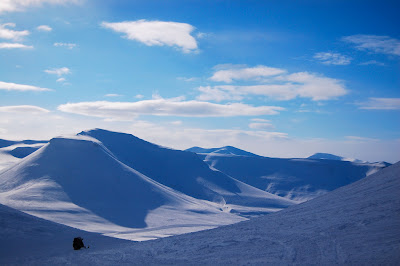
Today is our last day here in Svalbard, and the weather is impeccable.  Ice blue sky and no wind.  Of course we chose today to explore the completely enclosed ice cave.  The ice cave is formed by glacier melt water and runs for miles about six stories below the surface, with the melting and refreezing forming incredible ice stalagmites and stalactites.  The tunnel ranges from walking comfortably with cathedral ceilings to wiggling on your stomach below giant chunks of ice.  The caves obviously aren’t lit, so everyone has a miner style head lamp to guide the way.  (Those who know me well can certainly picture the scene where I have my tripod set up on the timer and am trying to coordinate the position of my fellow hikers to most dramatically light a particularly nice ice formation.)  At the end, we all had coffee and cookies in a particularly large chamber, then emerged back out into the blinding light of the glacier surface. 
So tonight it is down to Oslo for a couple days - then back to Washington.  Unless I meet a polar bear on the way home from the bar tonight, I will have to try again another day...


Monday, April 26, 2010

Snowmobiling 101

So today I learned how to drive a snowmobile.  Johnny Norseman and I took a trip with three other tourists and a guide (armed guide - every one leaving the city limits must carry a rifle or sizable handgun in case of polar bear attack) to dash around the glacier and visit Barentsburg, a random little Russian coal mining town about 60 kms from Longyearbyen.  (It is sort of a long story how there is a random little Russian coal mining town in the middle of the Norwegian Arctic.  It involves intricate international treaties, but the necessary bits for this story is that it was built between 1950 and 1980, is staffed by 400 Ukrainian miner and there assorted dependents, and very much feels like not only stepping into Russia, but stepping back in time into Russia.  But I digress.)


The basic concept of snowmobiling isn’t that difficult.  On the left, there is a brake, very similar to the one found on every 10 speed bike in the world.  On the right is a level that serves as that throttle, the harder you pull back, the faster you go.  The only vaguely complicated bit is that the terrain you cross is very uneven, so when you turn on any kind of gradient, you need to shift your weight by climbing off the seat and leaving hard to the high side to keep the machine steady.  (It is sort of like a combination of leaning into a turn on a motorcycle and sitting on the high side on a little sailboat.)  They are relatively heavy - with the one I rode weighing as much as my little Rav4 back home - but they do go over if you aren’t careful - as we will see firsthand later on in our story. 


Anyway, these things a frigging blast.  Blazing along the top of the glacier, under the crystal blue sky, ice flows in the ocean looming ahead, reindeer scattered on the hillsides… (A note about the reindeer here, they are pygmies!  They have these stumpy little legs to keep them low to the ground so they stay warmer during the bitter cold months.  If I wasn’t positive I would be run through with an antler as soon as I got too close, I would certainly bring on home - and be the envy of all the designer dog snobs at the park. But I digress.) 


The trip out of Barentsburg takes a few hours with picture stops along the way.  You can tell you are getting close when you see the giant plumb of black smoke rising into the sky.  We had lunch at the Soviet style cafeteria - where everything was served with beets and mayonnaise.  We say the aging mine entrance, the aging school, the aging social hall, the aging hospital, the aging church, the aging sports club…  It must have been a veritable worker’s paradise a generation or so ago.  Now the only people crazy enough to work there (there was a giant coal dust fire a few years back that was only extinguished when the entire mine was filled with sea water for a little while) are chain smoking Ukrainians on two year contracts.  Cheers to those boys - after two hours I was ready to get the hell out of there.


Which only left the trip back.  But Mother Nature had added a new wrinkle.  It has started to snow.  Less than 30 minutes into the ride, conditions were near complete white out.  I was the first snowmobile behind the guide and I was struggling to keep the black speck in sight.  Also, when you can’t see the terrain, you are less able to anticipate when you are going to need to compensate, leading to a few exciting moments when you hit an embankment or large bump in the snow.  After an hour or so, we stop for cookies and to admire what I would assume is a fine view if the visibility ever crawled above zero.  (And it was cold.  It, in general, is cold here, with the high for today being only in the low 20s, but there isn’t any wind so with enough layers it isn’t too bad, unless you are on top of a glacier in the middle of a swirling snowstorm.  Then it is a little chilly.)  I have trouble getting my machine started, but eventually it turns over and off we go.  Conditions now are really tough.  I am struggling to stay upright and keep pace, but we don’t want to slow down too much because things aren’t likely to get better weather-wise.  Halfway into this final push, the guide stops.  I pull in behind him and turn around to look for the others.  But there are no others.  The guide drops the supply sled and turns around to find them. 


It couldn’t have taken more than 10 minutes.  (Johnny had hit a bad bump in the snow and went over.  The others had stopped to help get the snowmobile back up, but they had lost the two of us in the process.)  But the guide took the gun.  And I was all by myself.  In the middle of a snowstorm.  With almost no visibility.  With a supply sled full of things a polar bear might like to eat.  And me, which the polar bear might also like to eat.  It has been 15 years since the last fatal attack - mostly because of new safety precautions - but I was a little nervous.  If I saw a polar bear, I could probably outrun him on the snowmobile, but without a GPS and in the snow, I would be causing a second set of problems.  And I had had trouble getting the engine to turn over last time I started up.  Just as I was convinced that I could hear the snorting and shuffling of a hungry polar bear behind my back no matter which way I turned, the guide and my fellow riders come roaring up.  Back to town.  Where, having faced the first situation in my life where I had a practical use for a firearm, I was now faced with a somewhat more immediate need for a drink. 


And for those in the audience keeping score: in the last two days I have eaten seal, (minky) whale and reindeer.