Sunday, June 03, 2012

"India"

You shouldn’t lie to your mother.  I know this.  But – as all those of you that have ever been born know – they are kind of stress-cases once in awhile.  And – as those of you that have been reading this blog for awhile know – mine is particularly a bit of a stress case.  So I told her I was going to “India.” 

But try to imagine the conversation last month that would have preceded my departure – “Hi Mom.  Happy Mother’s Day.  Glad you like the lawn fountain from Katie and I.  By the way, I am going to Pakistan today.  Hope Dad takes you somewhere nice for dinner tonight.  Bye!” 

Pakistan is the big bad wolf these days.  If you believe the mainstream media – it is a country where they stop warring with India only long enough stage cross border raids on NATO troops in Afghanistan.  If you believe the right wing loons – it is a country where they offer tax breaks to rogue international terrorists to set up multi-wife compounds in major cities.  In any case – I wasn’t coming in with particularly high expectations for the week-long training course that I would be teaching in Islamabad. 

As it always is with these things, the truth was much more mundane.  Islamabad is a South Asian city with relative good infrastructure.  (I daresay it might even be efficient if it were for the security checkpoints and the check-the-trunk-mirror-the-underside routine done every time one enters any commercial or residential establishment.)  The people seemed very nice – hardworking bureaucrats who actually seemed interested in learning more about statistics – or at least nice enough to humor me for a few days.  It was hot – over 100 degrees every day.  Bit on the dusty side – but the developing world will get you with that one every time.  All in all – not really any different than anywhere else I work.

All this is with the caveat that I barely left the confines of the hotel / office carousel.  One day I went shopping – because I discovered that what looked conservative coming out of my closet in DC – didn’t look quite as conservative on the ground.  One night a fellow alum of my grad program snuck me out of the hotel to go to dinner.  (Okay – it wasn’t quite as cloak-and-dagger as all that – all I did was blend into the crowd leaving some function and get into his car.)  He showed me around the city a bit and we had tea on the mountain that borders the city.  Beautiful view to watch the rolling blackouts blink different neighborhoods on and off.  And much cooler. 

The only tense part of the whole trip was the departure.  The airport in Islamabad is a bit serious.  They take customs and immigration to a whole new level of scrutiny.  Plus my colleague was Indian American (dot not feather) – so we basically looked like a Bollywood star travelling with her faithful sidekick Casper the Friendly Ghost.  She cleared the first check point like a pro – but there was a great bit of discussion over my ticket.  (Note that all of this takes place at 3 am because the flight departs at convenient hour of 5:40 am.)  One guard looks at it for awhile.  Then he calls over another guard.  As the third guard arrives, I am beginning to get a bit nervous.  I know everything is in order, but had the situation been reversed (Pakistani in an American airport), I would have already been being swabbed for bomb making residue.  The third guard looks at my ticket, turns to the first two and says, “Vegetarian – no eating meat,” followed by an Urdu version of the explanation.  All three look at me like I’m seriously deranged and very possibly dangerous – and I slink off to immigration. 

Thus ends my adventure in Islamabad.  I have been told that real Pakistan begins 10 km outside the city, so I know that it might be a bit premature to give the country the thumbs up – but someone might want to call Fox News and suggest that they hire a fact-checker.  Someone might want to do that anyway.

P.S. Since I didn't do anything photo-worthy in Pakistan - I am attaching a pair of pictures from Istanbul - where I stopped for a day on the way back.  


Wednesday, April 25, 2012

Calypso Turtle


What do you need to know about St. Lucia as background for this post?  It is a country of 238 square miles, with approximately 174,000 people, two Nobel Laureates (the world’s highest population to laureate ratio), and the same voting power as China in the UN.  As far as geography – it lies between Martinique and St. Vincent in the Eastern Caribbean.  (The nearest large country is Venezuela.)
With its high percentage of package tour resorts and American honeymooners, it is probably not the first place I would choose to go on vacation, so how did I end up there last week?  The work plan gods smiled on me.  I got to spend a week teaching a course in data collection and survey statistics for representatives of the Organization of Eastern Caribbean States.  The upside of teaching in paradise is that you can knock off for a half day and scuba dive in gin-clear waters, hang out with the world’s friendliest sea turtle (seriously – this guy was more than happy just to chill in the current with us – compliments to my dive partner for the photographic evidence), stop on your way to the airport to see the famous twin peaks of the Titons and visit “the Caribbean’s only drive in volcano,” and basically have the ability to brush your teeth with rum punch if you so desire.   

The downside is that everyone else in paradise is on vacation.  Which means at 10 pm – when I am on a deadline trying to bust out the last batch of slides for the next day’s class – the drunk fools attempting to sing what may was equally likely to be Hotel California or La Bamba acappella because the hotel has *finally* unplugged the karaoke machine – really piss me off.  So I am out there on my balcony wanting to scream “get off my lawn you god damned kids” and shake a broom at them.  Unbelievably the quietest place I found to work in the village of Rodney Bay was the Whiskey in a Jar Irish pub.  

Other than that, not much in the way of adventures to report.  I am going to close this post with a joke though.  I don’t normally repeat silly jokes that they print in airplane magazines, but my grandmother would have liked this one.  (She used to love calypso music – listening to it in Florida during the winters.  The only song that I can remember had the chorus of “the girl is your sister but your mamma don’t know” – until the last verse – in which the chorus was “your papa ain’t your papa but your papa don’t know.”)

 In any case:
Donovan was on his deathbed and his wife Leila was at his bedside. She held his fragile hand,tears running down her face. Her praying roused him from his slumber. He looked up and his pale lips began to move slightly.
'Mih dahlin Leila,' he whispered.
'Hush mih love,' she said, 'Rest... Doh talk.'
He was insistent. 'Leila,' he said in his tired voice, 'Me have someting me hafa confess to yuh.'
'You have nuttin to confess.' she said.
'No no me hafa die in peace love. Me sleep with yuh sister, yuh best friend, and yuh mudda.'
'Me know,' answered Leila, 'dats why me poison yuh.'
 

Thursday, April 05, 2012

Not Dead - Just Opinionated


*** Disclaimer alert : I am not speaking in any sort of official capacity here as a employee of the World Bank – just shooting bullshit from the hip as usual ***
So this is the first time that I am writing a post that is not about a travel adventure.  (That will hopefully pick up in a less dramatic fashion in a few weeks.)  But enough people have e-mailed me to ask me if I am still in Mali that I felt like I should say that I am not.  I am back in DC – after finishing my hitch in Mali and then a few weeks in Tanzania and Kenya.  This is relevant because it seems – rather than being a victim of random violence in Bamako – as originally thought – that I was actually in the vanguard of the revolution.  Mali had a coup d’etat on March 21st.  And none of this Arab Spring, ‘the people want to overthrow the regime’ nonsense.  The president was democratically elected and not running for another term.  Elections were supposed to be this month.  No, Mali had themselves a good ol’ fashioned putsch.  Well – maybe a half putsch.  The Merriam-Webster online dictionary gives the definition of a putsch as ‘a secretly plotted and suddenly executed attempt to overthrow a government.’  Okay, I will give you the latter, it was suddenly executed and did manage to overthrow the government.  As far as the ‘secretly plotted’ – I am not so sure.  Basically it started with a riot at a military base because some stuffed shirt minister was talking down to a frustrated and demoralized group of soldiers, and ended when someone realized they forgot to lock the door to the Presidential Palace.  But I am getting ahead of myself, here is what happened (at least as I see it).
The Malian government (similarly to most governments in the Sahel belt) has been fighting a low level insurgency against the Tuareg National Movement for the Liberation of Azawad.  The Tuaregs are an ethnic group that has traditionally lived nomadically in the Sahara but got chopped into five countries when the colonizers took a ruler to the desert to draw borders.  It is also unclear exactly what the rebels want.  Sometimes it seems to be full independence.  But sometimes someone seems to catch on that an entire country of thousands of square miles of sand would perhaps not be the most economically viable nation state – and then they want higher transfers from the central government.  In any case, whatever they want – they have been fighting for it for quite awhile. 
Then Qaddafi gets overthrown in Libya.  He had maintained a large number of well-trained and well-armed mercenaries during his tenure – many of which were Tuaregs.  So the recently-unemployed mercenaries packed up all the gear and firepower that they could carry – and headed south back to Mali.  So you suddenly have a very heavily armed capable fighting force facing off against the Malian national army – whose gear which basically consists of a Chinese rifle and a hat.  Naturally the insurgents are running rough shod over the north of Mali – helping themselves to whatever plunder they need in the villages they capture. 
So all of this really pisses people off down in the capital.  There are regular protests against the government to give the national army more weapons, training, and support.  (And it was the aftermath of one of these protests that I got caught up in.)  Fast forward to March 21.  A minister is speaking to the troops at a military base a few miles outside of the capital.  He apparently didn’t rally the men much because they booed him off stage, smashed up his car, and started breaking things and shooting their guns in the air.  And then here is where the unexpected bit kicks in.  These guys – enlisted men not officers – suddenly discover that no one is really guarding the city – so they march in – take the presidential palace and national radio and TV buildings – and declare themselves in charge.  (Okay, the guy leading the charge was a low-ranking officer – who has in fact received anti-terrorist training in the US – but the bulk is just regular blokes.)    
And – oh so ironically – these guys took over to ‘restore territorial integrity’ – meaning fight back against the insurgents with more firepower – but when the coup happened all chain of command broke down in the army – people abandoned their posts – and the rebels marched down and now control half the country. 
So here we are.  Where the guys in charge don’t have the experience to lead and the better armed rebels are in control of half the country.  Put these two halves together and it would seem to be the perfect combination for a civil war.  Good luck Mali – you guys kind of got screwed again on this one. 

Friday, February 03, 2012

Beset by the mob...

So I went back and forth about whether I should do this post. The goal of this blog has always been to present the silly funny and ironic ways that people across the world share a common humanity. In other words, good press to counteract the endless stories of horror that we usually see from the media. But I finally decided that it would be patronizing to whitewash the story. Bad things do happen here too. Good people are the victims of bad circumstances.

Which brings me to my day yesterday. I had heard that morning that there would be protests in downtown Bamako that day and "traffic and commercial disruptions" were possible. But I didn't think anything of it. There were a few burning tires around town as I went to my afternoon meeting and I heard marching and chanting in the street but again, nothing that unusual. Around 3 pm my colleague and I set off back to the hotel to work on the Internet. I asked our Malian colleagues if the protests were over. They told us, yes, the people have gone. We left the agricultural ministry, stopped at a boutique to buy water and snacks. All was quiet, though there were still a fairly large number of riot police and a few smoldering tires in the streets.

I should maybe pause here to explain a bit about what the original protests were about. Mali has had ongoing security issues in the north of the country for a number of years. The Touareg people has been waging a battle for a somewhat elusive goal - ranging between more development assistance to full independence. The story gets more complicated there as the desert is currently home to smugglers, thieves, al-Qaeda groups, recently unemployed Libyan mercenaries... What all of these groups have in common is that they are better trained and more heavily armed than the Malian soldiers sent up there to defend against them. There have been numerous attacks on soldiers in recent days - with many being killed - and the protesters wanted the government to do something more to protect the soldiers and civilians in the North.

At least that is where it started. Unbeknownst to us, by late afternoon the legitimate protesters had ceded the streets to the mobs. Most of the city was fine, but as we got closer to the hotel, it became apparent that this area had been hit quite hard. Every panel of glass that could have been broken was. People were on the streets but more cautiously.

Then we came around the corner next to the hotel and ran into the mob. Maybe 50 or so young men armed with bats and bricks. And here is where the true bad luck started. The taxi driver panicked. He recognized that having foreigner cargo was really bad. He stopped and started telling us to get out. To save his own ass and his taxi I guess. I was screaming at him Allez! Allez! Allez! GO! By then it was too late. Had he gunned the engine, or made a U-turn or anything but what he did- we would have probably been fine. As it stands though, the mob swarmed the taxi - first smashing out the back window and raining glass on my colleague in the back seat. Men then pulled open the doors and dragged us into the street. They separated us and began hitting us and trying to take our computer bags. A glancing blow to the head with a brick was enough to decide that the World Bank would give me another lap top. I let go but they continued to drag me along the sidewalk. I could hear my colleague screaming behind me but couldn't do anything. Then I heard two sharp cracks. The crowd holding on to me loosened its grip and started to run down the street. Tear gas canisters landed one after another around us. Generally three trucks loaded of amped up African riot police would not be my cup of tea - but at the time I was quite happy to see these particular amped up riot police. They loaded us into their vehicles and drove us to the commissariat - clearing the street in front of us with tear gas.

As it turns out- we were both mainly okay. My colleague had managed to keep her computer but she took a bit more of a beating because of it. I have just cuts and scraps from being dragged, and the general aches and pains resulting from mob violence. After being pretty rattled yesterday, I am back today to worrying mainly about what I am going to do in the next two weeks without a computer!

Wednesday, February 01, 2012

If Genghis Khan, so khan I!

“Don’t worry – it is going to warm up next week.”

My head immediately perked up. We were at dinner with a mutual friend in a German themed beer garden with the -51F night lurking right behind the window of my right shoulder.  Warmer?  Thank god.  The cold was killing me.  You cannot imagine how cold it is in Ulaanbaatar in January.  I promise.  I have been nigh in the North Pole and a week ago I couldn’t have imagined it was possible to live in this weather.  You step outside at night and your nose feels funny – because the moist membranes that line it freeze almost instantly.  The window in my hotel room is frozen shut – on the inside – because the glass on the window is so cold that steam from the shower freezes instantly builds into an inch thicket layer of ice.  I go to work every day – in a heated building – wearing ski thermals and deep cold hiking socks under my turtleneck sweater under my suit.  And I spend all day drinking hot water (avoiding caffeine is really inconvenient here) to try to keep off the chill.  So the promise of warmer weather was deeply thrilling. 

“Really,” I ask tenatively, “how warm?”

“I don’t know – maybe 20s.”

For joy!  The 20s!  Whereas in DC I would take a taxi home from the corner when it was that cold – here it would be bikini time.

“Yes,” he continues, “maybe even up to 15.”

“Oh.  You mean minus.”

So in addition to being god-awful cold in January – Mongolia is a different place – big country with a relatively small population squashed in between two massive superpowers.  Known for cashmere, nomads, and Ghengis Khan (which I learned is actually spelled Chinngis – and literally everything here is named after him – airport, main roads, beer, vodka…). 

And though I will admit that I didn’t see as much of the country as I might have given the fact that I refused to leave my ultra heated hotel room for the first… um… week, I have a couple of observations from my time here.

(1)  They are really into ice sculpture.  It works just like concrete but longer lasting given the climate.

(2) There is no such thing as clean coal in Mongolia (or really anywhere else for that matter but you have to give credit to true marketing genius).  The city is rapidly expanding in population (downside risk of having a huge nomadic population is that they can migrate to the city likety-split).  The new arrivals live in traditional tents on the outskirts – which are heated by coal stoves.  Thousands of massively inefficient Chinese coal stoves running on full blast.  The resulting haze lead to what I believe to be my most memorable experience with WeatherUnderground.com – which gave the forecast as “-25F with Smoke.” 


(3) Mongolians like horses – equally as transport, companions, and the main course.  It’s not bad, tastes more or less like venison. 


(4) Mongolians also like vodka.  And beer.  These wondertwins combined forces on my last night for a memorable (or not) dinner with colleagues that ended with me sleeping in my bathtub. 


(5) UB city doesn’t have much in the way of sightseeing.  Given I didn’t go outside much but Sunday I sucked it up (desperate to do anything *besides* working) and decided to do a half-day walking tour.  This lasted literally less than five minutes before I hired a taxi.  First stop was Zaisan – which is the requisite Soviet friendship monument standing on a hill outside town.  In addition to some lovely murals depicting happy workers, cosmonauts, and vanquished Nazis, there is a nice panorama of the smoke below.  While there I met two other tourists who had climbed to the top.  At first I was really impressed by the Japanese guy – who despite his age had braved the endless ice covered steps.  Then I got close enough to talk to him – and saw that he was about my age.  His mustache and goatee were completely iced over to a perfect snow white.  Then I hit the Winter Palace – which was frigid – and in serious need of restoration in places – but contained some cool Buddhist tapestry art.  My third stop was the Ganden Temple Monastery – complete with requisite giant golden Buddha – which was bumpin’ on a Sunday.  And then… well.  My walking tour originally had six stops.  After three I decided, even with the car, screw it, I hadn’t been able to feel my toes for hours and my camera had frozen – I was going cashmere shopping. 

And that pretty much sums it up.  I would like to go back at some point (like July) and see a bit of the countryside.  The only other cool thing I have to report is on the way in to UB I flew through Beijing.  We were landing at night near the Chinese New Year – and below us hundreds of houses were shooting off fireworks.  It was really spectacular.  And now I am on a plane again – flying the ever-popular Ulaanbaatar to Bamako route (by way of Beijing, Addis Ababa, and Lome).  It’s a good thing that none of my toes froze off – it is going to be open-toed shoes weather in a few hours. 

Sunday, December 25, 2011

Afar Afar Away


I am late again.  I guess of all the things that I could be late for at this point in my life, a blog post is probably one of the least mission-critical, but I am still going to resolve to blog more and more closely to the time of actual events in the ’12.

So I am writing this in a 767 one hour from landing and Dulles airport and the kickoff of my weeklong 7,000 mile DC-LI-NYC-PA-CA holiday swing.  I spent the last two weeks cleaning data (which if you have the benefit of not knowing what that is please for the love of god don’t even change that about yourself) in the steamy tropical Dar es Salaam.  None of the events encompassed in the previous two sentences are even remotely interesting *but* I spent most of the first two weeks of December in Afar.


The Afar region of Ethiopia is located in the northeast of the country – having exotic and interesting neighbors like Djibouti, Eritrea, and Somalia.  The region itself actually lies below sea level in the Afar Depression.  It will eventually flood with ocean when continental drift finally tears the Horn completely off from the mainland (though they are pretty safe for the next few millennium).  And while I know that I seem to say this with alarming regularity – the people of Afar have a long proud tradition.  But seriously though.  The skeleton of Lucy was found in Afar.  For those of use that aren’t quite sold on the “dinosaur bones are a test of our faith” line of reasoning (which I like to think is the majority of people even if the minority of Republican presidential candidates), that pretty much drops the ace of trump on this particular discussion.

Tradition has it that men are armed to protect the family’s herd – which in one go contains the household’s main food source and entire net worth.  And indeed most men wear a long curved ornate sword over their traditional skirts.  But the neighborhood has gone downhill since your grandfather’s day – warlords and beardos setting up shop just down the street – that curved sword just isn’t quite the deterrent it once was.  But luckily you can buy a Klashnikov for about $75 bucks (of course my male colleagues asked).  As such, every male over the age of 16 has an AK-47.  And a few clips.  (Whereas in many parts of Africa every male of 16 has a gun, but you can be reasonably assured they can’t afford bullets.)


Also, when you first cruise into “town” you notice there is a surprising amount of green being sold despite the surrounding territory having the fertility of southeastern Mars.  Then you realize this isn’t vitamin rich spinach for the kiddies.  It is qat.  Qat is a cross between chewing tobacco and LSD – giving you a nice little mildly hallucinogenic buzz.  So the basic rule of working up here is that you want to get up really early if you want to do anything – because by noon it will both be too hot and everyone will be too stoned to get much else done.


Other than that – just spent my week following a henna headed local guide with his Klashnikov over his shoulders – through the sand – sweating like a goat (no pigs allowed in Afar) in the sun under my long skirt and head scarf.  Then kicking back in my little dung-constructed room in the UN guesthouse (which nonetheless had an air conditioner fully capable of commercial meat storage), eating eggs, drinking warm bottled water, cursing the irony of mosquitoes in the desert, smoking cigarettes, and getting ready to do it all again the next day.  The funny thing about this is that it was all my idea.  It was me that proposed we test out a new methodology for counting nomads and their herds in Africa.  It was me that wrote all the grant proposals.  Me that secured the funding and planned the trip.  What the hell was I thinking?  Next grant proposal is going to be to count traditional surfers in the Solomon Islands.


Happy holidays everyone.

Monday, November 28, 2011

Just a Batburger in Paradise


So admittedly this is poor form.  It has been almost a month since I got home from my latest wanderings – the standard assortment of work stuff - teaching a course in the Kingdom of Swaziland, checking in on my nomads in Ethiopia, potentially getting myself tangled in an unholy mess in Kenya -  and then 10 long sunny relaxing days doing shit-all on islands of the Seychelles. 
For those of you not familiar with the Seychelles, it is an island chain that split off from Gowana about the same time Africa and Asia decided to go their separate ways.  Therefore, unlike most small island nations which are volcanic, the Seychelles is granite.  And as those of you who have recently installed countertops (or been dragged to 1001 Long Island granite showrooms with loved ones who recently installed countertops) know – granite is nice.  Particularly when mixed with stunning powder soft white/pink sand beaches and sunsets.  One of the beaches we visited – Source d’Argent – was recently voted the nicest beach in the world by National Geographic.  I was skeptical.  I don’t know about these NatGeo guys – but this chick has been around a bit.  There are some nice beaches out there. 
Then I was converted.  If it isn’t the nicest beach in the world – it is damned frigging close.

I was joined for this adventure by my favorite travel sidekick – whom you may remember from such adventures as Drunk Flying and Subsequent Central American Adventures and Drive and Dive 2010 – Roommate.  (Roommate’s wife also came along for the first few days but she had to return to work.  Interestingly, we met her boss on the flight back a week later.  I’m not saying nothin’ I’m just sayin’ is all.)  Our goal was to do the trip on about 100 USD per day each (excluding diving - which is worth selling a kidney every time).  It involved a fair bit of haggling, some public buses, and a few home-cooked meals that were straight out of the dark days of undergrad (as a bonus we got to open a can of tuna without a can opener – also just like college), but we basically made it.  We were greatly assisted by the fact that there is a law in the Seychelles that – while you can buy as much property as you want up until the shoreline – beaches are public property and therefore you must allow public access to them.  Oh – hello $2000 a night Four Seasons patrons – we are just going to walk down to your magnificent white sand beach and pop a squat with you.  That’s cool right?  (Note: don’t fear – the 1%-ers got their pound of flesh when we bought drinks at the bar… a single sandwich cost more than the day’s car rental – add the gas too if you wanted fries with that.) 

Okay, more fun facts about the Seychelles.  First, they were found uninhabited by the French in the 1700s, though at least one old cemetery indicates that sailors had been passing through from a few centuries prior.  As a result, the entire population had to be imported – from Africa, France, South Asia.  The language and culture has evolved into a Creole mix – which if nothing else – knows how to make fish.  (The written Creole language is similar enough to French that I can read it.  As far as understanding spoken Creole – it is hopeless.  Though in a very telling moment about a number of things in my life – one Seychellois, after listening to me speak French with my hybrid New Yorker-West African accent, asked me where I learned to speak Creole so well.  *sigh.)

More Seychelles stuff – the main islands used to be home to super huge giant turtles, but various sailors, explorers, pirates, navies, etc ate them all.  (Slow and tasty is apparently a pretty tough evolutionary combination when you mix with things with opposable thumbs.)  But the native population was sad when there were no more turtles, so they brought over some just-regular-huge giant turtles from one of the other really remote islands.  So now those guys ‘roam’ (albeit not super fast) around the island.  Or more accurately the penned enclosures that every tourist establishment – regardless of size or function – conveniently has out front/back/in the parking.  And these things get old – routinely into their 130s-140s.  (Which led to a priceless moment in which we overheard an Italian tour guide admonishing a 120 year male turtle for bumping shells with a 30-something female – the guide jumped on the enclosure wall yelling ‘child abuse! child abuse!”) 


So in the spirit of conservation – we didn’t eat any turtles.  But in my grand tradition of suspending my vegetarianism to try local delicacies – we did have sautéed flying fox (pteropus megachiroptera for Elin, fruit bat for everyone else).  Eating the world’s largest bat – which can have a wingspan of up to 6 feet but weigh less than 5 pounds – is a good story.  It makes less appealing meal.  I said it was reminiscent of overcooked half-starved duck.  Roommate suggested monitor lizard.  (I swear sometimes he does these things just to show me up.)  In any case it came with a buffet that included all you can eat fresh grilled tuna – so we didn’t linger on the bat. 

Keeping with the rather non-linear stream of conscious nature of this post – let’s talk about pirates.  So the Seychelles is in the middle of the Indian OCean, and just about the only thing the island produces are tuna and coconuts (more on the latter in a minute).  Everything non-tuna is imported.  There are two main components of import prices – shipping and insurance.  Insurance prices are directly related to how likely Lloyd’s of London thinks it is that Somali pirates will jack the boat.  So the Seychellois hate pirates.  Every time those crazy SOBs grab a tankership – the cost of a car in Victoria doubles.  But do you know who else hates pirates?  Americans.  Americans hate pirates so much that they put a drone base at the airport to hunt down the pirates (and whatever else drones might get up to in the Yemen/Horn of Africa region).  In addition to that – these awesome Americans *pay* the Seychellois to have the drones there.  Bar none – there is not a country in the world that loves us as much as the Seychelles.  Every time we got in a cab and the driver figured out we were American, they thanked us for the drones and asked us if we worked on them.  We always said they were welcome but alas we were just tourists. 

Then the last day of the trip Roommate and I were picking up a pizza to go at one of the beach joints.  There was a young (early-mid 20s) clearly American guy sitting by himself.  As single people in the Seychelles are rare – it is the honeymoon capital of most of Europe – and Americans are even more rare – and because I am insatiably curious – I asked him what his story was.  He was from Alabama, contractor, working ‘out at the airport.’  I was so excited!  After 10 days – a real life drone guy!  When I said as much this guy almost had a heart attack.  SSSHHHH!!!  That’s classified information.


Someone better brief the taxi drivers.
Now from pirates to coconuts.  Seychelles is also home to the Coco de Mer coconut – the world’s largest coconut.  This is a fact that would probably be relegated in importance somewhere with Minnesota’s World’s Largest Ball of Twine, or Suffolk, England’s World’s Largest Rubber Ducky, had it not been for the rather unusual shape of these nuts.  The female coconuts are shaped like a woman’s… ahem.  And the male - long thin phallic stalks.  For those of us not down with the Divine Plan – this seems like one hell of a coincidence… Moving on – the coconuts are found only in this one forest preserve.  And fittingly they grow on oversized trees.  But the trees are shaped like giant weeds – so the whole reserve has a distinctive Honey I Shrunk the Kids feel.  Very cool to say the least.  (And I really like this photo that Roommate took of me.)

Other than that – the trip was lots of driving around the islands, taking ferries to other islands, eating fishing, diving, hiking, drinking beer, reading books – generally relaxing.  It was a bit of a bummer in that some of the dive sites were closed and there were bright yellow shark nets ruining the landscape on one of the most beautiful white sand beaches on Praslin Island – but two people had been attacked and killed by sharks there in a span of two weeks in August – so I guess that it was a necessary precaution.  We saw some sharks while diving but they generally didn’t bother us.  I guess they only eat French food.  Snobs.


I think that is about it – though one of the dangers of waiting this long to post is that I am sure that I am forgetting things.  My apologies.  Should any of you independently wealthy readers like to bequeath me a huge sum of money so that I can quit this statistics crap and become a professional travel writer – I’ll let you know where to send the check!


Wednesday, September 07, 2011

Gotas de Lluvia A-Fallin’ on My Head…

So Chiloe Island is about 650 miles south of Santiago – jutting out into the Atlantic Ocean.  In addition to being the termination point of the Pan-American highway (which starts in Fairbanks, Alaska), it is best known for misty mornings, hiking, kayaking, and mountains of shellfish at every meal.  Like if Maine was in Chile.
One should have perhaps thought more about the idea going to one of the rainiest places in the country, during one of the coldest and rainy times of the year.  Like if Maine was in Chile and it was early March.  It was damp – to say the least.  The seaside tourist market was partially boarded up – and many of the remaining stores had stowed the regional handmade knitware in favor of being Americanos (which is what stores selling used clothes are called down here). 

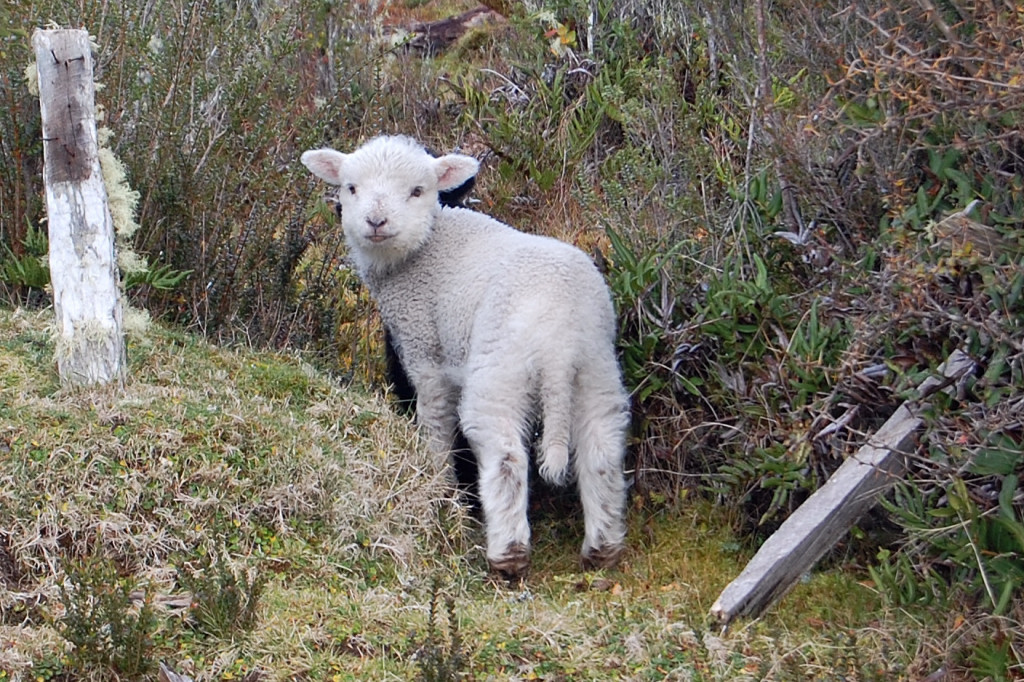
Despite the constant state of mainly-rain, there were one or two days of mostly-sun, so I was able to sneak in a day of hiking in the national park.  It was still early in the season so the trails at points were not that clearly marked (and to be honest I am not sure they ever get that clearly marked).  My fellow hiker and I got a bit lost and ended up walking up into a modern version of the fairy tales that Chiloe is famous for (though their fairy tales see to include a greater incidence of vicious sexual appetites and cannibalism than I remember from your standard Brothers Grimm).  We spotted two adorable little lambs, one black and one white. 


(My traveling companion was Welsh and taking pictures of sheep is apparently a bit of the national pastime – when one is not mining coal or playing rugby.)  We followed them down the path, trying to get a good picture, until we came upon a little wooden farmhouse on a hill.  Out from the farmhouse popped a pair of forest gnomes (okay, maybe not actually gnomes but they were certainly wee).  They led us into a low ceilinged wooden hut, where they imprisoned us until we bought handicrafts.  No joke.  I escaped with my life only by paying $2 for a splinter-throwing hand-carved wooden spoon. 

The best experience of the time in Chiloe though was the sunrise kayaking trip.  In the Chepu section of the park, a husband and wife team have set up a little eco-tourism lodge, with the main attraction of kayaking through the sunken forest at dawn.  (I know, but this fairy tale is slightly more grounded in science.  In 1960 a massive earthquake rocked Chiloe Island.  It caused this section of the coastal forest to suddenly drop six feet.  This proved to be an unfortunately development for the resident tree population as the forest floor was now below sea level.  The ocean rushed in and the trees died.  Now the sunken rotting stumps sticking out of the tidal plane is all that remain. In the misty dawn, this is a really eerie place to paddle around.)   It poured most of the time, but was still worth it.


But while the outdoor activities were a bit of a washout, the bivalves were stupendous.  The town of Castro is known for its pulmay – which is basically a huge pile of mussels, clams, giant mussels, giant clams, all served with (an easily removed) sausage and potato.  The giant mussels were the biggest that I have ever seen.  (Some of these guys had beards that would make the most harden Taliban commander envious.)  This plate was work.  I came in hungry, spent three hours, had three glasses of wine, read a book, picked up a fellow traveler, and I *still* had trouble finishing.


Having completed my twin missions of mollusks and outdooring, I headed north to Puerto Varas.  As far as I could gather from the Lonely Planet, Puerto Varas was a beautiful Alps-like town, nestled at the base of snow covered volcanoes.  Maybe.  I saw a lake and more rain.  Not to be thwarted, I hopped on the local bus and headed out 45 miles to the *really* scenic town.  My cloud friend accompanied me.  I stopped to see the majestic waterfall against the backdrop of the volcano.  I saw the waterfall and Cloud.  I waited 45 minutes trying (unsuccessfully) to hitchhike to the lake town.  Cloud kept me company – patting me lovingly on the head with his raindrops just to let me know he hadn’t forgotten about me.  I finally got to the lake, where I saw lake and Cloud.  I hiked up to the first view point on the volcano trail – where the soggy tourist map promised me an incredible panorama including the lake and three snow capped volcanoes.  I saw Cloud.  I told him to suck it.  This apparently pissed him off because he kicked it up a notch from steady rain shower to outright pouring.  I stubbornly continued to hike up until the trail became a free flowing creek. 
(The trail was not super well marked.  There are nice painted arrows on the bottom, which peter out to arrow-shaped piles of rocks after a mile or so, which further diminish to piles of rocks after another two miles, which fade out completely after that.  Going up was fairly easy – I just took the branch of the trail that seemed most against gravity – with the intention of following my boot tracks in the mud down.  The creek was a major impediment to the successful implementation of this strategy.)  So I gave up.  And stomped down the mountain, soaked to the bone, slipping in the mud the whole way.  Screw you Cloud.  I will have the last laugh.  I can go to places where you aren’t welcome.  I can go to places where it hasn’t rained in *years.*  Oh yes Cloud.  It’s on.

Then the next day I headed back to Santiago for a day of museums on my way back to DC.  I saw a couple of art exhibits and the pre-Columbian museum (it seems pre-Columbian society was really into psychedelic mushrooms and pottery).  And mercifully in Santiago – it was cold and clear.  I was enjoying my first dry day in a good long while.  Then, I shit you not, I almost got fire-hosed.  I was walking around Santiago and came across a couple of guys, in period costume, trying to get a 1864 steam powered fire truck to work.  They had stuck the intake hose into a fountain, had a pile of burning coals on the sidewalk, and were just wailing on this baby will all sorts of wrenches and business.  There was a crowd laughing and taking pictures.  (This is literally in the Chilean equivalent of Herald Square.)  Suddenly the contraption lets out a piercing whistle and the pistons start pumping madly.  The period fire fighters rejoice!  Except for the poor bastard that’s holding the fire hose.  The water steam swings madly across an intersection, broadsides a bus, then arches up and directly for the crowd.  This is the last picture I took before he started taking out bystanders and I was up over the barrier (admittedly into the middle of the street but fortunately there was traffic).   My hair had just dried and I was facing a 14 hour flight.  I’ll take my chances with an oncoming taxi. 


Then, after maxing my allotment of duty free Chilean wine, it was back to DC.  Just in time to meet the remnants of tropic storm Lee.